Diploid cells contain two sets of chromosomes (2n), while haploid cells contain one set of chromosomes (n).
The difference between diploid and haploid is one of the most important concepts in genetics and cell biology. Many students get confused because both terms describe the number of chromosomes in a cell, yet they play very different roles in living organisms.
In simple words, the difference between diploid and haploid comes down to chromosome sets. Diploid cells contain two sets of chromosomes, while haploid cells contain only one set.
Understanding the difference between diploid and haploid helps explain reproduction, inheritance, meiosis, fertilization, and genetic diversity.
If you’re studying biology, preparing for exams, or simply curious about how cells work, this guide will explain everything clearly with examples, tables, and real-world applications.
Difference Between Diploid and Haploid
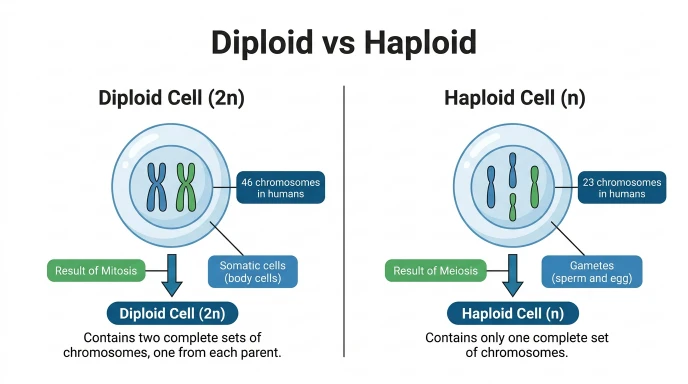
A diploid cell (2n) contains two complete sets of chromosomes—one from each parent. A haploid cell (n) contains only one set of chromosomes.
Example: Human body cells are diploid with 46 chromosomes, while sperm and egg cells are haploid with 23 chromosomes.
Definition of Diploid and Haploid
- Diploid (2n): A cell containing two complete sets of chromosomes, one inherited from the mother and one from the father.
- Haploid (n): A cell containing only one set of chromosomes.
Example: Human skin cells are diploid, while sperm cells are haploid.
Pronunciation
| Term | US Pronunciation | UK Pronunciation |
| Diploid | DIP-loid (/ˈdɪp.lɔɪd/) | DIP-loid (/ˈdɪp.lɔɪd/) |
| Haploid | HAP-loid (/ˈhæp.lɔɪd/) | HAP-loid (/ˈhæp.lɔɪd/) |
Now that you know what these terms mean and how to pronounce them, let’s explore why they are so important in genetics and reproduction.
Diploid vs Haploid Comparison
| Feature | Diploid (2n) | Haploid (n) |
| Chromosome Sets | Two sets | One set |
| Symbol | 2n | n |
| Human Chromosomes | 46 | 23 |
| Cell Type | Body cells | Sex cells (gametes) |
| Formation | Mitosis | Meiosis |
| Genetic Material | Double copy | Single copy |
| Function | Growth and repair | Reproduction |
| Examples | Skin, liver, muscle cells | Sperm and egg cells |
Key Differences Explained Between Diploid and Haploid
1. Number of Chromosome Sets
The biggest difference between diploid and haploid is chromosome count.
- Diploid = two sets (2n)
- Haploid = one set (n)
Example: Human body cells contain 46 chromosomes, while sperm cells contain 23.
2. Function in the Body
Diploid cells help with growth, development, and tissue repair.
Haploid cells are specialized for reproduction.
Real-Life Example: Your skin heals using diploid cells, but reproduction depends on haploid sperm and egg cells.
3. Method of Formation
Diploid cells are typically produced through mitosis.
Haploid cells are produced through meiosis.
This distinction is critical in biology exams and genetics studies.
4. Genetic Information
Diploid cells carry two copies of each chromosome.
Haploid cells carry only one copy.
This allows offspring to inherit genetic information from both parents after fertilization.
5. Role in Reproduction
Haploid cells combine during fertilization.
When a sperm (n) joins an egg (n), a diploid zygote (2n) forms.
6. Location in Organisms
Most cells in animals and humans are diploid.
Only reproductive cells are haploid.
7. Genetic Diversity
Haploid gametes contribute significantly to genetic variation through meiosis.
This helps species adapt and evolve over time.
What Is the Difference Between Diploid and Haploid in Human Cells?
Humans provide one of the easiest examples.
Diploid Human Cells
Examples include:
- Skin cells
- Muscle cells
- Blood precursor cells
- Liver cells
Each contains 46 chromosomes.
Haploid Human Cells
Examples include:
- Sperm cells
- Egg cells
Each contains 23 chromosomes.
Quick Formula
23 (sperm) + 23 (egg) = 46 (zygote)
This simple equation explains why diploid and haploid cells are both necessary for life.
Why Do Diploid and Haploid Cells Exist?
A common question is: Why not have all cells contain the same number of chromosomes?
The answer lies in reproduction.
If sperm and egg cells were diploid, chromosome numbers would double with every generation.
For example:
- Parent generation = 46 chromosomes
- Next generation = 92 chromosomes
- Following generation = 184 chromosomes
This would be biologically unsustainable.
Haploid cells solve this problem by reducing chromosome numbers before fertilization.
How Does the Diploid-Haploid Cycle Work?
Let’s understand this clearly.
Step 1: Diploid Adult Organism
Humans begin as diploid organisms.
Step 2: Meiosis
Special reproductive cells undergo meiosis to create haploid gametes.
Step 3: Fertilization
Sperm and egg unite.
Step 4: Diploid Zygote
The chromosome number is restored.
Step 5: Growth Through Mitosis
The zygote divides into trillions of diploid cells.
This cycle maintains chromosome stability across generations.
Difference Between Diploid and Haploid in Plants
Plants often have more complex life cycles than animals.
Many plants alternate between:
- Diploid sporophyte stages
- Haploid gametophyte stages
This phenomenon is known as alternation of generations.
Understanding diploid and haploid stages is essential in botany, agriculture, and plant breeding.
How Is the Difference Between Diploid and Haploid Important in Genetics?
Modern genetics depends heavily on this distinction.
Researchers studying inheritance patterns, DNA mutations, and chromosome disorders analyze diploid and haploid cells differently.
For example:
- Genetic testing examines diploid chromosome pairs.
- Fertility research focuses on haploid gametes.
- Agricultural breeding programs use haploid and diploid plant cells to develop improved crops.
Difference and Similarity Between Diploid and Haploid
| Feature | Diploid | Haploid | Similarity |
| Meaning | Two chromosome sets | One chromosome set | Both contain DNA |
| Symbol | 2n | n | Both use chromosome notation |
| Human Count | 46 chromosomes | 23 chromosomes | Both carry genetic information |
| Formation | Mitosis | Meiosis | Both arise from cell division |
| Function | Growth and repair | Reproduction | Both are essential for life |
| Cell Type | Somatic cells | Gametes | Both are living cells |
| Inheritance | Two chromosome copies | One chromosome copy | Both contribute to genetics |
| Biological Role | Maintains body tissues | Creates offspring | Both support survival |
This table clearly shows the difference and similarity between diploid and haploid for quick understanding.
Common Mistakes with Diploid and Haploid
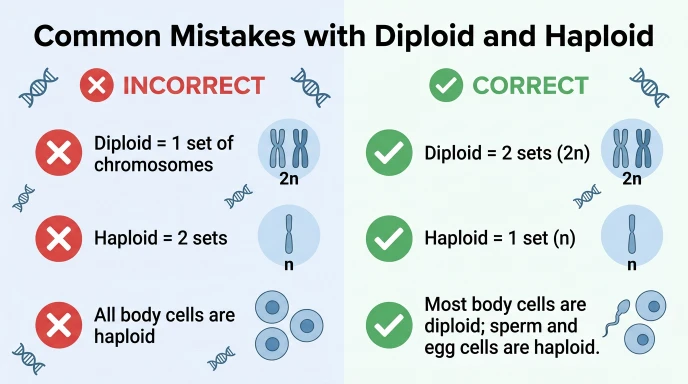
Mistake 1: Thinking Diploid Means Double the Cell Size
Diploid refers to chromosome sets, not physical cell size.
Fix
Focus on chromosome number rather than cell dimensions.
Mistake 2: Confusing Mitosis and Meiosis
Many students mix up these processes.
Fix
Remember:
- Mitosis → diploid cells
- Meiosis → haploid cells
Mistake 3: Assuming All Human Cells Are Diploid
Gametes are not diploid.
Fix
Remember that sperm and egg cells are haploid.
Mistake 4: Forgetting Chromosome Numbers
Students often memorize definitions but forget actual chromosome counts.
Fix
Use the simple formula:
46 → 23 + 23
Mistake 5: Thinking Haploid Cells Are Less Important
Without haploid cells, sexual reproduction would not occur.
Fix
Understand that both cell types are equally essential.
Real-Life Examples with Diploid and Haploid
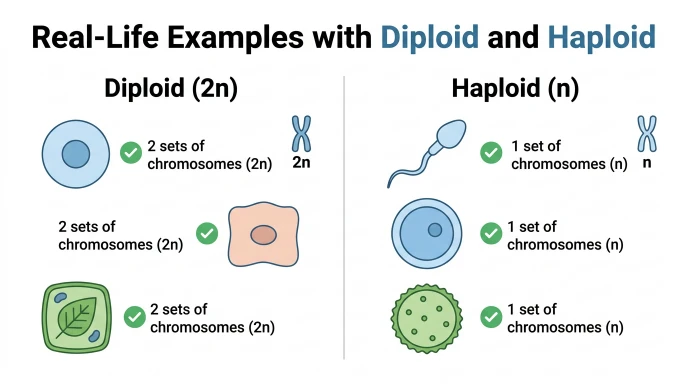
Personal Biology Example
Your skin cells are diploid.
Human Reproduction Example
Sperm and egg cells are haploid.
Medical Genetics Example
Doctors study diploid chromosomes when diagnosing certain genetic disorders.
Agricultural Example
Plant breeders use haploid technologies to create improved crop varieties.
Biotechnology Example
Researchers use chromosome analysis in laboratories to study inheritance and evolution.
When to Use Each Concept
Use Diploid When Discussing:
- Body cells
- Mitosis
- Growth
- Tissue repair
- Chromosome pairs
Use Haploid When Discussing:
- Gametes
- Meiosis
- Fertilization
- Reproduction
- Genetic diversity
Why People Get Confused About Diploid and Haploid
Several reasons cause confusion.
Similar Terminology
The words sound alike.
Abstract Concepts
Chromosomes cannot be seen without specialized equipment.
Exam Memorization
Students often memorize definitions without understanding biological functions.
Complex Cell Division Processes
Mitosis and meiosis add another layer of confusion.
Scientific Vocabulary
Terms like chromosome, gamete, zygote, and meiosis can overwhelm beginners.
How Search Engines Understand “Difference Between Diploid and Haploid” and User Intent
Search engines such as Google recognize that users searching for the difference between diploid and haploid usually want:
- Biology explanations
- Exam preparation help
- Genetics comparisons
- Chromosome number examples
- Meiosis and mitosis clarification
Educational videos on YouTube often explain these concepts visually, while science educators share learning content through platforms owned by Meta, including Facebook and Instagram.
Google prioritizes content that clearly answers the comparison, provides examples, and satisfies educational intent.
Expert Insight
From a genetics education perspective, the easiest way to remember the difference between diploid and haploid is to focus on chromosome sets rather than memorizing complex definitions.
In practical use, most beginners struggle because they try to memorize terms without understanding reproduction. Once you realize that haploid cells prevent chromosome numbers from doubling every generation, the entire concept becomes much easier to understand.
This biological strategy is one of nature’s most efficient systems for maintaining genetic stability while promoting diversity.
FAQs
What is the difference between diploid and haploid?
Diploid cells contain two chromosome sets (2n), while haploid cells contain one chromosome set (n).
Are humans diploid or haploid?
Most human cells are diploid, but sperm and egg cells are haploid.
What does 2n mean in biology?
2n means a cell has two complete chromosome sets.
What does n mean in biology?
n means a cell has one chromosome set.
Are sperm cells diploid or haploid?
Sperm cells are haploid.
Why are gametes haploid?
They must contain half the chromosome number so fertilization restores the diploid number.
Does meiosis produce diploid or haploid cells?
Meiosis produces haploid cells.
Does mitosis produce diploid or haploid cells?
Mitosis generally produces diploid daughter cells.
Why is the difference between diploid and haploid important?
It explains inheritance, reproduction, chromosome stability, and genetic diversity.
Conclusion
Understanding the difference between diploid and haploid is essential for learning genetics, reproduction, and cell biology. The key distinction is simple: diploid cells contain two complete chromosome sets, while haploid cells contain only one.
In humans, most body cells are diploid with 46 chromosomes, whereas sperm and egg cells are haploid with 23 chromosomes. This arrangement allows fertilization to restore the correct chromosome number and prevents chromosome counts from doubling in every generation.
The concept is important not only for biology students but also for genetics researchers, medical professionals, fertility specialists, and agricultural scientists. From human reproduction to plant breeding and biotechnology, diploid and haploid cells play critical roles in maintaining life and creating genetic diversity.
If you remember one thing, remember this: diploid equals two chromosome sets (2n), and haploid equals one chromosome set (n). That single idea makes the entire topic much easier to understand.
Read more about!
Difference Between Highlights and Lowlights: Complete Guide
Difference Between Major and Minor: Complete Guide

I am Emily Johnson, a USA-based content writer who creates easy-to-read blogs on language and daily life topics. I explain complex ideas in simple English for students and beginners so they can understand easily.