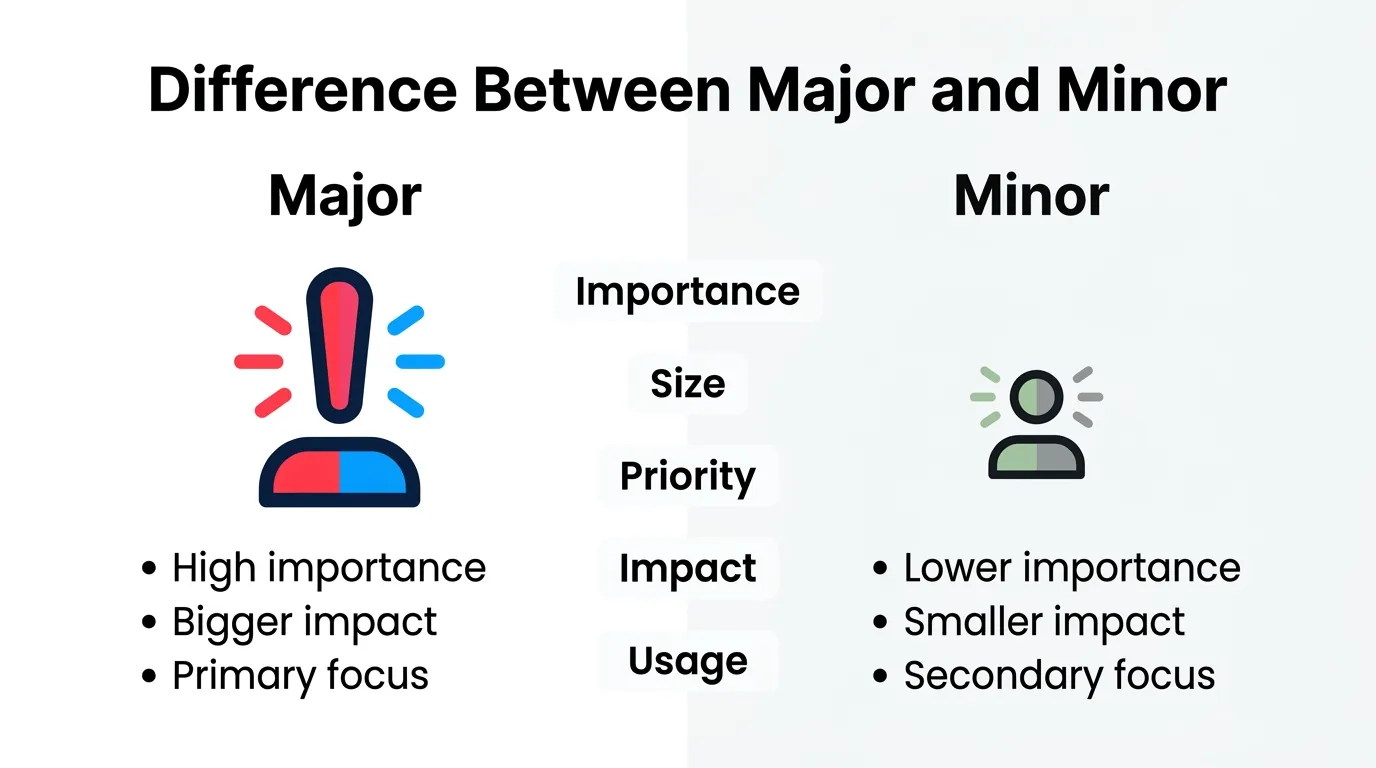
A major refers to something more important, larger, or primary, while a minor refers to something less important, smaller, or secondary.
The difference between major and minor is a common topic because these words are used in education, music, law, business, statistics, and everyday conversations.
Many people understand that a major is usually something bigger or more important, while a minor is smaller or less significant, but the exact meaning depends on the context.
Understanding the difference between major and minor helps you communicate more clearly and avoid common mistakes. If you are choosing a college major, discussing a minor issue at work, or learning music theory, knowing how these terms differ is important.
In this guide, you’ll learn definitions, pronunciation, comparisons, real-life examples, similarities, common mistakes, and practical usage scenarios.
Difference Between Major and Minor
A major refers to something more important, larger, stronger, or primary, while a minor refers to something less important, smaller, weaker, or secondary.
Example:
A company may face a major problem if its website crashes completely, while a small typo on a webpage would be considered a minor problem.
Definition of Major and Minor
- Major: Something that has greater importance, size, influence, seriousness, or priority.
- Minor: Something that has less importance, size, influence, seriousness, or priority.
Simple Example:
A broken bridge is a major issue, while a small crack in the paint is a minor issue.
Pronunciation
| Word | US Pronunciation | UK Pronunciation |
| Major | MAY-jer (/ˈmeɪ.dʒɚ/) | MAY-juh (/ˈmeɪ.dʒə/) |
| Minor | MY-ner (/ˈmaɪ.nɚ/) | MY-nuh (/ˈmaɪ.nə/) |
Now that you know how to pronounce these terms, let’s understand their meanings and practical differences in greater detail.
Comparison
| Feature | Major | Minor |
| Importance | High importance | Lower importance |
| Impact | Significant effect | Limited effect |
| Priority | Primary focus | Secondary focus |
| Size | Larger | Smaller |
| Severity | More serious | Less serious |
| Influence | Greater influence | Lesser influence |
| Decision Making | Requires immediate attention | Often handled later |
| Consequences | Bigger outcomes | Smaller outcomes |
Key Differences Explained Between Major and Minor
1. Level of Importance
A major matter carries more weight than a minor one.
Example: A major business decision affects the entire company, while a minor decision affects only one department.
2. Size or Scale
Major often describes something larger.
Example: A major city has a large population, while a minor town is much smaller.
3. Impact on Results
Major events create noticeable outcomes.
Example: A major software update changes many features, whereas a minor update fixes small bugs.
4. Degree of Seriousness
Major issues are generally more serious.
Example: A major injury requires extensive treatment; a minor injury may need only basic first aid.
5. Priority Level
Major tasks usually receive attention first.
Example: Organizations fix major security vulnerabilities before minor interface issues.
6. Visibility
Major changes are often obvious.
Example: A major redesign on Instagram is immediately noticeable, while a minor icon adjustment may go unnoticed.
7. Resource Requirement
Major projects require more time, money, and people.
Example: Building a new factory is a major project; repainting an office is a minor project.
What Is the Difference Between Major and Minor in Education?
One of the most common uses of these terms is in colleges and universities.
Major
A major is the primary academic subject a student studies.
Examples:
- Computer Science
- Psychology
- Business Administration
- Biology
Minor
A minor is a secondary area of study that complements the major.
Examples:
- Major in Business + Minor in Marketing
- Major in Computer Science + Minor in Mathematics
Why This Matters
Employers often focus on your major because it reflects your primary expertise, while a minor shows additional knowledge and skills.
Difference Between Major and Minor in Music
Music provides another well-known example.
Major Scale
Major scales typically sound:
- Bright
- Happy
- Energetic
- Positive
Minor Scale
Minor scales typically sound:
- Sad
- Emotional
- Serious
- Reflective
Example
Many uplifting songs use major keys, while dramatic movie soundtracks often use minor keys.
This is one reason beginners in music theory frequently ask about the difference between major and minor.
Difference Between Major and Minor in Law
In legal contexts, these words often describe age categories.
Major
A major is a person who has reached the legal age of adulthood.
Minor
A minor is someone below the legal age of adulthood.
Real Example
Many countries allow majors to sign legal contracts independently, while minors often require parental approval.
Why Does the Concept of Major and Minor Exist?
The distinction exists because humans naturally organize information according to significance.
If in:
- Education
- Business
- Technology
- Law
- Healthcare
- Music
people need a simple way to separate primary matters from secondary ones.
This helps prioritize decisions and allocate resources efficiently.
How Does the Major-Minor System Work in Real Life?
The concept follows a straightforward logic:
- Identify importance.
- Measure impact.
- Assign priority.
- Allocate resources accordingly.
Business Example
A company such as Google may classify a data breach as a major issue and a formatting error as a minor issue.
Social Media Example
Platforms like Instagram or Meta often release major updates with new features and minor updates that improve stability.
Difference and Similarity
| Feature | Major | Minor | Similarity |
| Meaning | More important | Less important | Both compare significance |
| Impact | Larger effect | Smaller effect | Both affect outcomes |
| Usage | Primary situations | Secondary situations | Used in many fields |
| Education | Main subject | Additional subject | Both are academic programs |
| Music | Bright sound | Emotional sound | Both are musical systems |
| Law | Adult person | Underage person | Both describe legal status |
| Priority | Higher | Lower | Both help organize tasks |
| Decision Making | Requires attention first | Often considered later | Both influence choices |
This table clearly shows the difference and similarity between major and minor for quick understanding.
Common Mistakes with Major and Minor
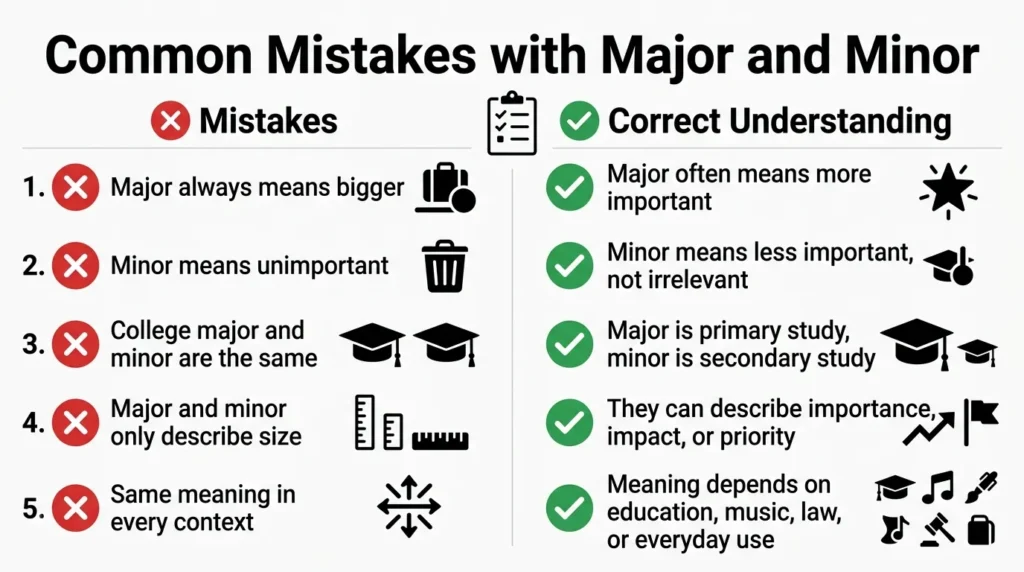
Mistake 1: Thinking Major Always Means Large
Not always.
A major concern may not be physically large but can still be highly important.
Mistake 2: Assuming Minor Means Unimportant
Minor does not mean irrelevant.
A minor issue can still require attention.
Mistake 3: Confusing College Major and Minor
Many students think a minor is optional coursework without value.
In reality, it can strengthen career opportunities.
Mistake 4: Using Them Only for Size
These words often refer to importance, not physical dimensions.
Mistake 5: Ignoring Context
The meaning changes depending on if you’re discussing music, law, education, or business.
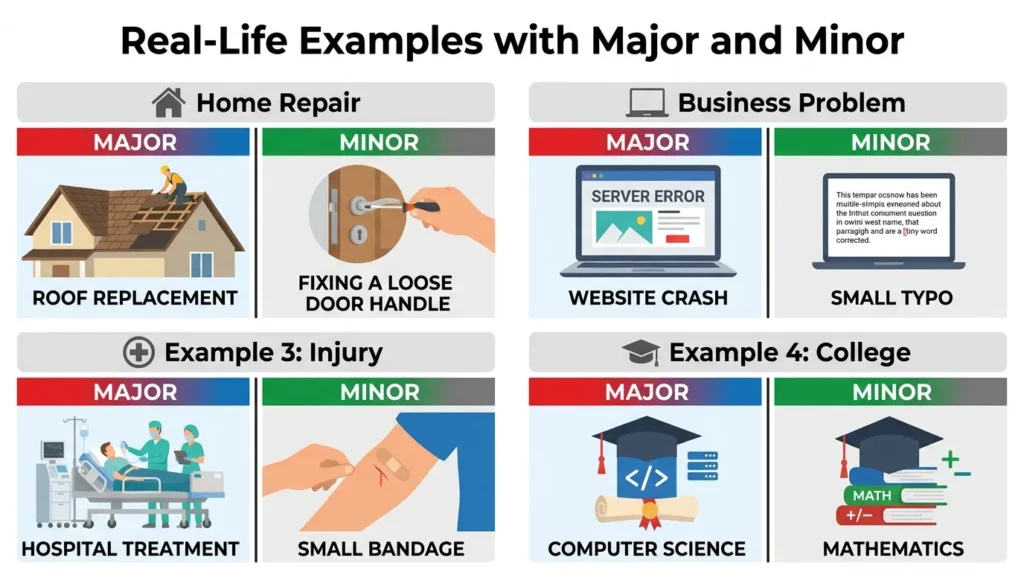
Real-Life Examples with Major and Minor
Personal Life
A major home repair may involve replacing a roof.
A minor repair may involve fixing a loose door handle.
Business
A major customer loss affects revenue significantly.
A minor complaint may affect only one transaction.
Education
Choosing Computer Science as a major and Mathematics as a minor.
Healthcare
A major surgery requires extensive recovery.
A minor procedure may be completed in a single visit.
Technology
A major software release introduces new functionality.
A minor release fixes bugs and improves performance.
When to Use Each
Use Major When:
- Describing something important
- Discussing large impacts
- Referring to primary priorities
- Talking about significant changes
Use Minor When:
- Describing something less important
- Referring to smaller impacts
- Discussing secondary matters
- Talking about limited changes
Quick Rule
If it has a greater effect, it’s usually major. If it has a smaller effect, it’s usually minor.
Why People Get Confused About Both
Several factors create confusion:
Multiple Meanings
The terms are used across education, music, law, and business.
Context Changes Meaning
A major in college differs from a major in music.
Everyday Language
People often use these words casually, making meanings less precise.
Industry Influence
Different industries define importance differently.
Educational Terminology
Students frequently misunderstand how majors and minors work in universities.
How Search Engines Understand Major and Minor and User Intent
Search engines such as Google analyze user intent rather than individual words alone.
When someone searches:
- “difference between major and minor”
- “major vs minor in college”
- “major and minor meaning”
- “major and minor examples”
Google examines context signals, semantic relationships, and user behavior to determine the most relevant results.
Similarly, platforms like YouTube and Instagram categorize content based on user engagement and topic relevance. Understanding the distinction between major and minor helps algorithms better match content with search intent.
Expert Insight
From an educational and communication perspective, the distinction between major and minor is fundamentally about priority and significance.
In real-world scenarios, successful organizations constantly separate major issues from minor ones to manage resources efficiently. Most beginners focus only on size, but professionals evaluate impact, urgency, risk, and long-term consequences.
Understanding this mindset makes the difference between major and minor much easier to recognize across different fields.
FAQs
What is the difference between major and minor?
A major is more important or primary, while a minor is less important or secondary.
Is a major always bigger than a minor?
Not necessarily. Major often refers to importance rather than physical size.
What is a major and minor in college?
A major is your main field of study, while a minor is a secondary specialization.
What is a minor in law?
A minor is a person below the legal age of adulthood.
What is the difference between major and minor in music?
Major keys usually sound brighter, while minor keys often sound more emotional or serious.
Can a minor issue become a major issue?
Yes. If ignored, a minor problem can grow into a major problem.
Why do companies classify issues as major or minor?
It helps prioritize resources, risk management, and decision-making.
Is a minor less valuable than a major?
Not necessarily. A minor can add useful knowledge and complementary skills.
Conclusion
Understanding the difference between major and minor is essential because these terms appear in many areas of life, including education, music, law, technology, healthcare, and business. In simple words, a major refers to something more important, significant, or primary, while a minor refers to something less important, smaller in impact, or secondary.
The exact meaning depends on context. A college major is your primary academic focus, a major key in music sounds bright and uplifting, and a legal major is an adult. Likewise, a minor may refer to a secondary field of study, a musical scale with a more emotional tone, or a person below the age of adulthood.
Many users get confused because the same words are used across different industries. However, the core idea remains the same: major equals greater significance, and minor equals lesser significance. Once you understand this principle, identifying the difference becomes much easier in real-world situations.
Read more about!
Difference Between Communism and Fascism: Explained Clearly
Difference Between Naproxen and Ibuprofen: Complete Guide

I am Emily Johnson, a USA-based content writer who creates easy-to-read blogs on language and daily life topics. I explain complex ideas in simple English for students and beginners so they can understand easily.