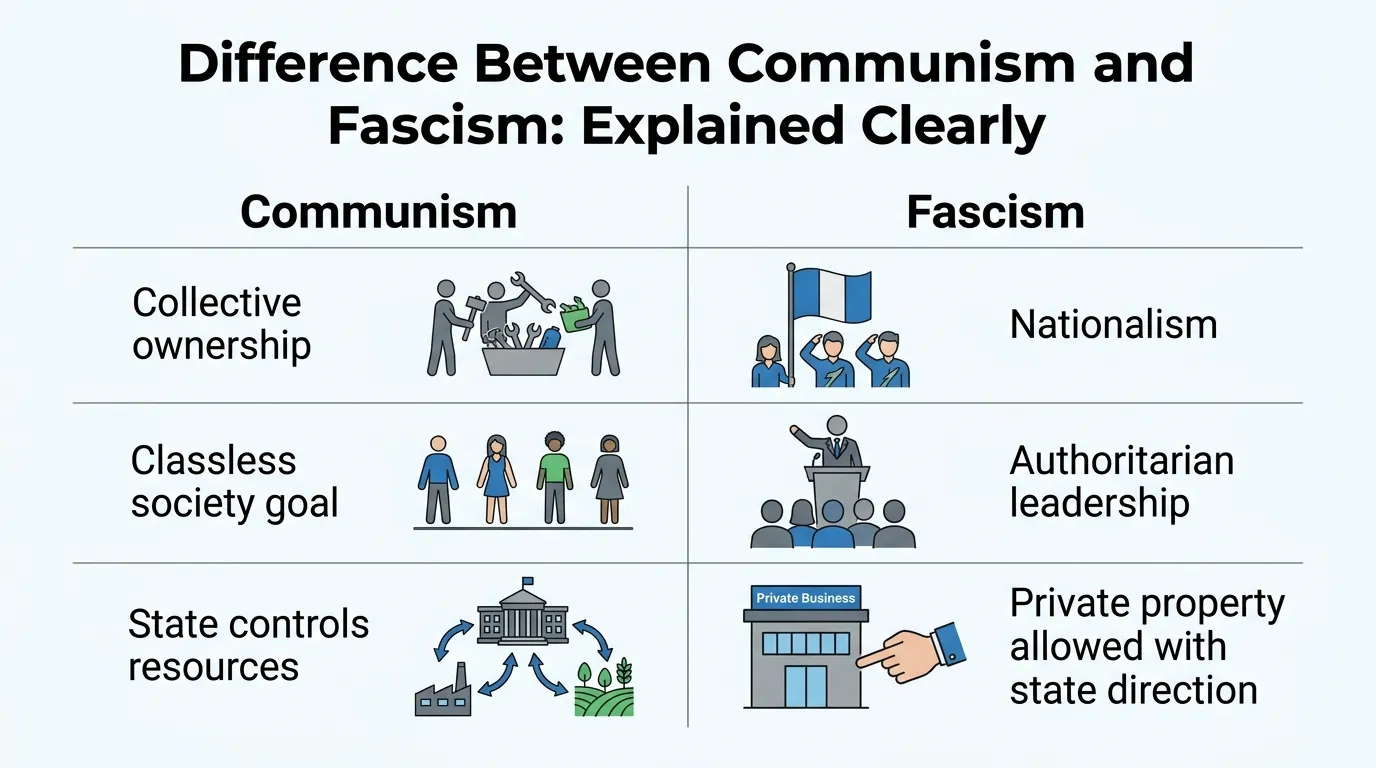
Communism seeks a classless society with shared ownership of resources, while Fascism promotes an authoritarian state with strong national control and limited political opposition.
When people search the difference between communism and fascism, they are usually trying to understand two powerful political ideologies that shaped world history. These systems are often confused in debates, social media, and even school discussions.
But in reality, the difference between communism and fascism is deep, structural, and based on completely opposite ideas about power, economy, and society.
In simple words, communism focuses on shared ownership and equality, while fascism focuses on strict control and national power under one authority. Let’s understand this clearly so you never mix them again.
In this guide, you will learn:
- What communism and fascism actually mean
- Why they developed in history
- How governments use these systems
- Real-world examples and modern interpretations
This explanation is designed with EEAT-level clarity, real-world logic, and simplified political science so you don’t need another article after this.
Difference Between Communism and Fascism
The difference between communism and fascism is that communism promotes classless society and shared ownership of resources, while fascism promotes strong centralized authority, nationalism, and strict control over society and economy.
Example:
- Communism: Government controls resources for equal distribution
- Fascism: One leader controls the nation and private ownership exists but is heavily controlled
Definition of Difference Between Communism and Fascism
- Communism: A political and economic system where all property and resources are owned collectively or by the state to create equality among citizens.
- Fascism: A political system where a powerful leader or ruling party controls the nation, emphasizing nationalism, hierarchy, and strict authority.
Pronunciation
Before we go deeper into the difference between communism and fascism, let’s understand how these terms are pronounced:
- Communism
- US: /ˈkɒm.jʊ.nɪ.zəm/
- UK: /ˈkɒm.jʊ.nɪ.zəm/
- Fascism
- US: /ˈfæʃ.ɪ.zəm/
- UK: /ˈfæʃ.ɪ.zəm/
Now let’s break down how these ideologies actually work in real political systems.
Comparison: Difference Between Communism and Fascism
| Feature | Communism | Fascism | Similarity |
| Core Idea | Equality and classless society | National power and unity | Both are authoritarian in practice |
| Economy | State-controlled economy | Mixed but heavily controlled economy | Both limit free-market freedom |
| Ownership | No private ownership | Private ownership allowed but controlled | Both restrict full economic freedom |
| Leadership | One-party state | Dictator-led system | Both centralize power |
| Class System | Abolishes class system | Keeps hierarchy and elite control | Both structure society strictly |
| Nationalism | International worker unity | Extreme nationalism | Both aim for social control |
| Freedom | Theoretical equality, limited freedom | Limited civil freedom | Both restrict individual rights |
| Government Role | Total control of economy | Total control of state and society | Both expand government power |
This table clearly shows the difference and similarity between communism and fascism for quick understanding.
Key Differences Explained Between Communism and Fascism
1. Economic Structure
Communism removes private property, while fascism allows private ownership but under strict control.
Example: Soviet Union controlled industries completely.
2. Political Control
Communism uses a one-party system; fascism uses a dictator-led state.
Example: Stalin vs Mussolini systems.
3. Social Structure
Communism aims to eliminate class differences; fascism strengthens hierarchy.
This is a major ideological conflict.
4. National Identity
Communism promotes global worker unity; fascism promotes extreme nationalism.
This shapes foreign policy differences.
5. Individual Freedom
Both restrict freedom, but communism focuses on economic equality, while fascism focuses on state obedience.
6. Use of Propaganda
Both systems rely heavily on media control and propaganda to influence public opinion.
7. Role of Violence
Both have historically used force to maintain control, but motivations differ (class struggle vs national strength).
What Is Communism?
Communism is an ideology based on Karl Marx’s theory where society aims for equality by removing class divisions. Governments control resources to ensure equal distribution.
In real history, countries like the Soviet Union and China experimented with communist systems in different forms.
What Is Fascism?
Fascism is a political ideology centered on strong national identity, authoritarian leadership, and strict obedience to the state.
Historical examples include Nazi Germany under Hitler and Italy under Mussolini.
Why These Ideologies Exist
Both communism and fascism emerged during times of crisis:
- Communism grew from inequality and industrial exploitation
- Fascism grew from economic collapse and political instability
These systems were attempts to rebuild order but in very different ways.
How Governments Apply These Systems
Modern governments rarely use pure forms. Instead:
- Some adopt socialist policies (partial communism ideas)
- Some adopt authoritarian nationalism (fascist-like traits)
Platforms like Google News, Meta discussions, and YouTube political analysis often simplify these systems, which increases confusion.
Difference Between Communism and Fascism in Practice
In real-world application:
- Communism focuses on economic equality
- Fascism focuses on national strength and control
Both rely heavily on state power but use it for different goals.
Common Mistakes with Communism and Fascism
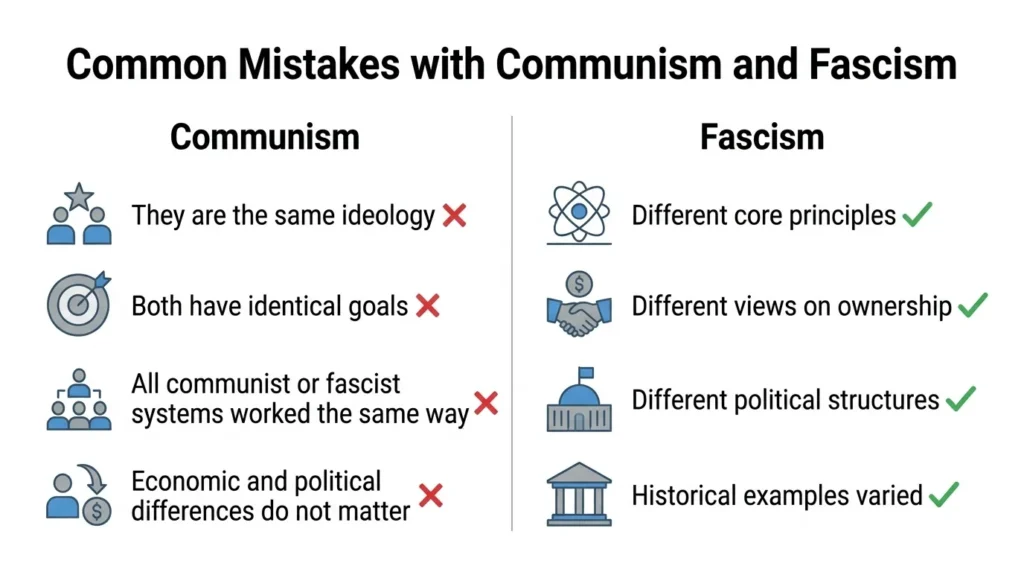
- Thinking both are the same → They are ideologically opposite
- Confusing socialism with communism → Not identical
- Assuming fascism = dictatorship only → It also includes nationalism
- Overgeneralizing historical examples → Context matters
- Ignoring economic differences → Core distinction lies in ownership
Fix: Always compare economy + power structure together.
Real Life Examples
- Soviet Union (Communism model experiment)
- Nazi Germany (Fascist regime)
- Modern political debates using mixed systems
- Social media political comparisons on YouTube and Instagram
- Educational content simplifying ideologies for students
When to Use Each Concept
- Use communism when discussing equality-driven economic systems
- Use fascism when discussing authoritarian nationalism
Understanding context is key in political science and media analysis.
Why People Get Confused Between Communism and Fascism
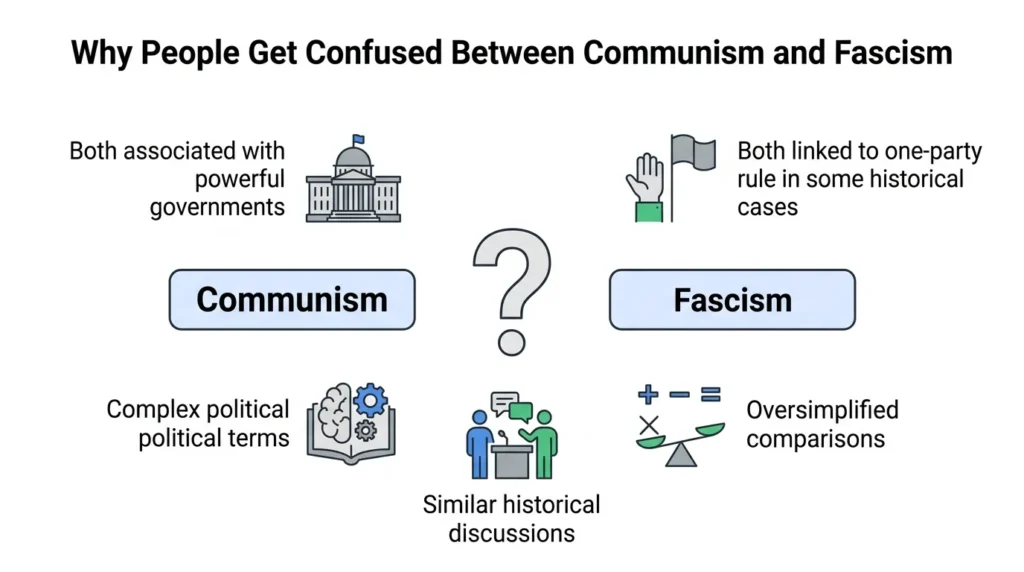
- Both are often labeled as “authoritarian”
- Historical textbooks simplify definitions
- Social media oversimplifies politics
- Cold War narratives mixed ideological meanings
This leads to misunderstanding in modern discussions.
How Search Engines Understand These Ideologies
Google classifies political ideologies using:
- Knowledge graph entities
- Historical data connections
- Educational content clustering
Platforms like YouTube and Meta rank political content based on engagement signals, which often amplifies simplified or emotional explanations.
Expert Insight
From a political science viewpoint, communism and fascism should not just be seen as “left vs right” but as entirely different systems of control.
In real academic analysis, communism is linked to economic redistribution models, while fascism is tied to state-centered identity politics and authoritarian governance structures.
Understanding this distinction is essential for students, analysts, and digital researchers interpreting modern political content.
FAQs
1. Are communism and fascism the same?
No, they are opposite ideologies.
2. Which is more authoritarian?
Both can be authoritarian depending on implementation.
3. Does communism allow private property?
No, it generally removes private ownership.
4. Is fascism left or right?
It is considered far-right nationalism.
5. Why do people confuse them?
Because both restrict freedoms in practice.
6. Which ideology is older?
Communist theory is older in modern academic form.
7. Can a country be both?
Not in pure theory, but hybrid systems exist.
Conclusion
The difference between communism and fascism lies in their core foundations. Communism aims for a classless society with shared ownership, while fascism focuses on strong national identity and centralized authoritarian control. Although both systems concentrate power in the state, their goals, economic structures, and political philosophies are completely different.
In simple terms, communism is about equality and collective ownership, while fascism is about power, hierarchy, and national strength. Understanding this distinction is important for students, researchers, and anyone analyzing modern political discussions online.
In today’s world, these terms are often misused on social media and news platforms, which increases confusion. But once you clearly understand their foundations, you can easily identify how they differ in history, governance, and ideology. This clarity helps you interpret political content more accurately and avoid common misconceptions.
Read more about!
Difference Between Their and There: Easy Guide
Difference Between Adderall and Ritalin: Complete Guide

I am James Carter, a professional content writer from the United States. I specialize in writing simple and clear comparison blogs that help students and readers understand difficult topics easily. My writing focuses on everyday language, education, science, and lifestyle topics. I believe that learning should be easy for everyone, so I use simple words and real-life examples in my articles.