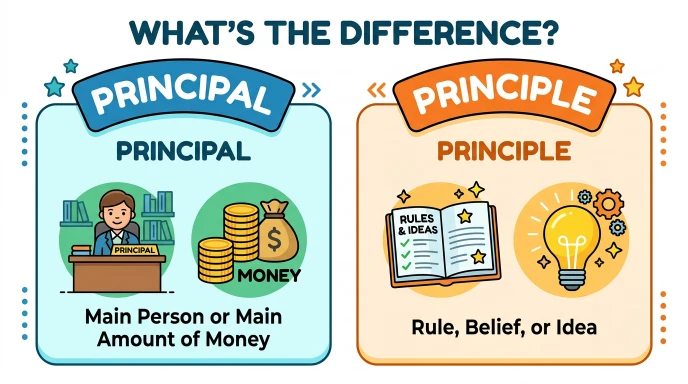
Principal is a person or main amount of money, while Principle is a rule, law, or belief.
Have you ever stopped while writing and wondered if to use principal or principle? You’re not alone. The difference between principal and principle is one of the most common English language confusions because the words sound almost identical but have completely different meanings.
In simple words, principal usually refers to a person, position, or something most important, while principle refers to a rule, belief, or fundamental truth.
Understanding the difference between principal and principle helps improve writing, communication, and grammar accuracy.
In this complete guide, you’ll learn definitions, pronunciations, comparisons, real-life examples, common mistakes, memory tricks, and practical usage tips so you never confuse these words again.
Difference Between Principal and Principle
Principal usually means a person in authority, the main thing, or an amount of money.
Principle means a rule, belief, value, law, or guiding idea.
Example
- The principal of the school announced a holiday.
- Honesty is an important principle in life.
Definition of Difference Between Principal and Principle
- Principal: A person with authority, something primary or most important, or the original amount of money borrowed or invested.
- Principle: A fundamental rule, moral belief, law, doctrine, or guiding truth.
Quick Example
- School principal = head of a school.
- Ethical principle = moral guideline.
Pronunciation
| Word | US Pronunciation | UK Pronunciation |
| Principal | PRIN-suh-puhl | PRIN-suh-puhl |
| Principle | PRIN-suh-puhl | PRIN-suh-puhl |
Interestingly, both words are pronounced almost exactly the same. That is one reason many users get confused.
Now let’s understand the real differences clearly.
Comparison: Difference Between Principal and Principle
| Feature | Principal | Principle |
| Meaning | Main person, thing, or amount | Rule, belief, or truth |
| Part of Speech | Noun or adjective | Noun |
| Common Context | Schools, finance, business | Ethics, science, philosophy |
| Refers to People | Yes | No |
| Refers to Ideas | Rarely | Yes |
| Finance Usage | Original loan amount | Not used |
| Education Usage | School leader | Educational philosophy |
| Example | School principal | Moral principle |
Key Differences Explained Between Principal and Principle
1. Principal Refers to a Person or Main Thing
The word principal often identifies someone in charge or something most important.
Real-Life Example
The school principal spoke to students during assembly.
When users ask “what is a principal?” they often mean a school administrator.
2. Principle Refers to a Rule or Belief
A principle is an idea that guides behavior or decision-making.
Real-Life Example
Treating others fairly is an important principle.
This usage appears frequently in ethics, leadership, and philosophy.
3. Principal Can Be Used in Finance
In banking and investing, principal means the original amount of money.
Example
If you borrow $10,000, that amount is the loan’s principal.
Interest is calculated separately.
4. Principle Cannot Mean Money
Unlike principal, principle never refers to finances.
Example
Incorrect: The principle on my loan is $5,000.
Correct: The principal on my loan is $5,000.
5. Principal Can Be an Adjective
Principal can describe something as primary or most important.
Example
The principal reason for success was teamwork.
6. Principle Is Always an Idea
A principle remains a concept, belief, standard, or truth.
Example
Freedom of speech is a democratic principle.
7. Context Usually Reveals the Correct Word
The easiest way to choose the correct word is to identify if you’re discussing:
- A person
- Importance
- Money
Use principal.
If discussing:
- Rules
- Values
- Beliefs
Use principle.
What Is Principal and How Does It Work?
Principal as a School Leader
The most familiar meaning is the head administrator of a school.
Example
The principal manages teachers, students, policies, and school operations.
Principal in Finance
Financial institutions use principal to describe the original amount borrowed or invested.
Example
A mortgage may include:
- Principal
- Interest
- Fees
The principal remains the original loan balance.
Principal as “Most Important”
Businesses frequently use principal as an adjective.
Example
The principal objective is customer satisfaction.
What Is Principle and Why Does It Matter?
Principles help guide decisions and behavior.
Examples include:
- Honesty
- Fairness
- Responsibility
- Integrity
- Accountability
In practical use, principles act like a personal compass.
Example
A company may operate according to principles of transparency and ethics.
Why Does the Difference Between Principal and Principle Exist?
English has many words that sound alike but have different meanings.
These are called homophones.
Principal and principle developed from related Latin roots but evolved into different meanings over time.
That’s why they sound similar yet serve different purposes in modern English.
Difference Between Principal and Principle in Education
Education provides one of the clearest examples.
Principal
The leader of a school.
Principle
A teaching philosophy or educational belief.
Example
- The principal introduced new policies.
- The school follows the principle of equal opportunity.
Difference Between Principal and Principle in Business and Finance
Principal in Business
Can mean:
- Main stakeholder
- Primary investor
- Original investment amount
Example
The principal investment was $100,000.
Principle in Business
Refers to ethical guidelines.
Example
Customer-first service is a core business principle.
Difference and Similarity
| Feature | Principal | Principle | Similarity |
| Meaning | Main person or thing | Rule or belief | Both are important concepts |
| Grammar | Noun or adjective | Noun only | Both are common English words |
| Education | School administrator | Educational belief | Both appear in schools |
| Finance | Loan amount | Not used financially | Both may appear in business writing |
| Ethics | Rarely used | Frequently used | Both affect decision-making contexts |
| Importance | Can mean primary | Can mean guiding value | Both involve significance |
| Pronunciation | Same sound | Same sound | Nearly identical pronunciation |
| Usage | People, money, importance | Rules, beliefs, values | Both require context |
This table clearly shows the difference and similarity between principal and principle for quick understanding.
Common Mistakes with Principal and Principle
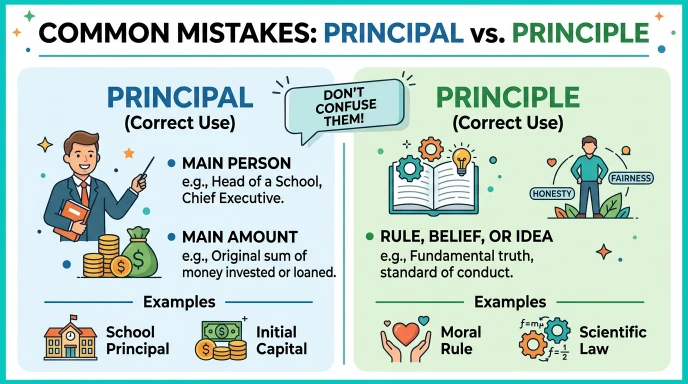
Mistake 1: Using Principle for a School Leader
❌ The school principle called my parents.
✅ The school principal called my parents.
Mistake 2: Using Principal for Moral Values
❌ Honesty is an important principal.
✅ Honesty is an important principle.
Mistake 3: Mixing Them in Financial Writing
❌ Pay down the principle first.
✅ Pay down the principal first.
Mistake 4: Assuming They Are Interchangeable
They are not synonyms.
Always identify if you’re discussing a person, money, importance, or a belief.
Mistake 5: Ignoring Context
Context usually makes the correct choice obvious.
Real-Life Examples with Principal and Principle
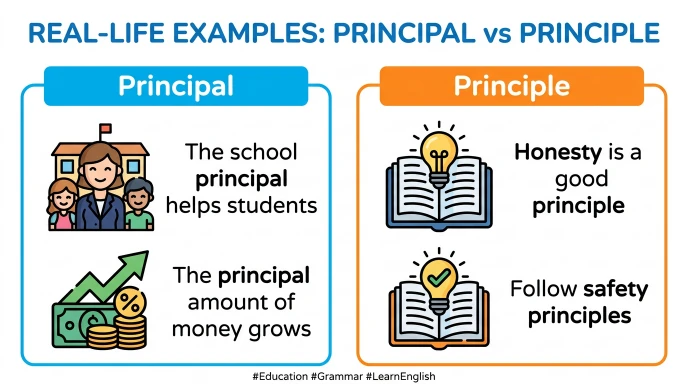
Personal Use
“My guiding principle is to tell the truth.”
School Example
“The principal greeted new students.”
Financial Example
“The principal balance on the loan decreased.”
Business Example
“The company’s principal objective is growth.”
Professional Ethics Example
“Confidentiality is a core professional principle.”
When to Use Each
Use Principal When:
- Referring to a school leader
- Discussing a loan amount
- Describing something primary
- Talking about the main person or thing
Examples
- School principal
- Principal investment
- Principal reason
Use Principle When:
- Discussing values
- Referring to beliefs
- Explaining rules
- Talking about ethics
Examples
- Moral principle
- Scientific principle
- Leadership principle
Why People Get Confused in Principal and Principle
Several factors contribute to confusion.
Identical Pronunciation
Both sound virtually the same.
Similar Spelling
Only the ending differs.
Frequent Everyday Use
Students, professionals, and writers encounter both words regularly.
Fast Digital Communication
Social media platforms like Instagram and discussions on YouTube often contain spelling mistakes, reinforcing confusion.
How Search Engines Understand Difference Between Principal and Principle and User Intent
Search engines such as Google analyze if users want:
- Grammar help
- Vocabulary explanations
- Educational content
- Writing guidance
When someone searches “difference between principal and principle,” Google recognizes comparison intent and typically prioritizes content that includes:
- Definitions
- Usage examples
- Grammar explanations
- Memory tricks
- Side-by-side comparisons
Platforms owned by Meta often reveal common language questions through user discussions, helping search engines understand learning-related queries.
Expert Insight
As an English language writing guideline, one of the simplest memory tricks remains highly effective:
Remember This
The principal is your pal.
The word principal contains “pal.”
A school principal can be your pal.
If you’re talking about a person, money, or something primary, principal is usually correct.
If you’re talking about a rule, value, belief, or truth, use principle.
In real-world editing, this simple trick eliminates most mistakes instantly.
FAQs
What is the difference between principal and principle?
Principal refers to a person, main thing, or money amount. Principle refers to a rule, belief, or truth.
Is a school leader principal or principle?
Principal.
Is honesty a principal or principle?
Honesty is a principle.
Which word is used in finance?
Principal.
Why do principal and principle sound the same?
They are homophones with different meanings and spellings.
What is the principal of a loan?
The original amount borrowed before interest.
Can principal be an adjective?
Yes. It can mean primary or most important.
Is principle ever used for a person?
No.
What is the easiest memory trick?
Remember: “The principal is your pal.”
Which word appears more in academic writing?
Principle often appears more frequently because academic writing discusses theories, rules, and concepts.
Conclusion
Understanding the difference between principal and principle becomes easy once you focus on meaning rather than spelling. Principal usually refers to a person in charge, something primary, or an original amount of money. Principle, on the other hand, refers to a rule, value, belief, or fundamental truth that guides behavior and decisions.
Many beginners get confused because both words sound exactly alike. However, context provides the answer. If you’re discussing a school leader, a loan balance, or something most important, choose principal. If you’re talking about ethics, values, scientific laws, or personal beliefs, choose principle.
A useful memory trick is that the principal is your pal. This simple reminder helps distinguish the two instantly. Once you understand this core distinction, you’ll write with greater confidence, avoid common grammar mistakes, and communicate more clearly in academic, professional, and everyday situations.
Read more about!
Difference Between Bedrock and Java: Which Is Better?
Difference Between Centipede and Millipede: Easy Guide

I am Emily Johnson, a USA-based content writer who creates easy-to-read blogs on language and daily life topics. I explain complex ideas in simple English for students and beginners so they can understand easily.