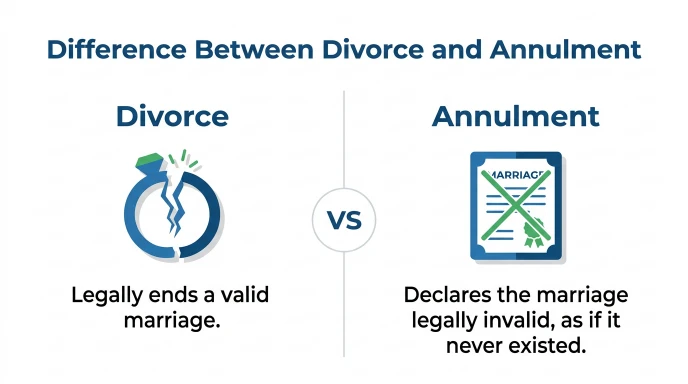
Divorce legally ends a valid marriage, while annulment declares the marriage legally invalid as if it never existed.
Many people searching for the difference between divorce and annulment assume both mean the same thing. In reality, they are very different legal processes.
Understanding the difference between divorce and annulment can affect property rights, financial obligations, and even future marriage plans.
If you’re wondering what is divorce, what is annulment, how they work, and why courts treat them differently, you’re in the right place.
This guide explains the difference between divorce and annulment in simple language with real-world examples, practical insights, and expert-level explanations.
If you’re researching family law, preparing for legal proceedings, or simply curious, this article covers everything you need to know.
Difference Between Divorce and Annulment
A divorce legally ends a valid marriage, while an annulment declares that the marriage was never legally valid in the first place.
Example: If a couple marries and later separates due to irreconcilable differences, they may seek a divorce. If one spouse was already legally married to someone else at the time of the wedding, the marriage may qualify for an annulment.
Definition of Difference Between Divorce and Annulment
- Divorce: A legal process that ends a valid marriage and recognizes that the marriage existed.
- Annulment: A legal ruling stating that a marriage was invalid or legally defective from the beginning.
Example
A couple married for ten years may file for divorce. A marriage based on fraud or legal ineligibility may qualify for annulment.
Pronunciation
| Term | US Pronunciation | UK Pronunciation |
| Divorce | dih-VORSS | dih-VORSS |
| Annulment | uh-NULL-ment | uh-NULL-ment |
Now that we understand the definitions, let’s explore the key legal and practical differences.
Comparison: Difference Between Divorce and Annulment
| Feature | Divorce | Annulment |
| Marriage Status | Ends a valid marriage | Declares marriage invalid |
| Legal Recognition | Marriage existed legally | Marriage treated as if it never existed |
| Common Grounds | Separation, incompatibility, irreconcilable differences | Fraud, coercion, bigamy, incapacity |
| Time Limits | Usually none | Often strict deadlines |
| Property Division | Commonly required | May vary by jurisdiction |
| Spousal Support | May be awarded | Often limited |
| Child Custody | Can be determined | Can also be determined |
| Future Marital Status | Divorced person | Generally considered never legally married |
Key Differences Explained Between Divorce and Annulment
1. Legal Effect
The biggest difference is legal recognition.
A divorce ends a marriage that legally existed. An annulment says the marriage should never have existed under the law.
Real-world example: A couple married for five years and later separated would typically seek divorce.
2. Grounds for Filing
Divorce often requires proving the marriage has broken down.
Annulment usually requires specific legal reasons such as fraud, coercion, underage marriage, or existing marriage.
Example: Marrying someone who concealed a previous marriage may support annulment.
3. Duration of Marriage
A marriage can be divorced regardless of length.
Annulments are often sought shortly after discovering the legal issue.
4. Financial Consequences
Divorce commonly involves property division, debt allocation, and possible alimony.
Annulment may handle financial issues differently depending on local laws.
5. Social and Religious Impact
Some religious organizations recognize annulments differently from divorces.
For some individuals, this distinction is very important.
6. Burden of Proof
Divorce often requires proving a valid ground or meeting no-fault requirements.
Annulment usually requires stronger evidence showing the marriage was invalid.
7. Court Requirements
Many jurisdictions make divorce procedures more standardized.
Annulments can involve more detailed legal review because courts must determine if the marriage was invalid from the start.
What Is Divorce and How Does It Work?
Divorce is the legal termination of a valid marriage.
Modern legal systems often allow:
- No-fault divorce
- Contested divorce
- Uncontested divorce
- Collaborative divorce
The court may decide:
- Property division
- Child custody
- Child support
- Spousal support
In practical use, divorce is the most common method used to end a marriage.
What Is Annulment and How Does It Work?
Annulment is different because it challenges the validity of the marriage itself.
Common grounds include:
- Fraud
- Bigamy
- Forced marriage
- Mental incapacity
- Underage marriage without proper consent
The court examines if the marriage should be considered legally void or voidable.
Why Does the Difference Between Divorce and Annulment Matter?
Many users get confused because both processes result in the couple no longer being married.
However, the legal consequences can differ significantly.
The difference may affect:
- Inheritance rights
- Immigration matters
- Religious recognition
- Financial obligations
- Future legal records
Understanding these distinctions can help individuals make informed decisions.
Difference Between Divorce and Annulment in Real-Life Situations
Scenario 1: Long-Term Marriage
A couple married for 15 years decides to separate.
Best option: Divorce.
Scenario 2: Marriage Based on Fraud
One spouse discovers important information was intentionally hidden before marriage.
Possible option: Annulment.
Scenario 3: Existing Prior Marriage
A person unknowingly marries someone who is already legally married.
Possible option: Annulment.
Scenario 4: Mutual Separation
Both spouses agree the relationship no longer works.
Best option: Divorce.
Scenario 5: Religious Considerations
Some individuals seek annulment because of religious beliefs regarding remarriage.
Difference and Similarity
| Feature | Divorce | Annulment | Similarity |
| Purpose | Ends marriage | Invalidates marriage | Both change marital status |
| Court Process | Legal proceeding | Legal proceeding | Both require legal action |
| Marriage Validity | Recognized as valid | Considered invalid | Both involve marriage review |
| Property Issues | Often addressed | May be addressed | Financial matters can arise |
| Child Custody | Applicable | Applicable | Children’s rights remain protected |
| Legal Documentation | Divorce decree | Annulment decree | Official court orders issued |
| Future Marriage | Allowed after divorce | Allowed after annulment | Both permit remarriage |
| Evidence Needed | Varies by jurisdiction | Usually more specific | Both require legal documentation |
This table clearly shows the difference and similarity between divorce and annulment for quick understanding.
Common Mistakes with Divorce and Annulment
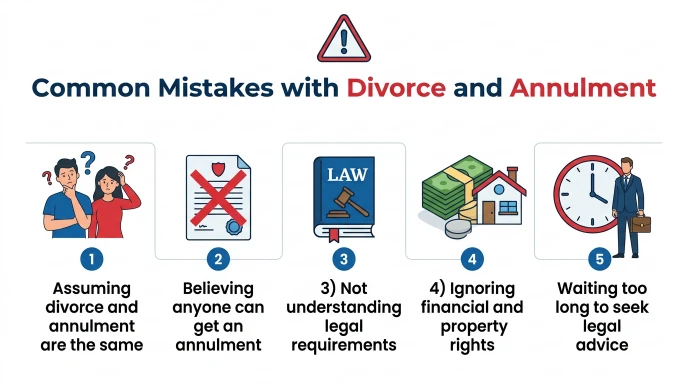
Mistake 1: Assuming They Are Identical
Correction: Divorce ends a marriage; annulment invalidates it.
Mistake 2: Believing Anyone Can Get an Annulment
Correction: Specific legal grounds are usually required.
Mistake 3: Thinking Children Become Illegitimate
Correction: Laws generally protect children’s legal status.
Mistake 4: Ignoring Filing Deadlines
Correction: Some annulment claims must be filed within certain time limits.
Mistake 5: Assuming Religious and Legal Annulments Are the Same
Correction: Religious annulments and civil annulments often follow different rules.
Real-Life Examples with Divorce and Annulment
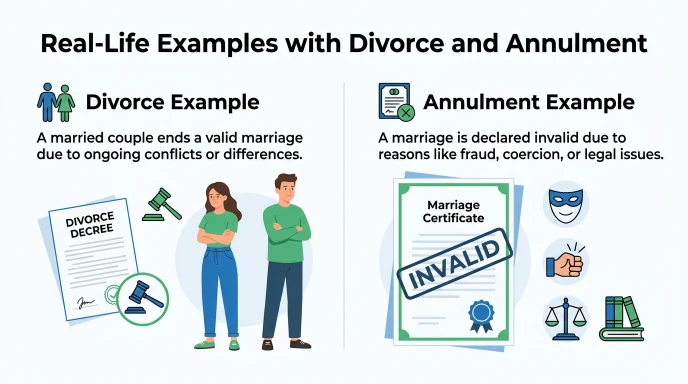
Personal Use
A couple grows apart after years together and files for divorce.
Family Situation
A spouse discovers deception regarding identity before marriage and seeks annulment.
Legal Industry Example
Family law attorneys evaluate if a case meets annulment requirements or should proceed as a divorce.
Religious Context
Some faith communities treat annulments differently from divorces.
International Marriage Example
Cross-border marriages sometimes require special review to determine the proper legal process.
When to Use Each
Use Divorce When:
- The marriage was legally valid.
- The relationship has broken down.
- Property and support issues need resolution.
- Both parties acknowledge the marriage existed.
Use Annulment When:
- Legal defects existed from the start.
- Fraud or coercion occurred.
- One spouse lacked legal capacity.
- Marriage eligibility requirements were not met.
Why People Get Confused in Divorce and Annulment
Several factors create confusion:
Similar Outcomes
Both result in spouses no longer being married.
Media Representation
Movies and television often use the terms incorrectly.
Regional Legal Differences
Rules vary across countries and states.
Religious Influence
Some religious institutions emphasize annulment differently than civil courts.
How Search Engines Understand Difference Between Divorce and Annulment and User Intent
Search engines such as Google analyze search intent behind phrases like:
- what is divorce
- what is annulment
- divorce vs annulment
- difference between divorce and annulment
They identify comparison intent and prioritize content containing:
- Clear definitions
- Side-by-side comparisons
- Practical examples
- Legal explanations
Platforms such as Meta, Instagram, and YouTube often feature discussions where users ask similar questions, which helps search engines understand common user confusion and content demand.
Expert Insight
From a legal education perspective, the most important distinction is not emotional but procedural.
In real scenarios, most people qualify for divorce more easily than annulment. Courts generally require clear evidence before declaring a marriage invalid. Family law professionals often recommend understanding local laws early because requirements differ significantly by jurisdiction.
A practical rule is simple:
If the marriage was legally valid but failed later, divorce is usually appropriate. If the marriage was legally flawed from the beginning, annulment may be possible.
FAQs
Is annulment better than divorce?
Not necessarily. It depends on if valid grounds for annulment exist.
Can you get an annulment after many years of marriage?
Sometimes, but many jurisdictions impose limits.
Does annulment erase a marriage completely?
Legally, it treats the marriage as invalid from the beginning.
Is divorce easier to obtain than annulment?
In many cases, yes.
Can children be affected by annulment?
Generally, laws protect children’s legal rights.
Do all countries recognize annulment?
No. Rules vary widely across legal systems.
Can property be divided after an annulment?
Often yes, but the rules may differ from divorce cases.
Can someone remarry after divorce or annulment?
Yes, once legal requirements are satisfied.
What is the main difference between divorce and annulment?
Divorce ends a valid marriage, while annulment declares it invalid.
Why do people choose annulment?
Usually because legal grounds exist that challenge the marriage’s validity.
Conclusion
Understanding the difference between divorce and annulment is important because these legal processes serve different purposes. A divorce acknowledges that a valid marriage existed and legally ends it. An annulment, on the other hand, declares that the marriage was never legally valid from the beginning.
Many users get confused because both outcomes leave the parties unmarried. However, the legal basis, requirements, financial implications, and long-term effects can differ significantly. In practical use, divorce is far more common because most marriages are legally valid when they begin. Annulments are generally reserved for situations involving fraud, coercion, bigamy, incapacity, or other legal defects.
If you’re evaluating your options, understanding local laws and obtaining professional legal advice is essential. The clearest way to remember the difference between divorce and annulment is this: divorce ends a marriage, while annulment erases its legal validity from the start. Once you understand that distinction, the entire topic becomes much easier to navigate.
Read more about!
Difference Between Fate and Destiny: Clear Guide
Difference Between Nanny and Babysitter: Which Is Better?

I am Emily Johnson, a USA-based content writer who creates easy-to-read blogs on language and daily life topics. I explain complex ideas in simple English for students and beginners so they can understand easily.