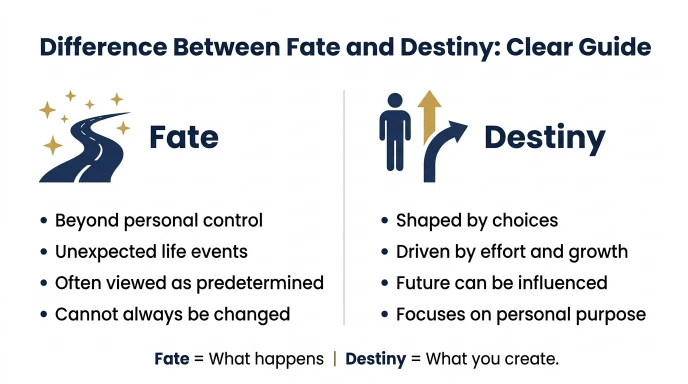
Fate is believed to be a fixed future you cannot change, while destiny is a future you can shape through your choices and actions.
Have you ever heard someone say, “It was my fate,” while another person talks about “following their destiny”? Many users get confused because these words are often used interchangeably. However, the difference between fate and destiny is deeper than most people realize.
In simple words, fate is often viewed as a predetermined path that happens regardless of your choices, while destiny is commonly seen as a future that can be shaped through decisions and actions.
Understanding the difference between fate and destiny helps explain concepts such as free will, purpose, life direction, and personal growth.
In this guide, you’ll learn what fate and destiny mean, how they differ, why people confuse them, real-life examples, philosophical perspectives, and practical ways these concepts are used in everyday conversations.
Difference Between Fate and Destiny
The difference between fate and destiny is that fate is usually considered an unavoidable outcome determined by external forces, while destiny is viewed as a future you can influence through your choices.
Example: Being born into a particular family may be considered fate, but building a successful career through effort is often described as destiny.
Definition of Difference Between Fate and Destiny
- Fate: A predetermined course of events believed to happen regardless of personal choices.
- Destiny: A future outcome or purpose that can be influenced by decisions, actions, and personal growth.
Example: Missing a flight due to unexpected circumstances may be called fate, while becoming a doctor through years of study may be considered destiny.
Pronunciation
| Word | US Pronunciation | UK Pronunciation |
| Fate | /feyt/ | /feyt/ |
| Destiny | /DES-tuh-nee/ | /DES-tuh-nee/ |
Now that the basic meanings are clear, let’s understand the deeper difference between fate and destiny.
Difference Between Fate and Destiny Comparison
| Feature | Fate | Destiny |
| Meaning | Predetermined outcome | Achievable future path |
| Personal Control | Little or none | Significant influence |
| Free Will | Limited | Important role |
| Flexibility | Fixed | Flexible |
| Focus | What happens to you | What you become |
| Responsibility | External forces | Personal choices |
| Growth Aspect | Less emphasized | Strongly emphasized |
| Common Usage | Luck, chance, inevitability | Purpose, goals, calling |
| Philosophical View | Determinism | Self-development |
| Emotional Tone | Passive | Empowering |
Key Differences Explained Between Fate and Destiny
1. Control vs Choice
The biggest difference between fate and destiny is control.
Fate suggests events happen regardless of your decisions.
Destiny suggests your actions help create the future.
Real-life example: Getting caught in an unexpected storm may feel like fate. Learning survival skills beforehand reflects destiny through preparation.
2. Fixed Path vs Flexible Journey
Fate is often viewed as fixed.
Destiny is usually seen as adaptable.
Many people believe destiny changes as life choices change.
3. Passive vs Active Role
Fate places emphasis on circumstances.
Destiny places emphasis on personal effort.
This distinction makes destiny feel more empowering.
4. Philosophy and Religion
Many philosophical traditions discuss fate as predetermined.
Destiny often appears in teachings focused on growth, purpose, and self-discovery.
5. Relationship with Free Will
Fate can exist without free will.
Destiny often depends on free will.
This is why many motivational speakers discuss destiny rather than fate.
6. Emotional Impact
Fate may create acceptance.
Destiny often inspires action.
One encourages understanding events; the other encourages shaping outcomes.
7. Life Purpose
Destiny frequently connects with purpose, mission, and personal goals.
Fate is more often associated with events beyond human control.
What Is the Difference Between Fate and Destiny in Simple Words?
Let’s understand this clearly.
Imagine life as a road.
- Fate is the road you unexpectedly find yourself on.
- Destiny is the destination you actively choose to pursue.
In practical use, many people combine both ideas. They may believe certain opportunities appear through fate, but success comes through destiny-driven effort.
Why Does the Difference Between Fate and Destiny Matter?
This distinction influences how people view:
- Success
- Failure
- Relationships
- Career decisions
- Personal responsibility
Someone who believes only in fate may wait for opportunities.
Someone focused on destiny often creates opportunities through action.
This difference affects behavior, motivation, and long-term decision-making.
How Do Fate and Destiny Work in Philosophy?
Throughout history, philosophers have debated if humans control their future.
Fate and Determinism
Determinism suggests every event has a cause and may be inevitable.
This idea closely aligns with fate.
Destiny and Human Agency
Human agency emphasizes personal choice and responsibility.
This concept closely resembles destiny.
Many modern thinkers believe life includes elements of both.
Difference Between Fate and Destiny in Literature and Storytelling
Authors frequently use these concepts to create compelling narratives.
In famous stories:
- Fate often drives unavoidable events.
- Destiny motivates characters toward goals.
For example, heroes may encounter fate through unexpected circumstances but fulfill destiny through courage and decisions.
This storytelling pattern appears across novels, films, mythology, and modern entertainment.
Why Do People Associate Fate with Luck and Destiny with Purpose?
Language has shaped these meanings over centuries.
Fate often carries associations with:
- Chance
- Luck
- Coincidence
- Unavoidable events
Destiny is commonly linked to:
- Purpose
- Achievement
- Calling
- Self-realization
This subtle difference explains why the words create different emotional reactions.
Difference Between Fate and Destiny in Everyday Life
Career Example
A person unexpectedly meets a mentor.
That meeting may feel like fate.
Following the mentor’s advice and building a successful career reflects destiny.
Relationship Example
Meeting someone by chance may seem like fate.
Building a strong relationship through effort demonstrates destiny.
Education Example
Being accepted into a university may feel fortunate.
Graduating with honors requires destiny-driven choices and commitment.
Can Fate and Destiny Exist Together?
Many people think they are opposites.
However, a growing perspective suggests they can coexist.
In real scenarios:
- Fate provides opportunities.
- Destiny determines how you respond.
This balanced view combines external circumstances with personal responsibility.
It is one reason the discussion remains relevant today.
Difference Between Fate and Destiny Across Cultures
Different cultures interpret these ideas differently.
Some traditions emphasize fate through divine plans or cosmic order.
Others emphasize destiny through growth, achievement, and personal purpose.
Modern global culture often blends both concepts, especially through books, podcasts, and personal development content.
Why Is the Difference Between Fate and Destiny Popular Online?
People frequently search this topic because it relates to life’s biggest questions.
On Google, users often ask:
- What is fate?
- What is destiny?
- Can destiny be changed?
- Is fate real?
Content creators on YouTube discuss these ideas through philosophy, psychology, and self-improvement.
Inspirational posts shared on Instagram and platforms owned by Meta frequently use the word “destiny” because it encourages action and personal growth.
Difference and Similarity
| Feature | Fate | Destiny | Similarity |
| Meaning | Predetermined events | Future shaped through actions | Both relate to life outcomes |
| Control | Minimal control | Significant control | Both influence life direction |
| Free Will | Less important | Highly important | Both involve decision-making discussions |
| Flexibility | Fixed path | Adaptable path | Both describe future possibilities |
| Focus | Events | Purpose | Both concern personal journeys |
| Responsibility | External forces | Personal actions | Both affect behavior |
| Emotional Effect | Acceptance | Motivation | Both shape mindset |
| Common Usage | Luck and inevitability | Goals and purpose | Both appear in everyday language |
Common Mistakes with Fate and Destiny
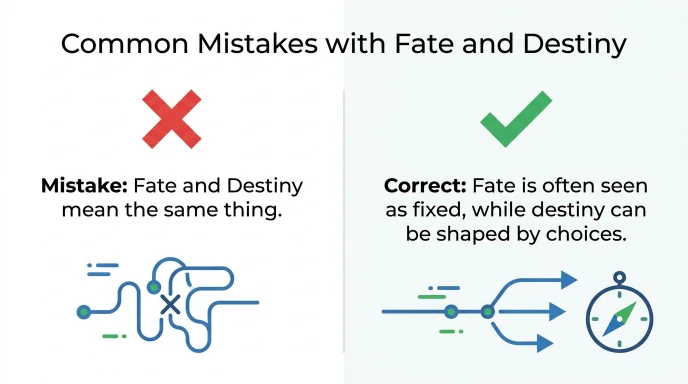
Mistake 1: Treating Them as Exact Synonyms
Correction: Their meanings overlap but are not identical.
Mistake 2: Assuming Destiny Is Predetermined
Correction: Destiny usually includes personal choice and effort.
Mistake 3: Believing Fate Requires No Action
Correction: Even if events occur, responses still matter.
Mistake 4: Ignoring Context
Correction: Literature, philosophy, and religion may define the terms differently.
Mistake 5: Using Fate and Luck Interchangeably
Correction: Fate often implies a larger predetermined pattern, not simple luck.
Real-Life Examples with Fate and Destiny
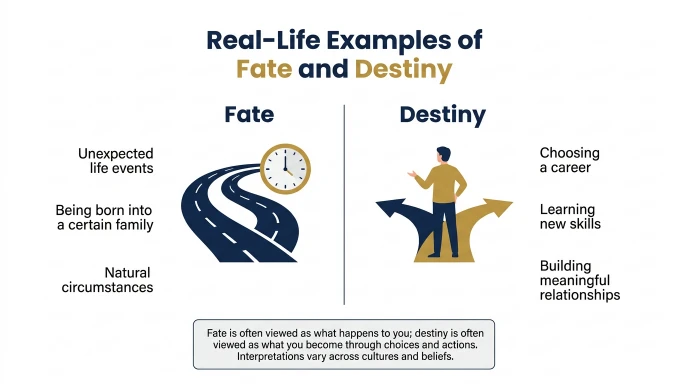
Personal Example
A student receives an unexpected scholarship opportunity (fate) but studies hard to graduate successfully (destiny).
Career Example
Meeting a future business partner by chance may feel like fate.
Building the company together reflects destiny.
Business Example
A market trend creates opportunity.
Strategic decisions determine if the business succeeds.
Sports Example
Natural talent may seem like fate.
Championship success comes from training and discipline.
Creative Industry Example
An artist gains sudden online exposure.
Long-term success depends on consistent effort and growth.
When to Use Each
Use “Fate” When:
- Discussing unavoidable events
- Referring to coincidence
- Talking about predetermined outcomes
- Describing circumstances beyond control
Use “Destiny” When:
- Discussing life purpose
- Referring to goals and ambitions
- Talking about personal growth
- Emphasizing free will and effort
Why People Get Confused in Difference Between Fate and Destiny
Several reasons explain the confusion:
- Similar dictionary definitions
- Popular media mixing the terms
- Religious and cultural variations
- Translation differences across languages
- Movies and books using them interchangeably
Most beginners encounter both words in inspirational quotes, where distinctions are often blurred.
How Search Engines Understand Difference Between Fate and Destiny and User Intent
When someone searches “difference between fate and destiny,” search engines identify a comparison-based informational query.
Google recognizes that users want:
- Definitions
- Examples
- Philosophical explanations
- Everyday usage guidance
- Similarities and differences
Pages that clearly explain concepts, answer related questions, and provide practical examples tend to satisfy this search intent most effectively.
Expert Insight
As a language and semantic content specialist, one insight consistently appears across literature, philosophy, and modern communication: people often prefer the concept of destiny because it preserves personal responsibility.
Fate explains circumstances.
Destiny explains direction.
In practical use, the most balanced perspective is that life presents opportunities and obstacles beyond our control, but our responses largely shape who we become.
That distinction creates the clearest understanding of the difference between fate and destiny.
FAQs
What is the main difference between fate and destiny?
Fate is usually considered predetermined, while destiny is often influenced by personal choices.
Are fate and destiny the same thing?
No. They are related concepts but emphasize different levels of control and free will.
Can destiny be changed?
Many philosophical views suggest destiny can evolve through decisions and actions.
Is fate unavoidable?
Traditional interpretations generally describe fate as unavoidable.
Which is more positive, fate or destiny?
Destiny is often viewed more positively because it emphasizes growth and possibility.
Do religions distinguish between fate and destiny?
Many religious traditions discuss both concepts, though interpretations vary.
Why do motivational speakers talk about destiny?
Because destiny encourages action, responsibility, and personal development.
Can fate and destiny exist together?
Many modern thinkers believe both can coexist in different aspects of life.
Is destiny connected to purpose?
Yes. Destiny is frequently associated with life purpose and achievement.
Why do people search for the difference between fate and destiny?
They want clarity about free will, life direction, personal growth, and philosophical meaning.
Conclusion
Understanding the difference between fate and destiny helps us answer one of humanity’s oldest questions: How much of life lies beyond our control, and how much can we shape ourselves? Fate refers to events that occur beyond our control, while destiny reflects the future we create through our choices, effort, and personal growth.
Although the two concepts overlap, they create very different perspectives. Fate emphasizes acceptance of circumstances, while destiny encourages action and responsibility. In real life, many people combine both ideas believing that some opportunities appear unexpectedly, but what happens next depends largely on their decisions.
The key takeaway is simple. Fate focuses on what happens to you. Destiny focuses on what you become. Once you understand this distinction, the difference between fate and destiny becomes much easier to recognize in everyday conversations, literature, philosophy, and personal development.
Read more about!
Difference Between Advice and Advise: Complete Guide
Difference Between Major and Minor: Complete Guide

I am James Carter, a professional content writer from the United States. I specialize in writing simple and clear comparison blogs that help students and readers understand difficult topics easily. My writing focuses on everyday language, education, science, and lifestyle topics. I believe that learning should be easy for everyone, so I use simple words and real-life examples in my articles.