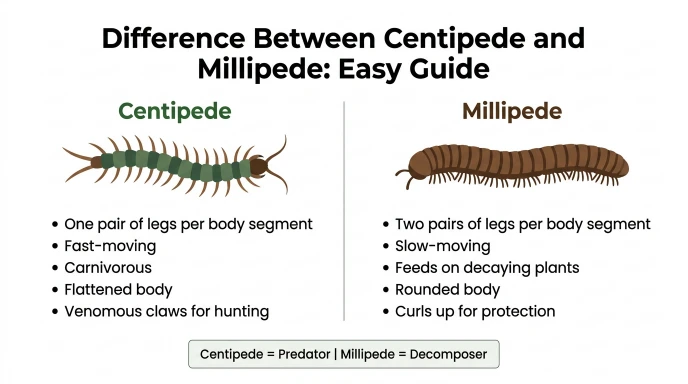
Centipedes and millipedes may look similar, but they differ in body structure, number of legs, speed, diet, and defense mechanisms.
Have you ever lifted a rock, moved a flower pot, or spotted a many-legged creature in your garden and wondered if it was a centipede or a millipede? You’re not alone.
Many users search for the difference between centipede and millipede because these arthropods look similar at first glance.
The difference between centipede and millipede comes down to body shape, leg structure, movement, diet, and behavior.
Centipedes are fast-moving predators with one pair of legs per body segment, while millipedes are slow-moving decomposers with two pairs of legs per segment.
In this complete guide, you’ll learn what each creature is, how to identify them quickly, their ecological roles, habitats, dangers, similarities, and why understanding the difference between centipede and millipede matters for gardeners, homeowners, students, and nature enthusiasts.
Difference Between Centipede and Millipede
The difference between centipede and millipede is that centipedes are fast, predatory arthropods with one pair of legs per segment, while millipedes are slow, plant-eating or decomposing arthropods with two pairs of legs per segment.
Example: If the creature runs quickly and has a flatter body, it’s likely a centipede. If it curls into a coil when disturbed and moves slowly, it’s probably a millipede.
Definition of Difference Between Centipede and Millipede
- Centipede: A long, segmented arthropod that has one pair of legs per body segment and feeds on insects and small animals.
- Millipede: A long, segmented arthropod that has two pairs of legs per body segment and primarily feeds on decaying plant matter.
Example: A house centipede hunts insects, while a millipede helps break down dead leaves.
Pronunciation
| Term | US Pronunciation | UK Pronunciation |
| Centipede | SEN-tuh-peed | SEN-tuh-peed |
| Millipede | MIL-uh-peed | MIL-uh-peed |
Now that we know the basics, let’s explore how these fascinating creatures differ in appearance, behavior, and ecological importance.
Difference Between Centipede and Millipede Comparison
| Feature | Centipede | Millipede |
| Body Shape | Flat | Rounded or cylindrical |
| Legs Per Segment | One pair | Two pairs |
| Speed | Fast | Slow |
| Diet | Predator | Decomposer |
| Defense Method | Venomous bite | Curling and defensive chemicals |
| Movement | Quick and agile | Slow and steady |
| Habitat | Under rocks, logs, houses | Soil, leaf litter, compost |
| Human Risk | Can bite | Generally harmless |
| Antennae | Longer | Shorter |
| Ecological Role | Controls pests | Recycles nutrients |
Key Differences Explained Between Centipede and Millipede
1. Body Shape
The easiest visual clue is body shape.
Centipedes have flattened bodies.
Millipedes have rounded bodies.
Real-life example: Looking from above, a centipede appears slimmer and flatter than a millipede.
2. Number of Legs
Many users think centipedes have exactly 100 legs and millipedes exactly 1,000.
That’s a myth.
Centipedes have one pair of legs per body segment.
Millipedes have two pairs per segment.
3. Speed and Movement
Centipedes move surprisingly fast.
Millipedes move slowly and deliberately.
If it suddenly races away, it’s probably a centipede.
4. Diet Differences
Centipedes are hunters.
Millipedes are recyclers.
Centipedes eat insects, spiders, and small invertebrates.
Millipedes consume dead plants and organic debris.
5. Defense Mechanisms
Centipedes use venomous front claws to capture prey.
Millipedes usually curl into a spiral and release defensive chemicals.
6. Interaction with Humans
Most millipedes are harmless.
Some centipedes can deliver painful bites, though serious complications are uncommon.
7. Ecological Purpose
Centipedes help control pest populations.
Millipedes improve soil health by breaking down organic matter.
What Is the Difference Between Centipede and Millipede in Classification?
Both creatures belong to the phylum Arthropoda.
However, they belong to different classes.
- Centipedes belong to Class Chilopoda.
- Millipedes belong to Class Diplopoda.
This classification explains many of their physical and behavioral differences.
Why Do Centipedes and Millipedes Look Similar?
Let’s understand this clearly.
Both animals have:
- Segmented bodies
- Numerous legs
- Long antennae
- Similar habitats
Because they often live in dark, moist environments, many beginners assume they are the same animal.
However, their lifestyles are completely different.
Difference Between Centipede and Millipede Appearance
Centipede Appearance
- Flattened body
- Long legs extending outward
- Fast-moving
- Usually yellow, brown, or reddish
Millipede Appearance
- Rounded body
- Shorter legs beneath the body
- Slow-moving
- Commonly dark brown or black
A quick glance at body shape usually reveals the correct identification.
How Do Centipedes Hunt Prey?
Centipedes are active predators.
Their first pair of modified legs acts like venomous claws.
They use these claws to:
- Capture prey
- Inject venom
- Immobilize insects
In practical use, centipedes can help reduce pest populations around gardens and homes.
How Do Millipedes Help the Environment?
Millipedes play a vital role in nutrient recycling.
They consume:
- Dead leaves
- Decaying wood
- Organic debris
As they digest plant material, nutrients return to the soil.
This process supports healthy ecosystems and plant growth.
Difference Between Centipede and Millipede Habitat
Centipede Habitats
- Under rocks
- Basements
- Logs
- Leaf litter
Millipede Habitats
- Compost piles
- Moist soil
- Forest floors
- Garden mulch
Both prefer humid environments because they lose moisture easily.
Are Centipedes or Millipedes Dangerous?
Centipedes
Some species can bite.
Most bites cause:
- Pain
- Swelling
- Redness
Large tropical species may produce stronger reactions.
Millipedes
Millipedes rarely bite.
Some release defensive fluids that may irritate skin temporarily.
For most people, millipedes are harmless.
Difference Between Centipede and Millipede in Gardening
Gardeners often encounter both creatures.
Benefits of Centipedes
- Eat pests
- Reduce insect populations
Benefits of Millipedes
- Improve soil quality
- Recycle plant material
Interestingly, both can be beneficial despite their different lifestyles.
Why Is the Difference Between Centipede and Millipede Popular Online?
Nature enthusiasts, students, and homeowners frequently search this topic.
On Google, common searches include:
- What is a centipede?
- What is a millipede?
- Are centipedes dangerous?
- How many legs does a millipede have?
Educational creators on YouTube often feature identification videos because visual comparisons are easy to understand.
Nature photographers on Instagram and communities on Meta regularly share wildlife images that spark curiosity about these creatures.
Difference and Similarity
| Feature | Centipede | Millipede | Similarity |
| Body Form | Flat body | Cylindrical body | Both segmented |
| Legs | One pair per segment | Two pairs per segment | Both have many legs |
| Diet | Carnivorous | Detritivorous | Both consume organic resources |
| Speed | Fast | Slow | Both move using many legs |
| Defense | Venom claws | Curling and chemicals | Both protect themselves |
| Habitat | Moist shelters | Moist shelters | Prefer humid environments |
| Ecological Role | Predator | Decomposer | Important ecosystem members |
| Human Impact | May bite | Usually harmless | Generally avoid humans |
This table clearly shows the difference and similarity between centipede and millipede for quick understanding.
Common Mistakes with Centipede and Millipede
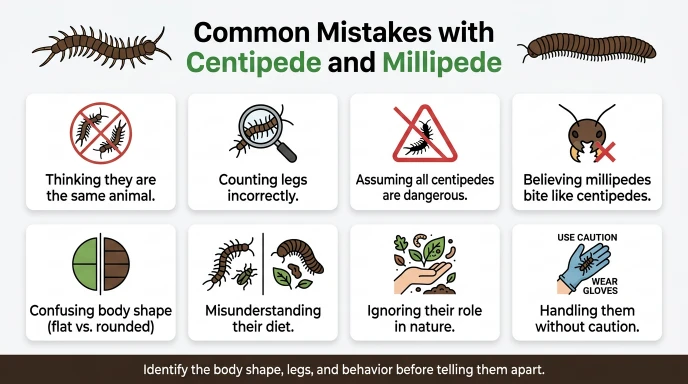
Mistake 1: Counting Total Legs
Correction: Focus on legs per segment, not total leg count.
Mistake 2: Assuming Millipedes Have Exactly 1,000 Legs
Correction: Most species have far fewer than 1,000 legs.
Mistake 3: Thinking Both Are Dangerous
Correction: Millipedes are generally harmless.
Mistake 4: Ignoring Body Shape
Correction: Body shape is one of the quickest identification methods.
Mistake 5: Treating Them as Insects
Correction: Both are arthropods but not insects.
Real-Life Examples with Centipede and Millipede
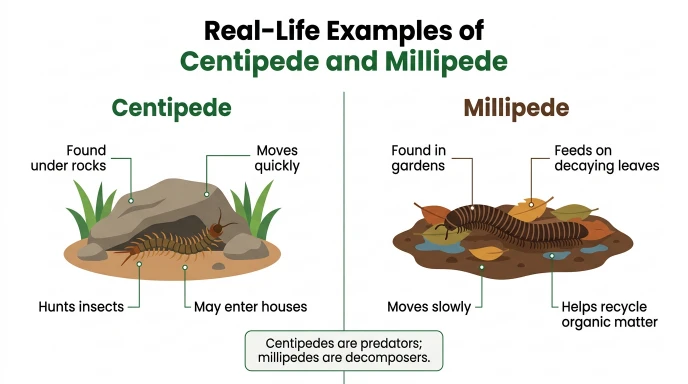
Homeowner Example
A fast-moving creature appears in a basement. Its flattened body identifies it as a centipede.
Gardening Example
A gardener finds a curled creature beneath mulch. It turns out to be a millipede helping decompose plant matter.
Educational Example
Students studying arthropods compare body segments and leg arrangements.
Pest Control Example
A homeowner appreciates centipedes because they help reduce insect populations.
Environmental Science Example
Researchers examine millipedes’ role in nutrient cycling and soil formation.
When to Use Each Identification
Identify a Centipede When:
- The body is flat
- Movement is fast
- It actively hunts insects
- Legs extend outward
Identify a Millipede When:
- The body is rounded
- Movement is slow
- It curls into a spiral
- It feeds on decaying matter
Why People Get Confused in Difference Between Centipede and Millipede
Several factors create confusion:
- Similar body shapes
- Many legs
- Shared habitats
- Similar names
- Lack of close observation
Most beginners focus on leg count rather than body structure and behavior.
How Search Engines Understand Difference Between Centipede and Millipede and User Intent
When users search “difference between centipede and millipede,” search engines recognize a comparison-based informational query.
Google understands that users usually want:
- Identification tips
- Safety information
- Habitat differences
- Visual characteristics
- Ecological roles
Articles that provide clear comparisons, tables, and practical examples generally satisfy user intent best.
Expert Insight
As a science and nature writer, one observation consistently helps beginners identify these animals instantly: ignore the total number of legs and look at movement.
If the creature moves rapidly and appears to be hunting, it’s likely a centipede.
If it moves slowly, curls into a coil, and hides in damp organic material, it’s almost certainly a millipede.
This simple field observation is often more useful than counting body segments or legs.
FAQs
What is the main difference between centipede and millipede?
Centipedes are predators with one pair of legs per segment, while millipedes are decomposers with two pairs per segment.
Which is more dangerous?
Centipedes are generally more dangerous because some can bite.
Do millipedes bite humans?
Most millipedes do not bite and are harmless.
Why do centipedes move faster?
Their body structure and predatory lifestyle require speed.
Are millipedes beneficial to gardens?
Yes. They help recycle nutrients and improve soil quality.
Do centipedes eat insects?
Yes. They are active predators of insects and other small invertebrates.
Which has more legs?
Millipedes typically have more legs than centipedes.
Are they insects?
No. Both belong to different arthropod classes and are not insects.
Where are centipedes commonly found?
Under rocks, logs, basements, and damp areas.
Why do millipedes curl into a ball?
It is a defense mechanism to protect their softer underside.
Conclusion
Understanding the difference between centipede and millipede becomes simple once you focus on a few key characteristics. Centipedes are fast-moving predators with flattened bodies and one pair of legs per body segment. Millipedes are slow-moving decomposers with rounded bodies and two pairs of legs per segment. While centipedes help control insect populations, millipedes contribute to healthy ecosystems by breaking down organic matter and enriching soil.
Although they share similar habitats and appearances, their behavior, diet, movement, and ecological roles are very different. For homeowners, gardeners, students, and nature enthusiasts, recognizing these differences can prevent unnecessary concern and improve understanding of local wildlife.
The easiest rule to remember is this: fast and flat usually means centipede; slow and round usually means millipede. Once you know that simple distinction, identifying them becomes much easier in real-world situations.
Read more about!
Difference Between Cigars and Cigarettes: Complete 2026 Guide
Difference Between Nanny and Babysitter: Which Is Better?

I am Emily Johnson, a USA-based content writer who creates easy-to-read blogs on language and daily life topics. I explain complex ideas in simple English for students and beginners so they can understand easily.