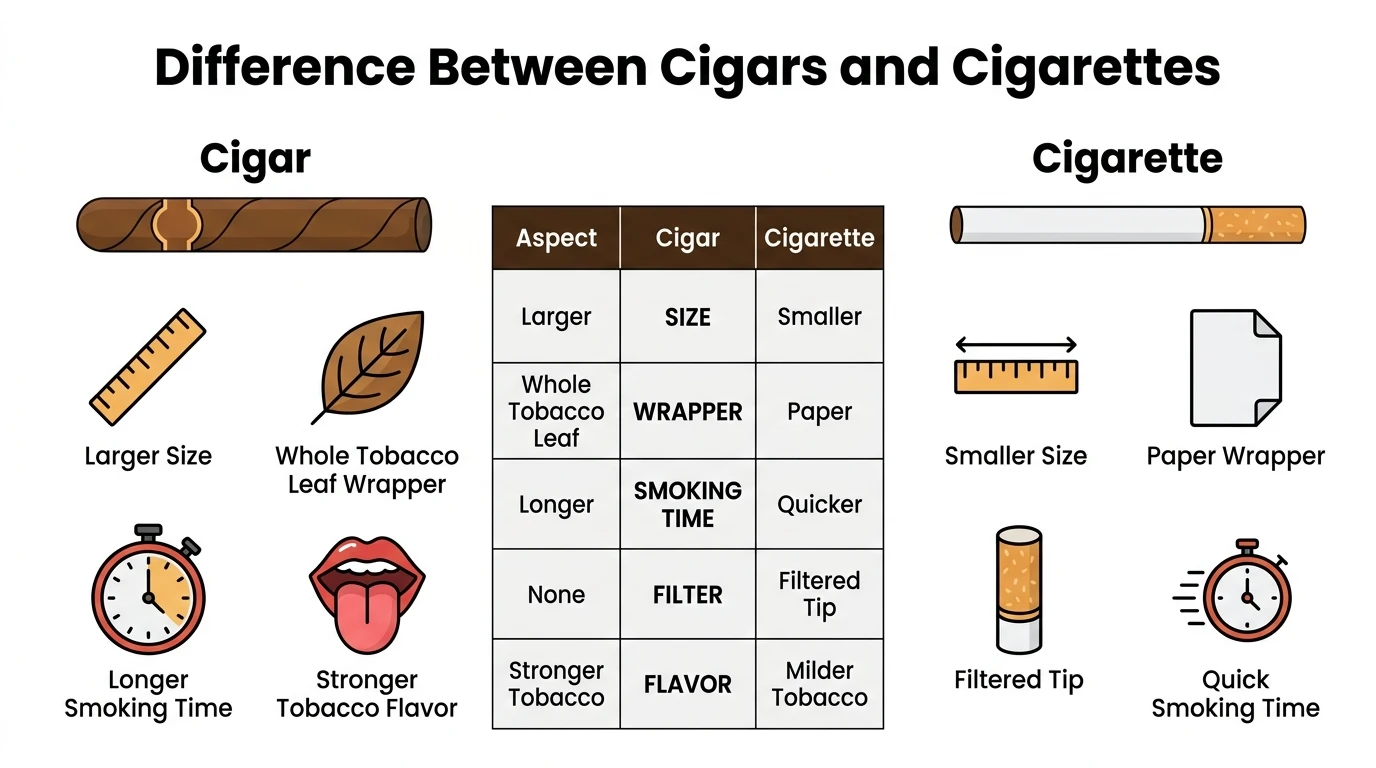
Cigars are larger, made of whole tobacco leaves, and smoked less frequently, while cigarettes are smaller, wrapped in paper, and designed for regular inhalation.
Many users get confused about the difference between cigars and cigarettes because both contain tobacco and are smoked. However, they differ in size, tobacco content, manufacturing, smoking style, nicotine exposure, and health risks.
If you’ve ever wondered about the difference between cigars and cigarettes, you’re not alone. People often search this topic to understand which one contains more tobacco, how they are made, and why smokers use them differently.
In this guide, you’ll learn what cigars and cigarettes are, how they compare, why the distinction matters, common misconceptions, real-life examples, and expert insights. Let’s understand this clearly and completely.
Difference Between Cigars and Cigarettes
A cigar is a tightly rolled bundle of fermented tobacco wrapped in tobacco leaf, while a cigarette is finely cut tobacco wrapped in paper and designed for quicker smoking.
Example: A person may spend an hour smoking one cigar, whereas a cigarette is often smoked in 5–10 minutes.
Definition of Difference Between Cigars and Cigarettes
- Cigar: A tobacco product made entirely from tobacco leaves, including the wrapper, filler, and binder.
- Cigarette: A small tobacco product made from finely shredded tobacco wrapped in paper, often including a filter.
Example: Premium hand-rolled cigars use whole tobacco leaves, while most cigarettes use processed tobacco blends.
Pronunciation
| Term | US Pronunciation | UK Pronunciation |
| Cigar | si-GAR | si-GAH |
| Cigarette | sig-uh-RET | sig-uh-RET |
Now that you know the definitions and pronunciation, let’s explore the key differences in detail.
Difference Between Cigars and Cigarettes Comparison
| Feature | Cigars | Cigarettes |
| Size | Larger and thicker | Smaller and slimmer |
| Wrapper | Tobacco leaf | Paper |
| Tobacco Amount | Much higher | Lower |
| Smoking Time | 30 minutes to several hours | 5–10 minutes |
| Nicotine Content | Usually higher | Lower per unit |
| Inhalation | Often not inhaled deeply | Typically inhaled |
| Manufacturing | Hand-rolled or machine-made | Mostly machine-produced |
| Cost | Usually more expensive | Generally cheaper |
| Usage Style | Leisure and social occasions | Daily smoking habit |
| Flavor Variety | Wide range of complex flavors | More standardized flavors |
Key Differences Explained Between Cigars and Cigarettes
1. Tobacco Composition
The biggest difference between cigars and cigarettes is the amount and type of tobacco used.
Example: One large cigar can contain as much tobacco as an entire pack of cigarettes.
2. Wrapping Material
Cigars use tobacco leaf wrappers, while cigarettes use paper wrappers.
This affects flavor, burn rate, and smoking experience.
3. Smoking Duration
Cigars are designed for slower smoking sessions.
Real-life example: A business executive may enjoy a cigar during a celebration, while a commuter might smoke a cigarette during a short break.
4. Nicotine Exposure
Most cigars contain significantly more nicotine than cigarettes.
Even when cigar smoke isn’t inhaled deeply, nicotine can still be absorbed through the mouth lining.
5. Cultural Use
Cigars are often linked to celebrations, luxury, and special events.
Cigarettes are commonly associated with routine daily smoking.
6. Manufacturing Process
Premium cigars often involve skilled craftsmanship and tobacco aging.
Cigarettes are largely mass-produced using automated machinery.
7. Flavor Complexity
Cigars often offer notes of coffee, chocolate, cedar, pepper, and earth.
Cigarettes generally provide a more uniform tobacco flavor.
What Is the Difference Between Cigars and Cigarettes in Tobacco Content?
Many beginners assume they contain similar amounts of tobacco.
In reality, a single premium cigar may contain between 5 and 20 grams of tobacco, while a cigarette typically contains less than 1 gram.
This difference explains why cigars burn longer and often contain more nicotine.
Why Are Cigars Usually Larger Than Cigarettes?
The larger size allows cigars to:
- Burn slowly
- Develop complex flavors
- Deliver a longer smoking experience
- Use multiple tobacco leaves
The design is intentional. Cigars are often meant to be savored rather than consumed quickly.
How Does Smoking a Cigar Differ From Smoking a Cigarette?
The smoking technique is different.
Cigarette Smoking
- Usually inhaled into the lungs
- Faster smoking pace
- Shorter duration
Cigar Smoking
- Often puffed rather than inhaled
- Focus on flavor and aroma
- Longer, slower experience
Most beginners are surprised that experienced cigar smokers often do not inhale deeply.
Difference Between Cigars and Cigarettes and Health Risks
A common misconception is that cigars are safer because many users do not inhale.
The reality is more complicated.
Both products expose users to harmful chemicals and increase health risks.
Potential risks include:
- Cancer
- Heart disease
- Oral health problems
- Respiratory issues
- Nicotine addiction
The health impact depends on frequency, inhalation patterns, and tobacco exposure.
Why Do Cigars Cost More Than Cigarettes?
Several factors contribute to higher cigar prices:
Tobacco Aging
Premium tobacco leaves may be aged for years.
Skilled Labor
Many premium cigars are hand-rolled.
Quality Control
Manufacturers carefully inspect wrappers, fillers, and construction.
Luxury Positioning
Many cigar brands market themselves as premium lifestyle products.
How Are Cigars and Cigarettes Made?
Cigar Production
- Tobacco cultivation
- Fermentation
- Aging
- Hand rolling or machine rolling
- Quality inspection
Cigarette Production
- Tobacco processing
- Blending
- Paper wrapping
- Filter attachment
- Packaging
The manufacturing process reflects the different goals of each product.
Why Do People Prefer Cigars Over Cigarettes?
Some users prefer cigars because:
- Longer smoking sessions
- Richer flavor profiles
- Social and celebratory use
- Collectible and premium varieties
In practical use, cigar enthusiasts often compare cigars similarly to how wine enthusiasts compare vintages.
Why Do People Prefer Cigarettes Over Cigars?
Others choose cigarettes because:
- Convenient size
- Faster use
- Easier availability
- Lower upfront cost
For many daily smokers, convenience plays a significant role.
Difference and Similarity Between Cigars and Cigarettes
| Feature | Cigars | Cigarettes | Similarity |
| Main Material | Whole tobacco leaves | Processed tobacco in paper | Both contain tobacco |
| Purpose | Leisure smoking | Quick smoking | Both are smoked products |
| Size | Large | Small | Both come in various sizes |
| Burn Time | Long | Short | Both burn tobacco |
| Nicotine | Usually higher | Lower per unit | Both deliver nicotine |
| Flavor | Complex and varied | Simpler | Both offer flavored varieties |
| Manufacturing | Often handcrafted | Mostly automated | Both require tobacco processing |
| Usage Context | Celebrations and relaxation | Daily consumption | Both are used recreationally |
This table clearly shows the difference and similarity between cigars and cigarettes for quick understanding.
Common Mistakes with Cigars and Cigarettes
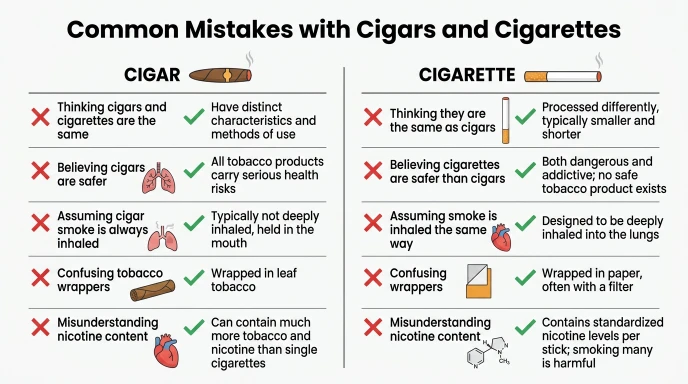
Mistake 1: Assuming Cigars Are Safe
Correction: Both products carry significant health risks.
Mistake 2: Thinking Cigars Contain Less Nicotine
Correction: Many cigars contain more nicotine than cigarettes.
Mistake 3: Believing All Cigars Are Hand-Rolled
Correction: Some cigars are machine-made.
Mistake 4: Treating Cigars Like Cigarettes
Correction: Smoking methods and intended experiences differ.
Mistake 5: Assuming Flavor Means Lower Risk
Correction: Flavor does not reduce tobacco-related risks.
Real-Life Examples with Cigars and Cigarettes
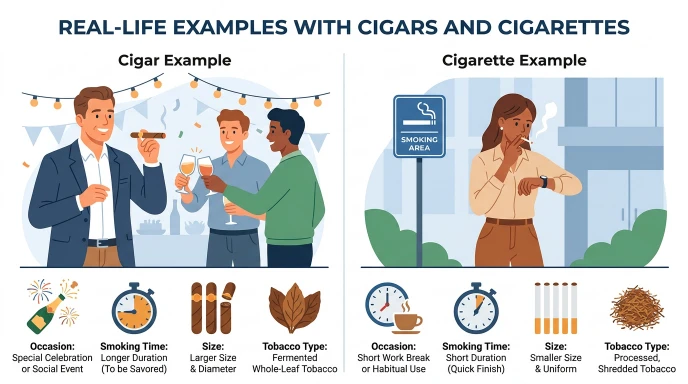
Example 1: Personal Use
A person enjoys a cigar during a wedding celebration but smokes cigarettes during daily routines.
Example 2: Business Environment
Corporate events sometimes feature premium cigars as luxury gifts.
Example 3: Hospitality Industry
High-end lounges may offer cigar selections for guests.
Example 4: Retail Industry
Tobacco shops often maintain separate sections for cigars and cigarettes due to different customer preferences.
Example 5: Collector Market
Some enthusiasts age and collect rare cigars, similar to collectible wines.
When to Use Each
Choose Cigars When:
- Celebrating special occasions
- Enjoying longer smoking sessions
- Exploring premium tobacco flavors
- Participating in cigar culture
Choose Cigarettes When:
- Seeking a quick smoking experience
- Prioritizing convenience
- Looking for lower upfront costs
- Maintaining a routine smoking habit
Why People Get Confused in Difference Between Cigars and Cigarettes
Several reasons contribute to confusion:
- Both contain tobacco.
- Both produce smoke.
- Media often groups them together.
- Beginners focus on appearance rather than construction.
- Social discussions sometimes use the terms interchangeably.
In simple words, they belong to the same broad tobacco category but function quite differently.
How Search Engines Understand Difference Between Cigars and Cigarettes and User Intent
When users search “difference between cigars and cigarettes,” search engines such as Google try to identify comparison intent.
The algorithm recognizes that users want:
- Definitions
- Side-by-side comparisons
- Health information
- Usage differences
- Practical examples
Platforms like YouTube often show visual comparisons, while discussions on Instagram and Meta properties may focus on lifestyle and cultural aspects. Search engines analyze engagement signals and content depth to determine which pages best satisfy user intent.
Expert Insight
From a tobacco industry perspective, the distinction is not merely about size.
The most meaningful difference lies in the construction, tobacco quantity, smoking style, and intended experience.
In real scenarios, beginners often focus on appearance, while experienced users evaluate factors such as wrapper quality, tobacco aging, flavor complexity, and smoking duration.
Understanding these factors provides a much clearer picture than simply comparing dimensions or nicotine levels.
FAQs
Are cigars stronger than cigarettes?
Generally, cigars contain more tobacco and often more nicotine than cigarettes.
Do cigar smokers inhale?
Many cigar smokers do not inhale deeply, though practices vary.
Which lasts longer, a cigar or a cigarette?
A cigar usually lasts much longer than a cigarette.
Are premium cigars handmade?
Many premium cigars are hand-rolled, but not all.
Why are cigars more expensive?
Higher-quality tobacco, aging, and skilled labor increase costs.
Can one cigar equal a pack of cigarettes?
Some large cigars may contain as much tobacco as an entire pack of cigarettes.
Do cigars have filters?
Most traditional cigars do not include filters.
Which is more popular worldwide?
Cigarettes are generally more widely consumed worldwide.
Why do cigars have different flavors?
Different tobacco blends, aging methods, and wrappers create flavor variation.
Are cigars and cigarettes made from the same tobacco?
Both use tobacco, but processing methods and leaf selection often differ.
Conclusion
Understanding the difference between cigars and cigarettes is important because these products differ in far more than appearance. Cigars are larger, contain more tobacco, burn longer, and are often associated with leisurely or celebratory smoking experiences. Cigarettes are smaller, wrapped in paper, designed for convenience, and commonly used for shorter smoking sessions.
The key distinction lies in their construction, tobacco content, smoking style, nicotine delivery, and cultural use. While many beginners assume they are nearly the same, a closer look reveals significant differences in how they are made, used, and experienced.
If you’re researching tobacco products, comparing smoking methods, or simply satisfying curiosity, knowing the difference between cigars and cigarettes helps you understand the topic more accurately. In simple terms, cigars focus on a slower, flavor-oriented experience, while cigarettes prioritize speed and convenience. That fundamental contrast explains most of the differences users notice in real-world situations.
Read more about!
Difference Between Plaque and Tartar: Complete Guide
Difference Between Naproxen and Ibuprofen: Complete Guide

I am James Carter, a professional content writer from the United States. I specialize in writing simple and clear comparison blogs that help students and readers understand difficult topics easily. My writing focuses on everyday language, education, science, and lifestyle topics. I believe that learning should be easy for everyone, so I use simple words and real-life examples in my articles.