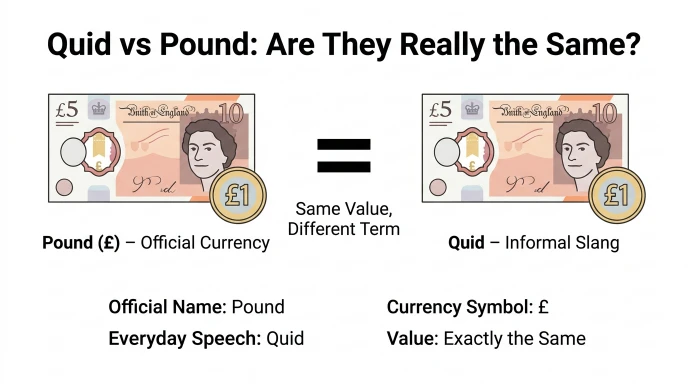
Quid and pound refer to the same currency, but “quid” is the informal slang term while “pound” is the official name of the UK’s currency.
Many travelers, students, and even English learners get confused about the difference between quid and pound. You may hear someone in the UK say, “That costs 20 quid,” while a price tag shows “£20.” This often leads people to wonder if quid and pound are different currencies.
The simple answer is that there is almost no monetary difference between quid and pound. However, the way they are used in conversation creates confusion.
Understanding the difference between quid and pound helps when traveling, studying British English, following UK business news, or exchanging money.
In this guide, you’ll learn what quid means, what a pound is, why both terms exist, how they’re used in real life, and when to use each correctly.
Difference Between Quid and Pound
The difference between quid and pound is mainly linguistic, not financial.
A pound is the official currency unit of the United Kingdom, while quid is an informal slang word for one pound.
Example: £10 and 10 quid have exactly the same value.
Definition of Difference Between Quid and Pound
- Pound: The official currency unit of the United Kingdom, represented by the symbol £ and officially called Pound Sterling.
- Quid: An informal British slang term used to refer to one pound.
Example: “I paid 50 pounds” and “I paid 50 quid” mean the same thing.
Pronunciation
| Term | US Pronunciation | UK Pronunciation |
| Quid | KWID | KWID |
| Pound | POUND | POUND |
Now that the definitions are clear, let’s explore why people use both words and how they differ in everyday communication.
Difference Between Quid and Pound Comparison
| Feature | Quid | Pound |
| Meaning | Informal slang term | Official currency name |
| Legal Status | Not official | Official currency unit |
| Written on Money | No | Yes |
| Used in Banking | Rarely | Always |
| Used in Conversation | Very common | Common |
| Appears on Currency Exchange Sites | No | Yes |
| Formal Documents | No | Yes |
| Financial Reports | No | Yes |
| Everyday Speech | Extremely common in UK | Common |
| Monetary Value | Equal to one pound | Equal to one pound |
Key Differences Explained Between Quid and Pound
1. Official vs Informal Usage
The biggest difference between quid and pound is formality.
“Pound” is the official term used by banks, governments, and financial institutions.
“Quid” is informal speech.
Example: A bank statement shows pounds, not quid.
2. Same Monetary Value
Many users get confused because they assume quid has a different value.
In reality:
- 1 quid = £1
- 10 quid = £10
- 100 quid = £100
There is no exchange rate between them.
3. Business Communication
Companies use “pound” in contracts and invoices.
Example: A business agreement might state £5,000 rather than 5,000 quid.
4. Everyday British Conversation
British people frequently use quid in daily speech.
Example: “Can you lend me twenty quid?”
This sounds natural in casual conversation.
5. International Recognition
People worldwide recognize “pound.”
Quid is mainly understood in the UK and among those familiar with British English.
6. Financial Reporting
Financial media and investment reports use pound.
You won’t see stock market reports discussing “millions of quid.”
7. Currency Exchange Usage
Foreign exchange markets refer to Pound Sterling.
Travelers exchanging money always deal with pounds, not quid.
What Is the Difference Between Quid and Pound in British English?
The difference between quid and pound exists because languages naturally develop informal alternatives.
Just as Americans may say “bucks” instead of dollars, British speakers often say “quid” instead of pounds.
The monetary value remains identical.
This makes quid a linguistic variation rather than a separate financial unit.
Why Do British People Say Quid Instead of Pound?
This is one of the most searched questions on Google.
Several reasons explain the popularity of quid:
- Shorter to say
- Sounds more casual
- Deeply rooted in British culture
- Common in everyday conversation
In practical use, saying “20 quid” often feels more natural than saying “20 pounds.”
How Does the UK Currency System Work?
Understanding the UK currency system helps explain why quid exists.
Official Currency
The official currency is the Pound Sterling (£).
Smaller Unit
One pound equals 100 pence.
Currency Issuer
The currency is issued primarily by the Bank of England.
When people say quid, they are still referring to this same currency system.
Difference Between Quid and Pound in Banking and Finance
Banks never use quid in official records.
You’ll find pounds in:
- Bank statements
- Tax documents
- Investment reports
- Payroll systems
- Business contracts
This distinction matters because financial accuracy requires standardized terminology.
Why Is Pound Called Pound Sterling?
Many beginners ask this question.
“Pound Sterling” refers to the official UK currency.
The word “sterling” helps distinguish it from other currencies called pounds, such as those used in different countries.
The abbreviation GBP stands for Great British Pound.
Foreign exchange markets worldwide recognize GBP as the official code.
Difference Between Quid and Pound in Travel and Tourism
Travelers often hear both terms during UK visits.
At Currency Exchange Counters
You’ll see:
- Pound Sterling
- GBP
- £ symbol
In Restaurants and Shops
You may hear:
- “That’ll be ten quid.”
- “The ticket costs fifty quid.”
Both refer to pounds.
Understanding this prevents confusion when visiting the UK.
Why Does Quid Not Appear on Banknotes?
Because quid is slang.
Currency notes and coins use official terminology.
For legal, financial, and international purposes, the official name remains Pound Sterling.
This is similar to how US currency says “dollars” rather than “bucks.”
Difference Between Quid and Pound in Modern Media
Today, both terms appear across digital platforms.
Many people use Google to search for exchange rates in pounds.
On YouTube travel channels, creators frequently say quid while discussing UK prices.
On Instagram and services owned by Meta, British influencers commonly use quid in captions and videos because it feels conversational.
This difference reflects audience language rather than currency value.
How Did the Word Quid Originate?
The exact origin remains debated.
Some theories suggest links to:
- Latin phrases
- Historical trading terminology
- Old British slang
Regardless of origin, quid has become one of the most recognizable slang terms in British English.
Difference and Similarity
| Feature | Quid | Pound | Similarity |
| Meaning | Slang term | Official currency term | Both refer to the same value |
| Formality | Informal | Formal | Used to describe money |
| Banking Use | Rarely used | Standard term | Both reference UK currency |
| Legal Documents | Not used | Officially used | Both indicate pounds |
| Everyday Speech | Very common | Common | Both understood in UK |
| International Use | Limited | Worldwide recognition | Both represent GBP |
| Currency Symbol | None | £ | Same monetary value |
| Exchange Rates | Not listed | Officially listed | Both refer to UK money |
This table clearly shows the difference and similarity between quid and pound for quick understanding.
Common Mistakes with Quid and Pound
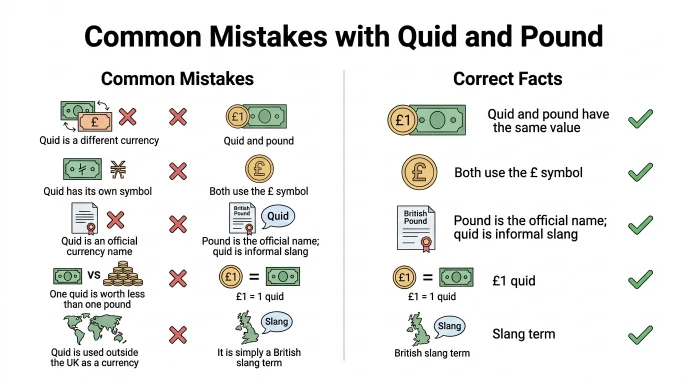
Mistake 1: Thinking Quid Is a Separate Currency
Correction: Quid is simply another word for pound.
Mistake 2: Assuming Quid Has a Different Exchange Rate
Correction: One quid always equals one pound.
Mistake 3: Using Quid in Formal Contracts
Correction: Official documents should use pound or GBP.
Mistake 4: Looking for Quid on Currency Exchange Websites
Correction: Exchange sites list GBP or Pound Sterling.
Mistake 5: Thinking Quid Appears on Banknotes
Correction: Currency displays pounds, not quid.
Real-Life Examples with Quid and Pound
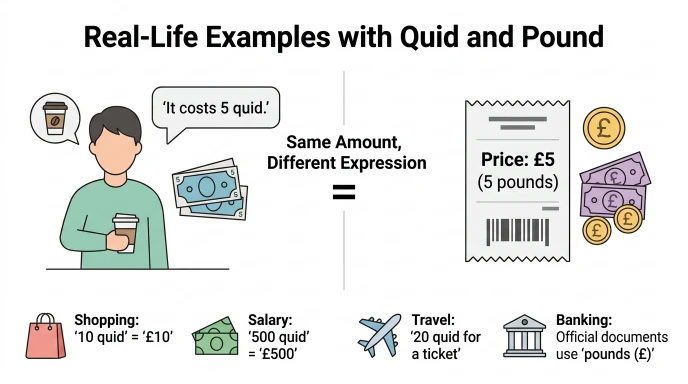
Personal Use
A friend says, “Can I borrow ten quid?”
Travel Scenario
A tourist exchanges dollars into pounds at the airport.
Business Use
A company invoice states £2,000 payable within 30 days.
Financial Industry
Investment reports track Pound Sterling performance against other currencies.
Online Shopping
A UK website lists products in pounds, while customers casually discuss prices in quid.
When to Use Each
Use Quid When:
- Speaking casually
- Chatting with friends
- Discussing everyday purchases
- Using informal British English
Use Pound When:
- Writing formally
- Completing financial documents
- Discussing exchange rates
- Creating business contracts
- Reporting financial data
Why People Get Confused in Difference Between Quid and Pound
Several factors cause confusion:
- Both refer to the same value.
- Travelers hear different words for the same currency.
- British slang is unfamiliar to many international visitors.
- Media often uses both terms interchangeably.
- Language learning resources may not explain the distinction clearly.
In simple words, the confusion comes from language, not money.
How Search Engines Understand Difference Between Quid and Pound and User Intent
When users search “difference between quid and pound,” search engines like Google identify a comparison intent.
Google understands users want answers to questions such as:
- Is quid the same as pound?
- What is quid in British money?
- Why do British people say quid?
- Is quid official currency?
Platforms like Instagram and YouTube often reinforce these questions because travelers, students, and content creators frequently discuss UK pricing and currency terminology.
Search engines prioritize content that quickly explains that quid and pound have the same value but different usage contexts.
Expert Insight
As someone who regularly analyzes language usage and financial terminology, one pattern appears consistently: beginners focus on value, while experts focus on context.
The real difference between quid and pound is not economic it’s linguistic.
In real-world communication, understanding when to use informal versus official language matters more than understanding the currency itself.
This distinction becomes especially important in business, finance, travel, and international communication.
FAQs
Is quid the same as pound?
Yes. One quid equals one pound.
Why do British people say quid?
It is a traditional slang term used in everyday conversation.
Is quid official currency?
No. Pound Sterling is the official currency.
How much is 20 quid?
20 quid equals £20.
Can I use quid in business contracts?
No. Formal documents should use pound or GBP.
Is quid written on British money?
No. Banknotes and coins use official currency terminology.
What does GBP stand for?
GBP stands for Great British Pound.
Is quid used outside the UK?
It is mainly recognized in the UK and among English speakers familiar with British slang.
Why is Pound Sterling called sterling?
The term helps distinguish the UK currency from other currencies called pounds.
Is there any value difference between quid and pound?
No. They represent exactly the same amount of money.
Conclusion
Understanding the difference between quid and pound is much simpler than many people expect. The pound is the official currency unit of the United Kingdom and is used in banking, government records, contracts, exchange markets, and international finance. Quid, on the other hand, is simply an informal slang word used in everyday British conversation.
The most important thing to remember is that there is no difference in value. One quid equals one pound, ten quid equals ten pounds, and so on. The distinction exists purely in language and context. When speaking casually with friends, quid sounds natural. When writing formally or dealing with financial matters, pound or GBP is the correct choice.
If you’re traveling to the UK, learning British English, studying currency systems, or following international markets, understanding the difference between quid and pound helps you communicate accurately and confidently.
Read more about!
Difference Between Jambalaya and Gumbo: Complete Guide
Difference Between Reposado and Añejo: Complete Guide

I am Emily Johnson, a USA-based content writer who creates easy-to-read blogs on language and daily life topics. I explain complex ideas in simple English for students and beginners so they can understand easily.