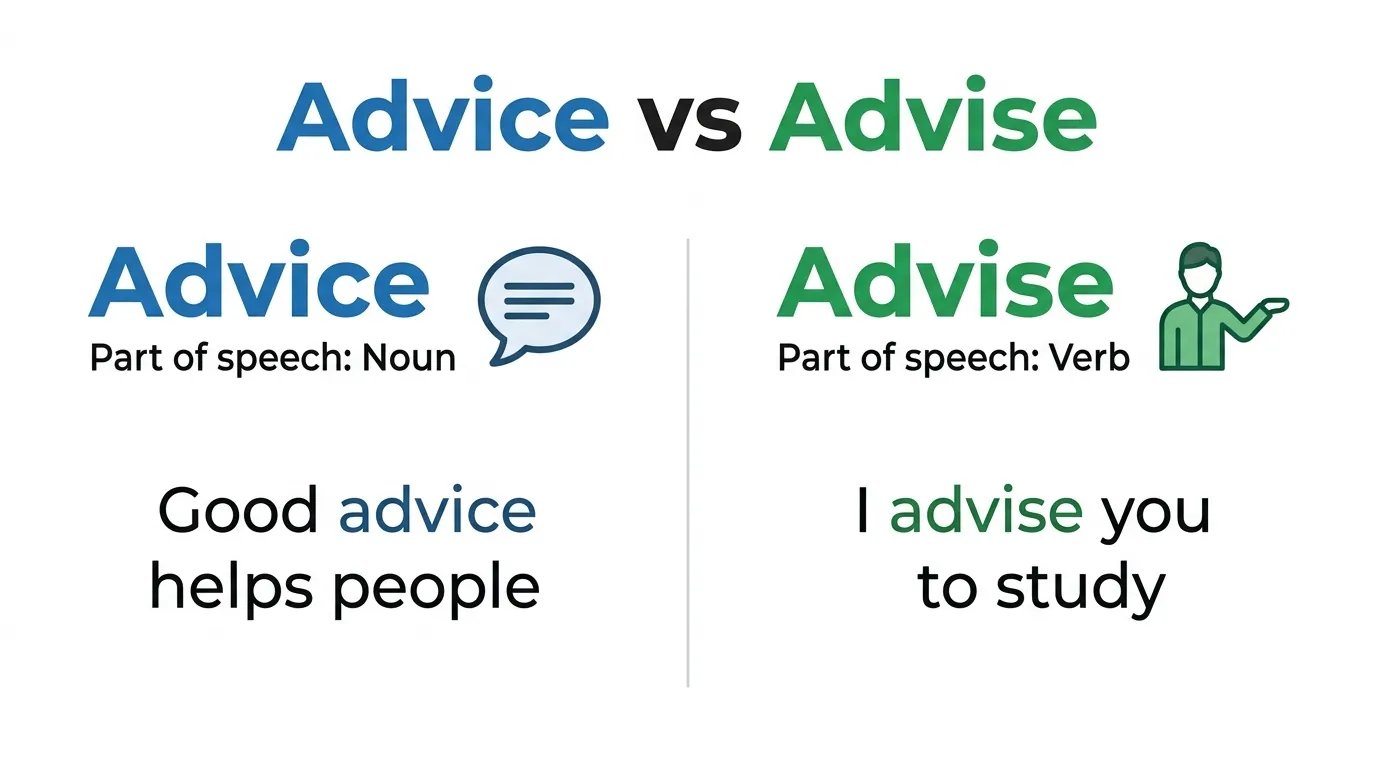
Advice is a noun meaning a suggestion or recommendation, while advise is a verb meaning to give a suggestion or recommendation.
Many English learners get confused when writing sentences like “Can you give me advice?” or “Can you advise me?” This is why the difference between advice and advise is one of the most searched grammar topics on Google. The difference between advice and advise is small in spelling but very important in meaning and usage.
In simple words, the difference between advice and advise is that “advice” is a noun meaning suggestion or guidance, while “advise” is a verb meaning the action of giving suggestions. Even native speakers sometimes mix them up in emails, exams, and professional writing.
In this complete guide, you will learn what advice and advise mean, how to use them correctly, real-life examples, common mistakes, pronunciation, and how search engines like Google, learning platforms like YouTube, and writing tools like Grammarly help users understand the difference between advice and advise.
Difference Between Advice and Advise
Advice is a noun that means a suggestion, while advise is a verb that means to give a suggestion.
Example:
“I need your advice.” (noun)
“I advise you to study.” (verb)
Definition of Advice and Advise
- Advice: A noun that means suggestions or recommendations given to someone.
- Advise: A verb that means the act of giving suggestions or recommendations.
Pronunciation
- Advice: “ad-VICE”
- Advise: “ad-VIZE”
Now let’s clearly understand how these two words work differently in real communication.
Comparison: Difference Between Advice and Advise
| Feature | Advice | Advise | Similarity |
| Word Type | Noun | Verb | Both related to guidance |
| Meaning | Suggestion or recommendation | To give suggestions | Both used in decision-making |
| Usage | “Give me advice” | “I advise you” | Both used in communication |
| Sentence Role | Object | Action | Both appear in same context |
| Grammar Function | Passive form | Active form | Both express guidance |
| Common Mistake | Using as verb | Using as noun | Often confused in writing |
This table clearly shows the difference and similarity between advice and advise for quick understanding.
Key Differences Between Advice and Advise
1. Word Type Difference
Advice is a noun, advise is a verb.
Example:
“I need advice” vs “I advise you.”
2. Usage in Sentences
Advice is used as a thing you receive. Advise is something you do.
3. Grammar Function
Advice acts as an object, while advise acts as an action word.
4. Pronunciation Difference
Advice ends with an “s” sound, advise ends with a “z” sound.
5. Formal Writing Use
In emails or professional writing, correct usage shows language skill.
6. Common Confusion in Exams
Students often mix them in grammar tests.
7. Real-Life Communication
Advice is received from friends; advise is given by teachers or experts.
Why Advice and Advise Exist as Separate Words
English language separates nouns and verbs to make communication precise. “Advice” represents information, while “advise” represents the action of sharing that information.
In digital learning platforms like Google Search, YouTube grammar lessons, and tools like Grammarly, this distinction is highlighted because it improves writing clarity and reduces mistakes.
How Advice and Advise Work in Real Communication
In real life, these words are used in:
- Emails
- Academic writing
- Job interviews
- Professional conversations
Example:
A manager may advise employees, while employees may ask for advice.
Real-Life Examples with Advice and Advise
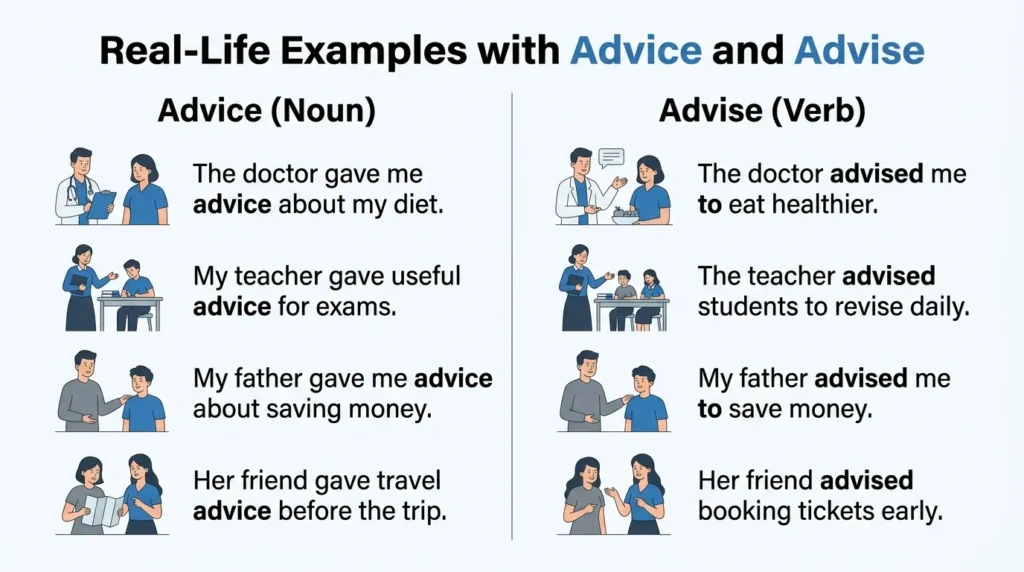
1. School
Teacher gives advice
Teacher advises students
2. Workplace
Manager advises team
Team asks for advice
3. Daily Life
Friends give advice
We advise others
4. Medical Field
Doctor advises patients
Patients follow advice
5. Online Learning
YouTube tutorials give advice
Instructors advise learners
6. Social Media Context
Influencers give advice on Instagram
Experts advise followers
Common Mistakes with Advice and Advise
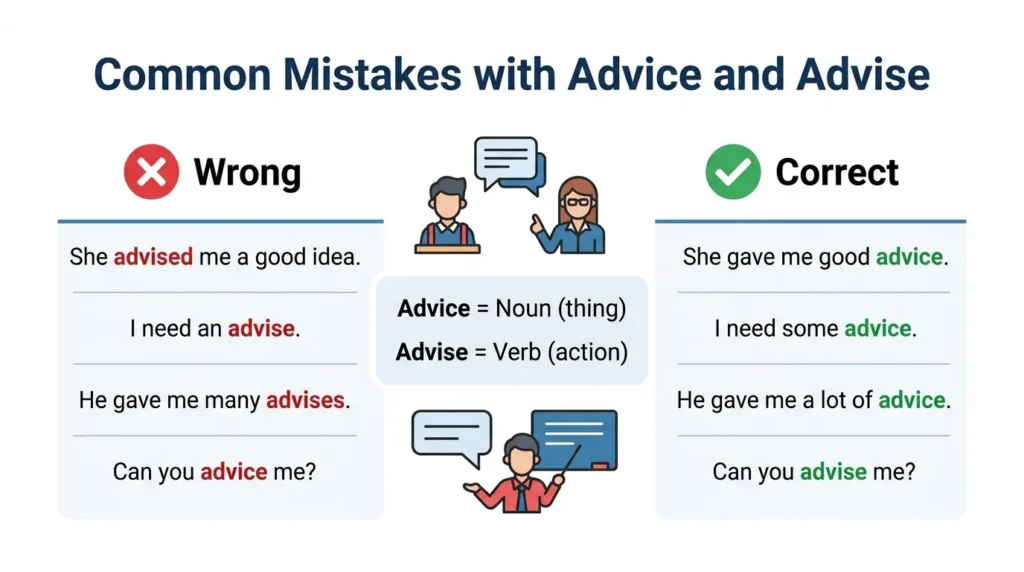
1. Using “advise” as a noun
Fix: Use “advice” instead.
2. Using “advice” as a verb
Fix: Replace with “advise.”
3. Spelling confusion
Fix: Remember advice ends with “-ice.”
4. Wrong pronunciation
Fix: Practice ad-VICE vs ad-VIZE.
5. Mixing in exams
Fix: Identify noun vs verb first.
When to Use Advice vs Advise
- Use advice when talking about suggestions (noun)
- Use advise when describing action (verb)
Simple Rule:
If you can replace it with “suggestion,” use advice.
If you can replace it with “suggest,” use advise.
Why People Get Confused
- Similar spelling
- Same meaning connection
- Fast typing errors
- Lack of grammar practice
- Social media shortcuts
Even platforms like Instagram captions and YouTube comments often show incorrect usage, increasing confusion.
How Search Engines Understand This Topic
When users search “difference between advice and advise,” Google analyzes intent such as:
- Grammar learning
- Word meaning clarification
- Sentence correction
- Exam preparation
Educational platforms like Google Search, YouTube, and writing assistants like Grammarly prioritize structured explanations, examples, and comparison tables for better learning results.
Expert Insight
From a language learning perspective, the confusion between advice and advise is one of the most common ESL (English as a Second Language) issues. In real teaching environments, educators focus on teaching noun vs verb patterns first because it strengthens grammar foundation.
In practical usage, mastering this difference improves writing clarity in academic essays, professional emails, and global communication where English is the primary language.
FAQs
Is advice a verb or noun?
Advice is a noun.
Is advise a noun or verb?
Advise is a verb.
Can I say “give me advise”?
No, the correct form is “give me advice.”
What is the easiest way to remember the difference?
Advice = thing (noun), Advise = action (verb).
Are advice and advise pronounced differently?
Yes, advice ends with “s” sound, advise ends with “z” sound.
Why do people confuse advice and advise?
Because of similar spelling and meaning connection.
Is advise formal?
Yes, it is commonly used in formal writing.
Conclusion
The difference between advice and advise is a simple but important grammar concept in English. Advice is a noun that refers to suggestions or guidance, while advise is a verb that describes the action of giving suggestions. Understanding the difference between advice and advise helps improve writing accuracy, speaking confidence, and communication skills.
In real-life usage, advice is what you receive, and advise is what someone gives. This distinction is widely used in education, business communication, and digital platforms like Google, YouTube, and grammar tools such as Grammarly.
By mastering the difference between advice and advise, learners can avoid common mistakes and communicate more clearly in both academic and professional settings.
Read more about!
Difference Between UI and UX: Complete Guide
Difference Between Autism and ADHD: Complete Guide

I am Emily Johnson, a USA-based content writer who creates easy-to-read blogs on language and daily life topics. I explain complex ideas in simple English for students and beginners so they can understand easily.