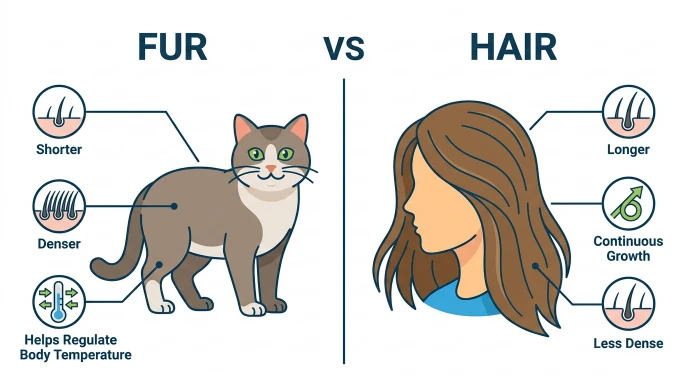
Fur is typically denser and shorter than hair, while hair grows longer and is less densely packed on the skin.
Have you ever looked at a dog, cat, or rabbit and wondered if it has fur or hair? Many people search for the difference between fur and hair because the terms are often used interchangeably.
The truth is that fur and hair are made from the same protein, but they differ in growth patterns, texture, density, and common usage.
Understanding the difference between fur and hair helps pet owners, animal lovers, students, and researchers identify animal coats more accurately.
In this guide, you’ll learn what fur and hair are, how they grow, why they exist, and the key differences that separate them. Let’s understand this clearly so you never confuse the two again.
Difference Between Fur and Hair
The difference between fur and hair is mainly based on growth cycle, density, and function. Fur typically grows to a fixed length, is denser, and helps animals regulate body temperature. Hair usually grows longer and has a longer growth cycle.
Example: A Labrador Retriever has fur, while a Poodle is often described as having hair because its coat keeps growing and requires regular trimming.
Definition of Fur and Hair
- Fur: A dense coat covering many mammals that helps provide insulation and protection. Fur usually grows to a certain length and sheds regularly.
- Hair: Protein-based strands that grow from follicles and often have a longer growth cycle. Human hair is the most common example.
Pronunciation
| Term | US Pronunciation | UK Pronunciation |
| Fur | /fɜr/ | /fɜː/ |
| Hair | /her/ | /heə/ |
Now that the definitions are clear, let’s dive deeper into the science behind the difference between fur and hair.
Difference Between Fur and Hair Comparison
| Feature | Fur | Hair |
| Growth Cycle | Shorter | Longer |
| Length | Usually fixed | Can grow continuously |
| Density | Generally denser | Usually less dense |
| Shedding | More frequent | Less frequent in some species |
| Function | Insulation and protection | Protection and sensory functions |
| Texture | Often softer and thicker | Can vary widely |
| Maintenance | Natural shedding | Often requires grooming |
| Common Examples | Dogs, cats, foxes | Humans, horses, Poodles |
Key Differences Explained Between Fur and Hair
1. Growth Cycle
The biggest difference between fur and hair is the growth cycle.
Fur stops growing after reaching a certain length. Hair remains in the growth phase much longer.
Real-life example: Human hair can grow for years, while a cat’s fur reaches a natural limit.
2. Shedding Pattern
Most animals with fur shed regularly.
Hair generally sheds less dramatically because it stays in the growth phase longer.
Example: Dogs often leave fur around the house during shedding season.
3. Density
Fur is usually denser.
This density helps animals survive cold temperatures and changing climates.
Example: Arctic foxes develop extremely dense fur to stay warm.
4. Insulation Ability
Fur functions primarily as insulation.
Hair can provide protection, but insulation is often not its main role.
Example: Polar mammals depend heavily on fur for survival.
5. Length Potential
Hair often grows continuously.
Fur usually grows to a predetermined length and then sheds.
Example: A Poodle’s coat can continue growing much longer than a typical dog’s fur.
6. Seasonal Changes
Many fur-bearing animals experience seasonal shedding.
Hair tends to remain more consistent year-round.
Example: Huskies develop thicker winter coats and shed heavily in spring.
7. Grooming Requirements
Animals with hair often require more grooming.
Since the hair keeps growing, trimming becomes necessary.
Example: Poodles need regular professional grooming.
8. Appearance
Fur generally creates a fluffy appearance.
Hair often appears smoother and more individual strand-based.
What Is Fur and Why Do Animals Need It?
Fur evolved as a survival adaptation.
Main Functions of Fur
- Temperature regulation
- Weather protection
- Camouflage
- Physical protection
- Sensory assistance
In real scenarios, mammals living in cold regions depend on thick fur for survival.
Examples of Animals With Fur
- Dogs
- Cats
- Foxes
- Rabbits
- Bears
What Is Hair and How Does It Work?
Hair grows from follicles embedded in the skin.
It consists primarily of keratin, the same protein found in nails.
Functions of Hair
- Protection from sunlight
- Sensory detection
- Temperature regulation
- Social and visual communication
Humans are the most familiar example of mammals with hair.
Why Does the Difference Between Fur and Hair Exist?
Many users get confused because fur and hair are biologically very similar.
In simple words, scientists often consider fur and hair to be variations of the same structure.
The distinction mainly comes from:
- Growth cycle
- Density
- Texture
- Common usage
Interestingly, there is no universally accepted scientific line separating fur and hair.
This is one of the most overlooked facts on the topic.
Difference Between Fur and Hair in Pets
Pet owners often ask if their dog has fur or hair.
Dogs Commonly Described as Having Fur
- Labrador Retriever
- German Shepherd
- Siberian Husky
Dogs Commonly Described as Having Hair
- Poodle
- Maltese
- Yorkshire Terrier
These breeds typically require more grooming because their coats continue growing.
Difference Between Fur and Hair in Wildlife
Wild animals often rely on fur for environmental adaptation.
Cold Climate Species
- Arctic Fox
- Polar Bear
- Snow Leopard
Warmer Climate Species
Some mammals develop thinner coats adapted for heat regulation.
The structure of fur often reflects the habitat where the species evolved.
How Does Fur and Hair Growth Work?
Both fur and hair grow through follicles.
Growth generally occurs in three phases:
Anagen Phase
Active growth period.
Catagen Phase
Transition phase.
Telogen Phase
Resting and shedding phase.
Hair typically remains in the anagen phase much longer than fur.
This explains why human hair can grow significantly longer.
Difference Between Fur and Hair in Modern Pet Care
As pet ownership increases globally, understanding coat types becomes more important.
Many educational videos on YouTube explain grooming techniques for different coat types.
Pet communities on Instagram often discuss shedding, grooming schedules, and coat health.
Search platforms like Google show millions of searches related to pet fur, dog hair, and shedding management because pet owners frequently seek practical advice.
Difference and Similarity
| Feature | Fur | Hair | Similarity |
| Composition | Keratin protein | Keratin protein | Same basic material |
| Growth | Shorter cycle | Longer cycle | Both grow from follicles |
| Density | Usually dense | Usually less dense | Both cover mammals |
| Length | Fixed growth | Continuous growth | Both vary by species |
| Shedding | Frequent | Less dramatic | Both naturally shed |
| Protection | Strong insulation | Moderate protection | Both protect skin |
| Maintenance | Natural renewal | Often requires grooming | Both need care |
| Purpose | Survival-focused | Protection and communication | Both have biological functions |
This table clearly shows the difference and similarity between fur and hair for quick understanding.
Common Mistakes With Fur and Hair
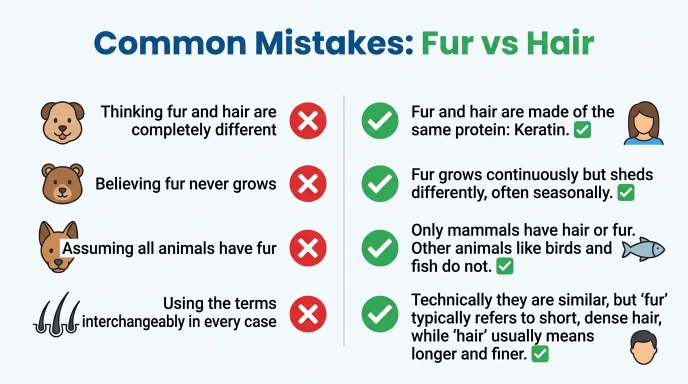
Mistake 1: Thinking Fur and Hair Are Completely Different
Correction: Both are made from keratin and grow from follicles.
Mistake 2: Assuming All Dogs Have Fur
Correction: Some breeds are commonly classified as having hair.
Mistake 3: Believing Hair Never Sheds
Correction: Hair sheds naturally too.
Mistake 4: Using Length as the Only Difference
Correction: Growth cycle matters more than length.
Mistake 5: Ignoring Density
Correction: Fur is usually much denser.
Mistake 6: Assuming Scientific Consensus Exists
Correction: Scientists often debate exact distinctions.
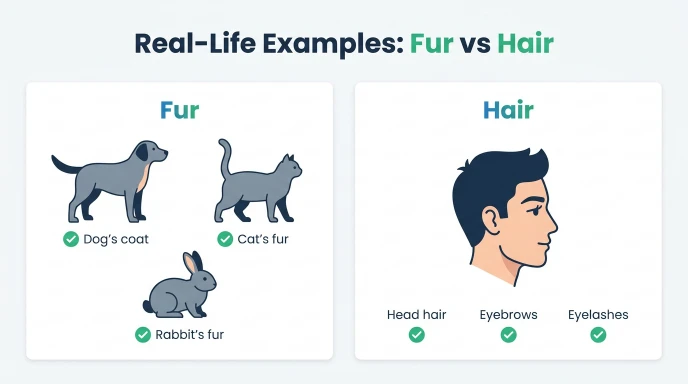
Real Life Examples With Fur and Hair
Personal Example
A person brushes their long hair regularly because it keeps growing.
Pet Example
A Husky sheds large amounts of fur during seasonal changes.
Grooming Industry Example
Poodle owners schedule regular trims due to continuous hair growth.
Veterinary Example
Veterinarians assess coat health to identify nutritional deficiencies.
Wildlife Example
Polar bears rely on thick fur for insulation in extreme cold.
Animal Shelter Example
Shelters educate adopters about shedding expectations before pet adoption.
When to Use Each Term
Use “Fur” When:
- Referring to dense animal coats
- Discussing insulation
- Talking about seasonal shedding
- Describing wild mammals
Use “Hair” When:
- Referring to human hair
- Discussing continuously growing coats
- Talking about grooming-intensive breeds
- Describing individual strands
Why People Get Confused in Fur and Hair
Several reasons contribute to confusion:
- Similar biological structure
- Overlapping terminology
- Different industry definitions
- Pet grooming terminology
- Media and marketing usage
Many beginners assume fur and hair are completely different substances, but they are remarkably similar.
How Search Engines Understand Difference Between Fur and Hair and User Intent
Search engines such as Google recognize that users searching “fur vs hair” typically want a biological comparison.
Algorithms analyze:
- User questions
- Educational intent
- Animal-related searches
- Pet care relevance
- Content depth
Platforms like Instagram and Meta contribute to public discussions about pet grooming and coat care, which increases interest in this topic.
Expert Insight
One fact often missed in competing articles is that the distinction between fur and hair is partly cultural rather than strictly scientific.
In practical use, biologists generally agree that both structures are made from keratin and grow from follicles. The difference is more about growth behavior, density, and common usage than a completely separate biological structure.
Most beginners focus only on appearance, but growth cycle is usually the more important factor.
FAQs
What is the difference between fur and hair?
Fur usually has a shorter growth cycle and greater density, while hair grows longer and often continuously.
Is fur actually hair?
Yes. Fur and hair are both made from keratin and grow from follicles.
Why do some dogs have hair instead of fur?
Certain breeds have longer growth cycles, causing their coats to grow continuously.
Does fur grow back after shedding?
Yes. Fur naturally regrows through the hair growth cycle.
Which is softer, fur or hair?
Fur is often softer because of its density, but this varies by species.
Do humans have fur?
Humans technically have body hair rather than fur.
Why do animals need fur?
Fur helps regulate temperature, protect the body, and improve survival.
Is there a scientific difference between fur and hair?
The distinction exists, but scientists often consider them variations of the same biological structure.
Conclusion
Understanding the difference between fur and hair becomes much easier once you know that both are made from the same protein called keratin. The main distinction lies in growth cycle, density, shedding patterns, and common usage. Fur is generally denser, grows to a certain length, and provides insulation for animals. Hair usually grows longer, remains in the growth phase longer, and often requires regular maintenance.
Many users get confused because the terms overlap in everyday language. In reality, the difference is not as absolute as many people think. Scientists often view fur and hair as closely related structures with different growth characteristics rather than entirely separate materials.
If you’re a pet owner, student, animal enthusiast, or simply curious, knowing the difference between fur and hair helps you better understand animal biology, grooming needs, and how mammals adapt to their environments. The next time someone asks if a dog has fur or hair, you’ll know exactly how to explain it.
Read more about!
Difference Between Antigen and Antibody: Simple Guide
Difference Between Cigars and Cigarettes: Complete 2026 Guide

I am Emily Johnson, a USA-based content writer who creates easy-to-read blogs on language and daily life topics. I explain complex ideas in simple English for students and beginners so they can understand easily.