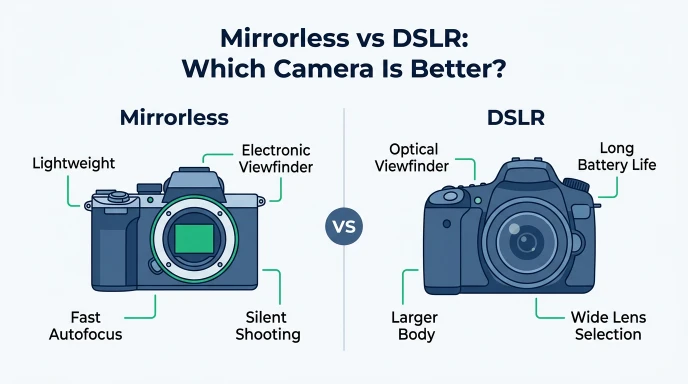
Mirrorless cameras are lighter and use modern autofocus, while DSLRs offer longer battery life and an optical viewfinder making the better choice depend on your needs.
If you’ve been shopping for a camera, you’ve probably wondered about the difference between mirrorless and DSLR cameras. Both can capture stunning photos and videos, but they work in different ways and serve different types of users.
Many beginners get confused when comparing mirrorless vs DSLR because both look professional and often produce similar image quality.
The real difference between mirrorless and DSLR comes down to design, autofocus technology, size, battery life, and shooting experience.
In this guide, you’ll learn what each camera type is, how they work, their advantages and disadvantages, and which one is the best choice for your needs in 2026.
Difference Between Mirrorless and DSLR
The main difference between mirrorless and DSLR cameras is that a DSLR uses a mirror and optical viewfinder, while a mirrorless camera does not.
For example, a wedding photographer using a modern mirrorless camera may benefit from faster autofocus and eye tracking, while a wildlife photographer may prefer a DSLR’s longer battery life.
Definition of Difference Between Mirrorless and DSLR
- Mirrorless Camera: A digital camera that captures images directly through the sensor without using a mirror mechanism.
- DSLR Camera: A Digital Single-Lens Reflex camera that uses a mirror to reflect light into an optical viewfinder before taking a photo.
Example: A mirrorless camera shows a live digital preview, while a DSLR shows an optical view through the lens.
Pronunciation
| Term | US Pronunciation | UK Pronunciation |
| Mirrorless | MIR-er-liss | MIR-uh-liss |
| DSLR | dee-ess-el-ar | dee-ess-el-ar |
Now that you know the basic definitions, let’s understand the key differences in detail.
Comparison: Difference Between Mirrorless and DSLR
| Feature | Mirrorless | DSLR |
| Mirror Mechanism | No mirror system | Uses mirror system |
| Size | Smaller and lighter | Larger and heavier |
| Viewfinder | Electronic Viewfinder (EVF) | Optical Viewfinder (OVF) |
| Autofocus | Faster and smarter | Good but often slower |
| Battery Life | Usually shorter | Usually longer |
| Video Performance | Excellent | Good but often behind |
| Silent Shooting | Available | Limited |
| Lens Availability | Growing rapidly | Extensive older selection |
| Learning Curve | Beginner-friendly | Traditional experience |
| Future Development | Industry focus | Gradually declining |
Key Differences Explained Between Mirrorless and DSLR
1. Mirror System
The biggest difference is the mirror mechanism.
A DSLR contains a physical mirror that reflects light into the optical viewfinder. A mirrorless camera removes this mirror entirely.
Real-world example: Modern travel photographers often choose mirrorless cameras because fewer moving parts make them lighter.
2. Size and Weight
Mirrorless cameras are generally smaller.
Without the mirror box, manufacturers can reduce camera body size significantly.
Example: Travelers carrying gear all day often prefer mirrorless systems.
3. Autofocus Technology
Mirrorless cameras dominate autofocus performance today.
Most modern systems use advanced AI-powered eye detection, face tracking, and subject recognition.
Example: Sports creators on YouTube frequently use mirrorless cameras because they can track moving subjects accurately.
4. Battery Life
DSLR cameras generally offer longer battery life.
The optical viewfinder requires less power than an electronic display.
Example: Wildlife photographers spending hours outdoors often appreciate DSLR battery endurance.
5. Video Features
Mirrorless cameras typically provide better video capabilities.
Many support advanced formats, higher frame rates, and superior autofocus during recording.
Example: Content creators posting on Instagram and YouTube often choose mirrorless cameras.
6. Viewfinder Experience
DSLR users see the real scene through the lens.
Mirrorless users see a digital preview of exposure, color, and white balance.
User Insight: Beginners often find electronic previews easier because they can see the final result before taking the shot.
7. Future Growth
Most camera manufacturers are focusing development on mirrorless systems.
New lens releases and flagship models increasingly target mirrorless platforms.
What Is a Mirrorless Camera and How Does It Work?
A mirrorless camera allows light to hit the image sensor continuously.
The sensor sends data directly to the electronic viewfinder or LCD screen.
Why Many Photographers Prefer Mirrorless
- Faster autofocus
- Better video tools
- Smaller bodies
- Silent shooting
- Real-time exposure preview
In practical use, these advantages make mirrorless cameras attractive for creators and professionals.
What Is a DSLR Camera and How Does It Work?
A DSLR uses a mirror that reflects incoming light upward into an optical viewfinder.
When you press the shutter button, the mirror flips up and the sensor captures the image.
Why Some Photographers Still Choose DSLRs
- Longer battery life
- Optical viewing experience
- Strong durability
- Large used-lens market
Many experienced photographers still enjoy the traditional shooting feel.
Difference Between Mirrorless and DSLR for Photography
When it comes to photography, image quality depends more on the sensor and lens than the camera type.
However, mirrorless cameras offer modern advantages:
- Better autofocus tracking
- Real-time previews
- AI subject detection
DSLR advantages include:
- Reliable optical viewing
- Longer shooting sessions
- Familiar professional workflow
Difference Between Mirrorless and DSLR for Video Recording
Video is one area where mirrorless cameras usually win.
Most modern mirrorless systems include:
- 4K and 8K recording
- Eye autofocus
- Log profiles
- Image stabilization
This is why many YouTube creators and online educators have transitioned to mirrorless systems.
Which Camera Is Better for Beginners?
Many users ask:
“Should I buy a mirrorless camera or DSLR as a beginner?”
For most beginners in 2026, mirrorless is often the easier choice.
Reasons include:
- Easier learning process
- Better autofocus
- Lighter bodies
- Strong video performance
However, budget-conscious beginners may find excellent DSLR deals on the used market.
Difference Between Mirrorless and DSLR for Professionals
Professional photographers choose based on needs.
Portrait Photographers
Often prefer mirrorless for eye autofocus.
Sports Photographers
Many now use mirrorless for advanced tracking.
Wildlife Photographers
Both systems remain popular depending on battery needs and lens collections.
Wedding Photographers
Mirrorless dominates due to silent shooting and reliable subject detection.
Difference and Similarity
| Feature | Mirrorless | DSLR | Similarity |
| Purpose | Capture photos and videos | Capture photos and videos | Both create professional-quality images |
| Sensor | Digital sensor exposed directly | Digital sensor behind mirror | Both use image sensors |
| Lenses | Interchangeable | Interchangeable | Lens choice affects quality |
| Learning | Easier visual feedback | Traditional learning style | Both require photography skills |
| Professional Use | Widely used today | Still used professionally | Both support professional work |
| Video | Usually stronger | Usually weaker | Both record video |
| Photography | Excellent | Excellent | Both can produce outstanding photos |
| Creative Control | Full manual control | Full manual control | Both allow advanced settings |
This table clearly shows the difference and similarity between mirrorless and DSLR for quick understanding.
Common Mistakes with Mirrorless and DSLR
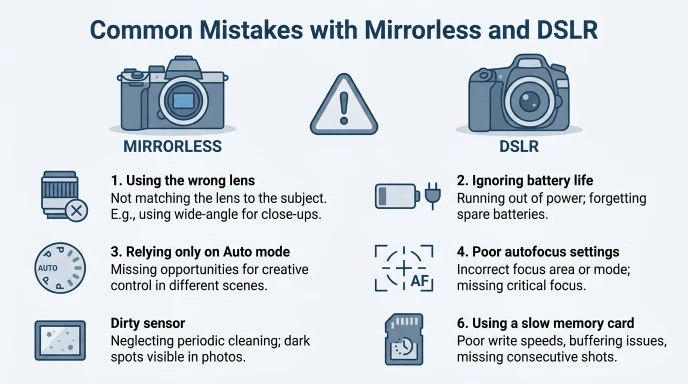
Mistake 1: Assuming Mirrorless Always Has Better Image Quality
Image quality depends largely on sensor size and lens quality.
Mistake 2: Thinking DSLRs Are Obsolete
Many DSLR systems remain highly capable.
Mistake 3: Ignoring Lens Availability
Lens ecosystems matter more than camera bodies.
Mistake 4: Buying Based Only on Size
Comfort and handling are equally important.
Mistake 5: Focusing Only on Camera Specs
Photography skills impact results more than equipment.
Real-Life Examples with Mirrorless and DSLR
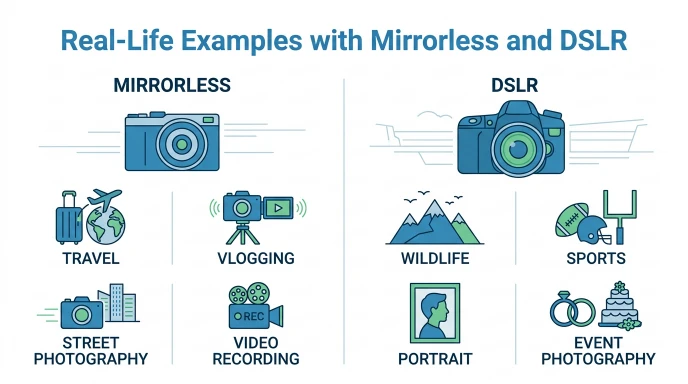
Personal Use
A traveler chooses a compact mirrorless camera for vacations.
Content Creation
A YouTube creator selects mirrorless for fast autofocus.
Professional Wedding Photography
Silent shooting helps capture ceremonies discreetly.
Wildlife Photography
A DSLR user benefits from extended battery life.
Educational Industry
Photography schools often teach both systems.
When to Use Each
Use Mirrorless When:
- You create videos
- You travel frequently
- You want modern autofocus
- You prefer lighter equipment
Use DSLR When:
- You need long battery life
- You prefer optical viewfinders
- You already own DSLR lenses
- You want lower-cost professional gear
Why People Get Confused Between Mirrorless and DSLR
Many users get confused because both cameras look similar and produce high-quality results.
Reasons include:
- Similar image quality
- Marketing claims
- Mixed online reviews
- Rapid technology changes
- Older DSLR recommendations still ranking on Google
Let’s understand this clearly: today’s debate is less about image quality and more about workflow and shooting style.
How Search Engines Understand Mirrorless and DSLR User Intent
When users search “difference between mirrorless and DSLR,” search engines like Google identify comparison intent.
Search algorithms analyze:
- Product comparisons
- Buying guides
- User reviews
- Photography tutorials
Platforms like YouTube and Instagram influence search behavior because creators regularly compare camera systems through real-world demonstrations.
Meanwhile, Meta platforms drive visual content trends, making video performance increasingly important for camera buyers.
Expert Insight
As someone who has evaluated camera systems across different photography workflows, one trend is clear: mirrorless cameras are now leading innovation.
However, many professionals still produce outstanding work with DSLRs. In real scenarios, success depends more on understanding lighting, composition, and storytelling than choosing one camera type over another.
The best camera is the one that supports your goals, budget, and workflow.
FAQs
What is the main difference between mirrorless and DSLR?
Mirrorless cameras do not use a mirror system, while DSLRs use a mirror and optical viewfinder.
Is mirrorless better than DSLR?
For most new buyers in 2026, mirrorless offers more modern features, especially for video and autofocus.
Do professionals use mirrorless cameras?
Yes. Many professional photographers have switched to mirrorless systems.
Are DSLR cameras still worth buying?
Absolutely. Many DSLR cameras remain powerful and cost-effective.
Which is better for beginners?
Mirrorless cameras are generally easier for beginners due to live previews and advanced autofocus.
Why are mirrorless cameras more popular now?
Manufacturers are investing more in mirrorless technology and lens development.
Is battery life better on DSLR cameras?
Yes. DSLRs usually provide longer battery performance.
Which camera is best for YouTube creators?
Mirrorless cameras are often preferred because of superior video features and autofocus.
Conclusion
Understanding the difference between mirrorless and DSLR cameras is easier once you know how each system works. A DSLR relies on a traditional mirror and optical viewfinder, while a mirrorless camera uses direct sensor-based imaging and an electronic viewfinder.
For most users in 2026, mirrorless cameras offer faster autofocus, stronger video features, lighter designs, and ongoing manufacturer support. That is why many content creators, travelers, and professionals are moving toward mirrorless systems.
However, DSLRs still provide excellent image quality, longer battery life, and access to a large ecosystem of affordable lenses. They remain a practical choice for many photographers.
The final answer depends on your goals. If you prioritize innovation and video performance, mirrorless is often the better option. If you value battery life, optical viewing, and budget-friendly gear, a DSLR may still be the right fit.
The key takeaway is simple: both systems are capable of producing professional results when used effectively.
Read more about!
Difference Between Antigen and Antibody: Simple Guide
Difference Between Cigars and Cigarettes: Complete 2026 Guide

I am Emily Johnson, a USA-based content writer who creates easy-to-read blogs on language and daily life topics. I explain complex ideas in simple English for students and beginners so they can understand easily.