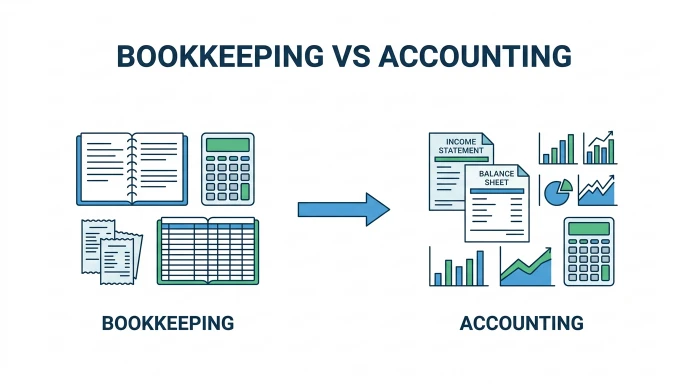
Bookkeeping records daily financial transactions, while accounting organizes, analyzes, and interprets those records to support financial decisions.
Many business owners, freelancers, and even students often wonder about the difference between bookkeeping and accounting. At first glance, they may seem identical because both deal with financial records and business transactions.
However, the difference between bookkeeping and accounting is significant and affects how financial information is managed and used.
In simple words, bookkeeping focuses on recording financial transactions, while accounting focuses on analyzing, interpreting, and reporting that information.
Understanding the difference between bookkeeping and accounting helps businesses make better financial decisions, stay compliant with tax regulations, and maintain accurate records.
In this guide, you’ll learn what bookkeeping and accounting are, how they work together, their key differences, similarities, real-world examples, common mistakes, and when to use each.
Difference Between Bookkeeping and Accounting
Bookkeeping is the process of recording daily financial transactions, while accounting involves analyzing, summarizing, and interpreting those records to guide financial decisions.
Example: A bookkeeper records a company’s sales and expenses. An accountant uses that data to prepare financial statements and evaluate business performance.
Definition of Bookkeeping and Accounting
- Bookkeeping: The systematic recording and organization of financial transactions such as sales, purchases, receipts, and payments.
- Accounting: The process of analyzing, summarizing, interpreting, and reporting financial information collected through bookkeeping.
Example: Recording a customer payment is bookkeeping. Using that payment data to create a profit-and-loss report is accounting.
Pronunciation
| Term | US Pronunciation | UK Pronunciation |
| Bookkeeping | /ˈbʊkˌkiː.pɪŋ/ | /ˈbʊkˌkiː.pɪŋ/ |
| Accounting | /əˈkaʊn.tɪŋ/ | /əˈkaʊn.tɪŋ/ |
Now that you know what each term means, let’s understand their differences in detail.
Bookkeeping vs Accounting Comparison
| Feature | Bookkeeping | Accounting |
| Primary Purpose | Records transactions | Analyzes financial data |
| Focus | Daily financial activities | Business insights and reporting |
| Complexity | Basic and procedural | More analytical and strategic |
| Financial Statements | Usually not prepared | Often prepared and reviewed |
| Decision-Making | Limited role | Major role |
| Skills Required | Data entry and organization | Financial analysis and interpretation |
| Tools Used | Ledgers, bookkeeping software | Accounting software and reporting tools |
| Business Impact | Maintains records | Supports planning and growth |
Key Differences Explained Between Bookkeeping and Accounting
1. Purpose
Bookkeeping exists to maintain accurate financial records.
Accounting exists to turn those records into useful financial insights.
Example: A retail store records sales daily through bookkeeping. Accounting helps determine if the store is profitable.
2. Level of Analysis
Bookkeeping records information.
Accounting interprets information.
Many users get confused here because both handle financial data, but accountants go beyond data entry and provide analysis.
3. Decision-Making Support
Bookkeepers maintain records.
Accountants help owners make decisions about budgeting, investments, taxes, and expansion.
Real-world example: A company deciding if to open a new branch relies on accounting reports rather than bookkeeping records alone.
4. Reporting Functions
Bookkeeping organizes data.
Accounting transforms data into reports such as:
- Income Statements
- Balance Sheets
- Cash Flow Statements
5. Educational Requirements
Bookkeeping often requires practical training and software knowledge.
Accounting generally requires advanced financial education, certifications, or professional qualifications.
6. Business Strategy Role
Bookkeepers focus on accuracy.
Accountants focus on financial strategy and long-term planning.
7. Regulatory Compliance
Bookkeeping helps maintain records.
Accounting helps ensure compliance with tax authorities and financial regulations.
8. Scope of Work
Bookkeeping is a subset of accounting.
Accounting includes bookkeeping plus analysis, forecasting, reporting, and advisory services.
What Is Bookkeeping and Why Does It Matter?
Bookkeeping is the foundation of a healthy financial system.
Without accurate bookkeeping:
- Expenses may be missed
- Revenue may be overstated
- Taxes may become difficult to calculate
- Financial reports may become unreliable
Modern businesses often use tools such as QuickBooks, Xero, and FreshBooks to automate bookkeeping tasks.
In practical use, bookkeeping acts like collecting puzzle pieces before accounting assembles the complete picture.
What Is Accounting and How Does It Work?
Accounting takes financial records and converts them into meaningful information.
Key accounting functions include:
- Financial reporting
- Tax preparation
- Budget planning
- Cash flow analysis
- Profitability assessment
- Business forecasting
For example, an accountant may identify declining profit margins even when sales are increasing.
That insight helps management take corrective action.
Why Does the Difference Between Bookkeeping and Accounting Matter for Businesses?
Understanding the difference between bookkeeping and accounting helps businesses allocate resources effectively.
A startup may begin with basic bookkeeping.
As the company grows, accounting becomes essential for:
- Investor reporting
- Tax planning
- Financial forecasting
- Risk management
In real scenarios, businesses that combine strong bookkeeping with professional accounting often make better strategic decisions.
How Technology Has Changed Bookkeeping and Accounting
Technology has transformed both fields dramatically.
Popular platforms include:
- QuickBooks
- Xero
- Sage
- Zoho Books
Even major technology companies like Google and Microsoft use sophisticated accounting systems to manage massive financial operations.
Cloud-based software now automates:
- Transaction recording
- Bank reconciliation
- Expense tracking
- Financial reporting
However, software cannot fully replace professional judgment, which remains a core accounting function.
Difference Between Bookkeeping and Accounting in Small Businesses
Small business owners often ask:
Do I need a bookkeeper or an accountant?
The answer depends on business complexity.
You Need Bookkeeping If:
- You need transaction records
- You track income and expenses
- You reconcile bank accounts
You Need Accounting If:
- You want financial analysis
- You need tax planning
- You seek growth strategies
- You require financial statements
Many businesses use both.
Difference Between Bookkeeping and Accounting for Taxes
Bookkeeping creates the records needed for tax filing.
Accounting ensures tax calculations are accurate and compliant.
For example:
A bookkeeper records deductible expenses.
An accountant determines how those deductions affect tax liability.
This distinction becomes especially important during audits and tax planning.
Difference and Similarity
| Feature | Bookkeeping | Accounting | Similarity |
| Meaning | Records transactions | Interprets financial information | Both manage financial data |
| Purpose | Maintain records | Support decisions | Both improve financial organization |
| Skills | Data recording | Financial analysis | Both require accuracy |
| Tools | Ledgers and bookkeeping software | Accounting and reporting software | Both use digital tools |
| Output | Transaction records | Financial statements | Both produce financial information |
| Timing | Daily activities | Periodic analysis | Both occur regularly |
| Users | Bookkeepers | Accountants | Both support businesses |
| Goal | Accurate records | Better decisions | Both improve financial management |
This table clearly shows the difference and similarity between bookkeeping and accounting for quick understanding.
Common Mistakes with Bookkeeping and Accounting
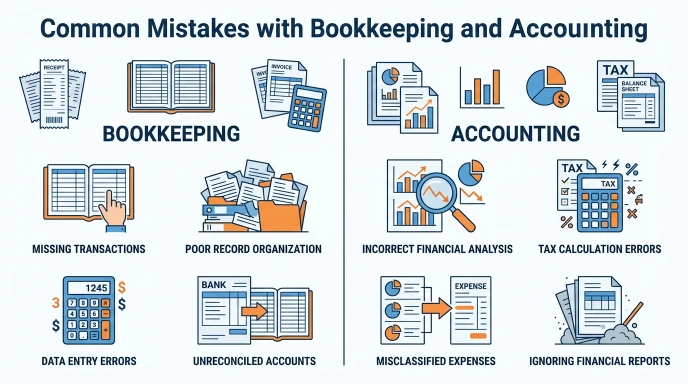
Mistake 1: Treating Them as the Same Thing
Correction: Bookkeeping records data; accounting analyzes it.
Mistake 2: Ignoring Bookkeeping Accuracy
Correction: Poor bookkeeping leads to unreliable accounting reports.
Mistake 3: Using Accounting Only During Tax Season
Correction: Accounting should support year-round decision-making.
Mistake 4: Believing Software Eliminates Accounting
Correction: Software automates tasks but cannot replace professional analysis.
Mistake 5: Waiting Too Long to Hire Help
Correction: Growing businesses benefit from professional bookkeeping and accounting support early.
Real-Life Examples with Bookkeeping and Accounting
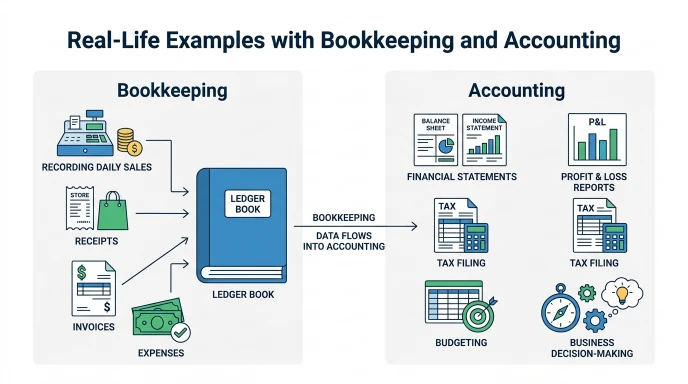
Example 1: Freelance Designer
Bookkeeping records client payments.
Accounting calculates annual profit and tax obligations.
Example 2: Retail Store
Bookkeeping tracks daily sales.
Accounting identifies seasonal trends and inventory performance.
Example 3: Startup Company
Bookkeeping organizes transactions.
Accounting prepares reports for investors.
Example 4: Manufacturing Business
Bookkeeping records supplier invoices.
Accounting evaluates production costs and profitability.
Example 5: E-commerce Store
Bookkeeping tracks online sales.
Accounting analyzes customer acquisition costs and margins.
When to Use Each
Use Bookkeeping When:
- Recording transactions
- Tracking expenses
- Managing invoices
- Reconciling bank accounts
Use Accounting When:
- Planning growth
- Preparing taxes
- Evaluating performance
- Making strategic decisions
The best approach is often using both together.
Why People Get Confused in Bookkeeping and Accounting
Several factors create confusion:
- Both deal with financial information
- Software often combines both functions
- Job descriptions sometimes overlap
- Small businesses may have one person doing both roles
In simple words, bookkeeping gathers the data, while accounting explains what the data means.
How Search Engines Understand Bookkeeping and Accounting User Intent
When users search “difference between bookkeeping and accounting,” search engines like Google Search recognize comparison intent.
The algorithm looks for content that answers:
- What is bookkeeping?
- What is accounting?
- Which is better?
- Which does a business need?
Content that provides clear comparisons, examples, tables, and practical guidance tends to satisfy user intent more effectively.
Platforms like YouTube and business education channels also reinforce these concepts through visual explanations and tutorials.
Expert Insight
As someone experienced in financial operations and business reporting workflows, one practical observation stands out:
Businesses rarely fail because of accounting software. They often struggle because they misunderstand the relationship between bookkeeping and accounting.
In real scenarios, successful organizations build strong bookkeeping processes first. Once accurate data exists, accounting can generate reliable insights that support growth, profitability, and compliance.
Think of bookkeeping as collecting accurate ingredients and accounting as preparing the final meal. One cannot function effectively without the other.
FAQs
Is bookkeeping the same as accounting?
No. Bookkeeping records financial transactions, while accounting analyzes and reports financial information.
Which comes first, bookkeeping or accounting?
Bookkeeping comes first because accounting relies on recorded financial data.
Can a small business survive with only bookkeeping?
For a short time, yes. Long-term growth usually requires accounting insights.
Is accounting harder than bookkeeping?
Generally, yes. Accounting involves analysis, interpretation, and strategic decision-making.
Can software replace bookkeepers?
Software automates tasks but still requires oversight and accuracy checks.
Can software replace accountants?
Not completely. Professional judgment and financial strategy remain essential.
Which career pays more?
Accounting positions generally offer higher salaries because of analytical and advisory responsibilities.
Do accountants do bookkeeping?
Some accountants perform bookkeeping, especially in small businesses, but their responsibilities extend much further.
What software is commonly used?
QuickBooks, Xero, Sage, FreshBooks, and Zoho Books are among the most popular solutions.
Why is accurate bookkeeping important?
Because accounting reports are only as reliable as the underlying financial records.
Conclusion
Understanding the difference between bookkeeping and accounting is essential for anyone managing finances, running a business, or pursuing a career in finance. While the two functions are closely connected, they serve different purposes.
Bookkeeping focuses on recording and organizing financial transactions. Accounting takes those records and transforms them into meaningful reports, insights, and strategies. One provides the data; the other provides the interpretation.
Most beginners assume they are the same, but in practical business environments, each plays a distinct role. Accurate bookkeeping creates a solid financial foundation, while accounting helps businesses evaluate performance, plan growth, manage taxes, and make informed decisions.
If you remember one thing, remember this: bookkeeping tells you what happened, and accounting tells you what it means. Together, they form the backbone of effective financial management and long-term business success.
Read more about!
Difference Between Quid and Pound: Are They Really the Same?
Difference Between Fate and Destiny: Clear Guide

I am James Carter, a professional content writer from the United States. I specialize in writing simple and clear comparison blogs that help students and readers understand difficult topics easily. My writing focuses on everyday language, education, science, and lifestyle topics. I believe that learning should be easy for everyone, so I use simple words and real-life examples in my articles.