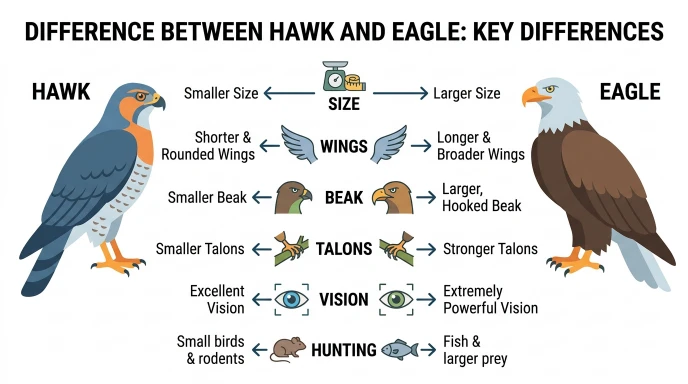
Hawks are generally smaller, faster, and more agile, while eagles are larger, stronger, and known for their powerful soaring flight.
Have you ever spotted a large bird soaring in the sky and wondered if it was a hawk or an eagle? Many people struggle to identify these powerful birds of prey because they share similar features.
However, the difference between hawk and eagle becomes much clearer once you understand their size, hunting behavior, habitat, and physical characteristics.
In simple words, eagles are generally larger, stronger, and more powerful than hawks. Hawks tend to be smaller, faster, and more agile hunters.
Understanding the difference between hawk and eagle helps birdwatchers, students, wildlife enthusiasts, and nature photographers correctly identify these fascinating raptors.
This guide covers everything you need to know about the difference between hawk and eagle, including definitions, comparisons, real-life examples, similarities, and expert insights.
Difference Between Hawk and Eagle
The main difference between hawk and eagle is size and power. Eagles are larger birds with stronger talons and broader wings, while hawks are generally smaller, more agile, and adapted for quick hunting.
Example: A bald eagle can weigh more than 14 pounds, while a red-tailed hawk typically weighs between 2 and 4 pounds.
Definition of Hawk and Eagle
- Hawk: A medium-sized bird of prey known for speed, agility, and sharp eyesight. Hawks often hunt small mammals, reptiles, and birds.
- Eagle: A large bird of prey with powerful talons, strong beaks, and impressive wingspans. Eagles typically hunt larger prey and dominate their ecosystems.
Example: A red-tailed hawk hunts rabbits, while a bald eagle may catch fish or larger animals.
Pronunciation
| Term | US Pronunciation | UK Pronunciation |
| Hawk | /hɔːk/ | /hɔːk/ |
| Eagle | /ˈiːɡəl/ | /ˈiːɡəl/ |
Now that you know what each bird is, let’s explore the key differences that separate hawks from eagles.
Hawk vs Eagle: Comparison
| Feature | Hawk | Eagle |
| Size | Smaller | Larger |
| Weight | Usually 1–5 lbs | Often 6–15+ lbs |
| Wingspan | Shorter | Much wider |
| Strength | Strong | Extremely powerful |
| Talons | Sharp | Larger and stronger |
| Hunting Style | Fast and agile | Powerful and dominant |
| Prey Size | Small to medium animals | Medium to large animals |
| Lifespan | Generally shorter | Often longer |
Key Differences Explained Between Hawk and Eagle
1. Size and Body Structure
One of the easiest ways to spot the difference between hawk and eagle is size.
Eagles have larger bodies, broader chests, and wider wings. Hawks appear slimmer and lighter.
Real-world example: If two birds are circling high above and one looks significantly larger, it is often the eagle.
2. Strength and Power
Eagles possess some of the strongest grips in the bird world.
Their talons can exert tremendous pressure, allowing them to capture larger prey.
Hawks are powerful too but rely more on speed and maneuverability.
3. Hunting Style
Hawks often ambush prey with quick dives and rapid movements.
Eagles typically use power and endurance to dominate prey.
Many beginners confuse the two because both are skilled hunters.
4. Wingspan
Eagles usually have broader wings designed for soaring over long distances.
Hawks often have narrower wings that help them navigate forests and tighter spaces.
5. Habitat Preferences
Hawks are found in forests, grasslands, suburbs, and cities.
Eagles often prefer open areas near lakes, rivers, mountains, and coastlines.
6. Diet
Hawks commonly eat:
- Rabbits
- Rodents
- Snakes
- Small birds
Eagles commonly eat:
- Fish
- Waterfowl
- Mammals
- Larger prey animals
7. Flight Characteristics
Hawks tend to flap more frequently and make rapid turns.
Eagles glide and soar for extended periods with minimal wing movement.
8. Symbolic Importance
Eagles often symbolize power, leadership, and freedom.
For example, the Bald Eagle serves as a national symbol in the United States.
Hawks often symbolize focus, awareness, and precision.
What Is a Hawk and Why Is It Unique?
Hawks belong to a group of raptors known for exceptional agility.
Their key advantages include:
- Fast acceleration
- Sharp eyesight
- Excellent maneuverability
- Efficient hunting in forests and open fields
In practical use, hawks are often easier to spot in suburban neighborhoods because they adapt well to human environments.
What Is an Eagle and How Does It Survive?
Eagles represent some of the largest birds of prey on Earth.
Well-known species include:
- Bald Eagle
- Golden Eagle
Their survival depends on:
- Exceptional eyesight
- Powerful talons
- Large territories
- Strong flight capabilities
An eagle can spot prey from remarkable distances while soaring high overhead.
Why Does the Difference Between Hawk and Eagle Matter?
Understanding the difference between hawk and eagle helps:
- Birdwatchers identify species correctly
- Wildlife photographers capture accurate records
- Students learn ecology and biology
- Conservationists monitor bird populations
In real scenarios, proper identification contributes to wildlife conservation programs and species tracking efforts.
Difference Between Hawk and Eagle in Hunting Behavior
Hawks and eagles both hunt, but they do so differently.
Hawks
- Attack quickly
- Use surprise
- Hunt smaller prey
- Navigate dense habitats
Eagles
- Use strength
- Target larger prey
- Soar over large territories
- Dominate open landscapes
Think of a hawk as a skilled sprinter and an eagle as a powerful heavyweight champion.
Difference Between Hawk and Eagle in Size and Appearance
A common question is:
How can I identify a hawk or eagle from a distance?
Look for:
Hawk Characteristics
- Compact body
- Narrow wings
- Smaller head
- Faster wing beats
Eagle Characteristics
- Massive body
- Broad wings
- Large beak
- Slow soaring flight
These visual clues help birdwatchers make quick identifications.
Difference and Similarity
| Feature | Hawk | Eagle | Similarity |
| Classification | Bird of prey | Bird of prey | Both are raptors |
| Eyesight | Extremely sharp | Extremely sharp | Both rely on vision |
| Hunting | Agile attacks | Powerful attacks | Both are predators |
| Beak | Hooked beak | Hooked beak | Used for tearing prey |
| Talons | Sharp claws | Larger claws | Both capture prey |
| Habitat | Diverse environments | Open territories | Both live in wild habitats |
| Flight | Fast and agile | Soaring and powerful | Both are skilled flyers |
| Diet | Small animals | Larger animals | Both are carnivorous |
This table clearly shows the difference and similarity between hawk and eagle for quick understanding.
Common Mistakes with Hawk and Eagle
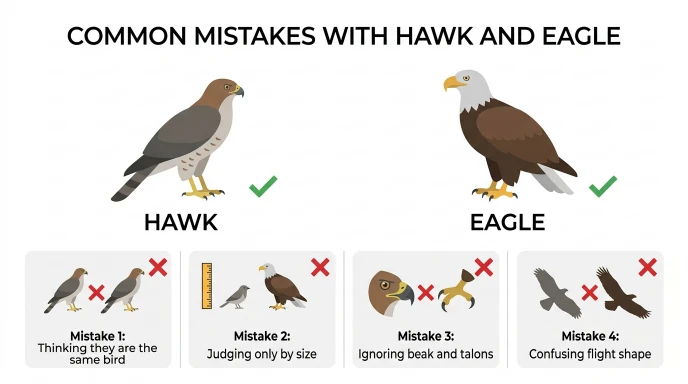
Mistake 1: Assuming All Large Birds Are Eagles
Correction: Many large birds seen in the sky are actually hawks.
Mistake 2: Judging Only by Color
Correction: Color varies among species and is not a reliable identifier.
Mistake 3: Ignoring Wingspan
Correction: Wingspan often provides a better clue than body color.
Mistake 4: Assuming Eagles Are Faster
Correction: Hawks are often more agile and faster during short pursuits.
Mistake 5: Confusing Juveniles
Correction: Young eagles can resemble large hawks.
Real-Life Examples with Hawk and Eagle
Example 1: Birdwatching
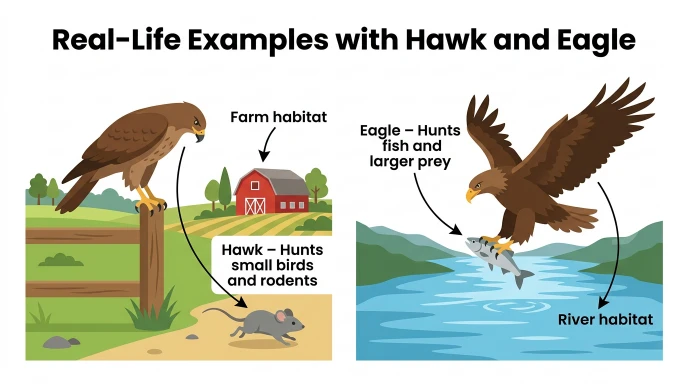
A birder sees a large soaring bird near a lake. The broad wings suggest an eagle.
Example 2: Backyard Observation
A smaller bird catches a squirrel in a suburban neighborhood. It is likely a hawk.
Example 3: Wildlife Photography
Photographers often distinguish eagles by their massive wingspan and slower flight patterns.
Example 4: Conservation Studies
Researchers monitor eagle nesting territories near rivers and coastlines.
Example 5: Educational Programs
Schools use hawk and eagle comparisons to teach food chains and predator behavior.
When to Use Each Identification
Identify a Hawk When:
- The bird appears medium-sized
- It moves quickly through trees
- It hunts small prey
- It frequently flaps its wings
Identify an Eagle When:
- The bird appears very large
- It glides effortlessly
- It has a broad wingspan
- It is near large bodies of water
Why People Get Confused Between Hawk and Eagle
Several reasons explain the confusion:
- Similar body shape
- Both are birds of prey
- Distance makes size difficult to judge
- Juvenile eagles often resemble hawks
- Media and photographs can distort scale
Many users get confused because they focus on color instead of size and flight behavior.
How Search Engines Understand Hawk and Eagle User Intent
When people search “difference between hawk and eagle,” platforms like Google recognize comparison intent.
Users typically want answers to:
- What is a hawk?
- What is an eagle?
- Which bird is bigger?
- How can I identify them?
Educational videos on YouTube and wildlife photography shared through Instagram often reinforce visual differences, helping users understand species identification more effectively.
Expert Insight
From a wildlife observation perspective, the most reliable way to distinguish hawks from eagles is not color it’s overall size, wing shape, and flight style.
Most beginners focus on feather patterns. Experienced birdwatchers focus on silhouette and behavior.
In practical use, if a bird looks exceptionally large, soars effortlessly, and dominates the sky with broad wings, it is often an eagle. If it appears agile, compact, and quick-moving, it is more likely a hawk.
This simple observation method works surprisingly well in the field.
FAQs
Is a hawk bigger than an eagle?
No. Eagles are generally much larger than hawks.
Which bird is stronger?
Eagles are stronger and possess more powerful talons.
Can hawks and eagles live in the same area?
Yes. Their habitats can overlap.
Which bird has better eyesight?
Both have exceptional eyesight, though large eagles can spot prey from incredible distances.
Are hawks faster than eagles?
In short bursts and tight turns, hawks are often more agile.
What do hawks eat?
They commonly eat rodents, rabbits, reptiles, and small birds.
What do eagles eat?
Many eagles eat fish, mammals, and larger prey animals.
Is a bald eagle a hawk?
No. A bald eagle is an eagle species.
Are hawks dangerous to humans?
Healthy wild hawks rarely pose a threat to humans.
Which bird is easier to see in cities?
Hawks are generally more common in urban and suburban environments.
Conclusion
Understanding the difference between hawk and eagle becomes much easier when you focus on size, strength, hunting style, and flight behavior. While both birds are powerful raptors with sharp eyesight and hooked beaks, eagles are typically larger, stronger, and better suited for capturing bigger prey. Hawks, on the other hand, excel in speed, agility, and maneuverability.
For birdwatchers, students, photographers, and wildlife enthusiasts, recognizing these distinctions can improve species identification and deepen appreciation for nature. Remember that appearance alone can sometimes be misleading, especially when observing birds from a distance. Looking at wingspan, body size, and flight patterns often provides the most reliable clues.
In simple words, hawks are agile hunters, while eagles are powerful soaring predators. Knowing the difference between hawk and eagle helps you better understand two of the most fascinating birds in the natural world.
Read more about!
Difference Between Wire and ACH: Complete Banking Guide
Difference Between Principal and Principle: Easy Guide

I am Emily Johnson, a USA-based content writer who creates easy-to-read blogs on language and daily life topics. I explain complex ideas in simple English for students and beginners so they can understand easily.