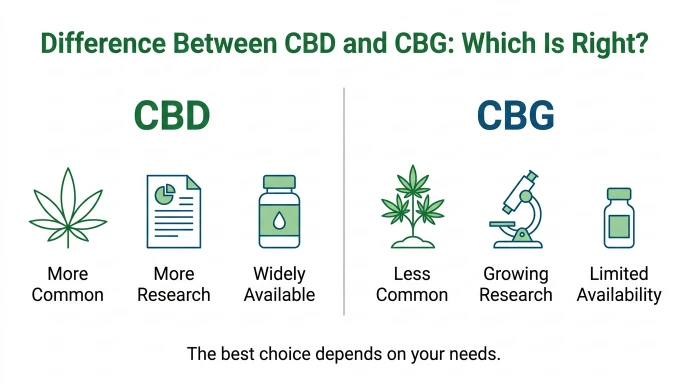
CBD is more common and better studied, while CBG is less common and still being researched.
If you’ve been exploring hemp or wellness products, you’ve probably come across CBD and CBG. People often compare CBD and CBG because they sound similar but are different.
CBD (Cannabidiol) is a common, non-intoxicating compound found in hemp. CBG (Cannabigerol) is known as the “mother cannabinoid” because other cannabinoids come from it.
This guide explains the difference between CBD and CBG, how they work, their uses, and when one might be better than the other.
Note: Research on cannabinoids is ongoing. CBD and CBG products are not approved to treat most medical conditions, and their effects can vary from person to person.
Always talk to a doctor before using cannabinoid products, especially if you are taking medicines.
Difference Between CBD and CBG
CBD is common in hemp and used in wellness products, while CBG is rarer and is the base compound that forms other cannabinoids.
For example, CBD products are easy to find in most stores, while CBG products are rarer and often cost more because they are harder to produce.
Definition of CBD and CBG
CBD (Cannabidiol):
CBD is a naturally occurring, non-intoxicating cannabinoid found in hemp and cannabis plants. It is commonly used in oils, capsules, gummies, creams, and other wellness products.
CBG (Cannabigerol):
CBG is another naturally occurring, non-intoxicating cannabinoid found in hemp and cannabis. It is called the “mother cannabinoid” because many cannabinoids like CBD and THC come from its original form (CBGA) in the plant.
Pronunciation
| Term | US Pronunciation | UK Pronunciation |
| CBD | See-Bee-Dee (/ˌsiː.biːˈdiː/) | See-Bee-Dee (/ˌsiː.biːˈdiː/) |
| CBG | See-Bee-Gee (/ˌsiː.biːˈdʒiː/) | See-Bee-Gee (/ˌsiː.biːˈdʒiː/) |
Now that you know the basics, let’s look at the difference between CBD and CBG in more detail and see how they compare.
Difference Between CBD and CBG : Comparison
| Feature | CBD | CBG |
| Full Name | Cannabidiol | Cannabigerol |
| Natural Abundance | Found in higher amounts in mature hemp | Found in much smaller amounts |
| Origin in the Plant | Develops from CBGA during plant growth | Derived from CBGA and considered the “parent” cannabinoid |
| Availability | Widely available | Less common and often more expensive |
| Product Types | Oils, gummies, capsules, creams, beverages | Oils, capsules, gummies, tinctures |
| Production Cost | Generally lower | Higher due to lower natural concentration |
| Research | More extensively studied | Growing but more limited research |
| Psychoactive Effects | Non-intoxicating | Non-intoxicating |
| Popularity | Very popular worldwide | Increasing popularity |
| Best Known For | Broad availability and extensive research | Unique role in cannabinoid development |
Key Differences Explained Between CBD and CBG
1. Natural Abundance
The biggest difference between CBD and CBG is how much of each cannabinoid is naturally present in mature hemp plants.
CBD is found in relatively high concentrations, making it easier and more affordable to extract.
CBG usually appears in much smaller amounts because much of it is converted into other cannabinoids as the plant matures.
Real-life example:
A hemp farmer may grow plants to get more CBD, while CBG needs special growing methods and is usually harvested earlier.
2. Role in Plant Development
Another important difference is how these cannabinoids develop.
CBG begins as CBGA (Cannabigerolic Acid), often referred to as the “mother cannabinoid.”
As the hemp plant grows, CBGA changes into CBD, THC, and other cannabinoids.
User insight:
Many people think CBD and CBG are unrelated, but CBG actually helps form other cannabinoids early in the plant’s growth.
3. Product Availability
CBD products are available almost everywhere hemp products are sold.
You can commonly find CBD in:
- Oils
- Gummies
- Capsules
- Topical creams
- Beverages
- Pet products
CBG products are less widely available because producing sufficient quantities is more challenging.
4. Cost
CBD products are generally less expensive due to greater supply and more efficient production.
CBG products often cost more because manufacturers extract smaller amounts of CBG from each plant.
Example:
Two hemp oils with similar bottle sizes may have noticeably different prices simply because one contains CBG.
5. Research and Scientific Interest
CBD has been studied more than CBG, so we know more about how it works.
Research on CBG is increasing, but scientists are still studying its possible effects.
Important note:
Early research looks promising, but more human studies are needed before any clear conclusions about CBG uses can be made.
6. Market Popularity
CBD has become a mainstream ingredient in the global wellness market.
CBG is newer for consumers but is becoming more popular as more hemp products are made with it.
People searching for alternative hemp compounds often compare CBD and CBG before making a purchase.
Why Does the Difference Between CBD and CBG Matter?
Knowing the difference between CBD and CBG helps people choose hemp products more easily and know what to expect.
For example:
- Someone purchasing a widely available hemp oil will likely encounter CBD products first.
- A wellness enthusiast interested in exploring less common cannabinoids may look for CBG products.
- Many products mix CBD and CBG together to make broad or multi-cannabinoid formulas.
- Checking product labels carefully helps you see which cannabinoids are inside and how much is included.
It helps you compare products using ingredients, price, availability, and real research instead of ads.
How Does CBD Work?
Like CBD, CBG also works with the body’s endocannabinoid system, but scientists are still learning how it is different.
CBG may work a bit differently from CBD in the body, but scientists are still studying it.
Here’s a simplified overview:
- CBD enters the body.
- It interacts with components of the endocannabinoid system.
- It may influence signaling pathways involved in normal body functions.
- The body processes and eliminates CBD naturally over time.
Why many people choose CBD
- Widely available
- Non-intoxicating
- Found in many product types
- Supported by a larger body of research than many other cannabinoids
- Easy to find in health and wellness markets
Mini Summary
CBD is the most common hemp cannabinoid because it is easy to find, non-intoxicating, and used in many products.
How Does CBG Work?
Like CBD, CBG also works with the body’s endocannabinoid system, but scientists are still learning how it is different.
CBG may affect cannabinoid receptors and other body systems differently than CBD, but research is still ongoing.
Here’s a simplified overview:
- CBG enters the body.
- It interacts with parts of the endocannabinoid system.
- Researchers continue studying its biological activity.
- The body metabolizes and removes CBG naturally.
Advantages of CBG
- Non-intoxicating
- Naturally occurring cannabinoid
- Growing scientific interest
- Often included in premium hemp formulations
- Can be combined with CBD in multi-cannabinoid products
Mini Summary
CBG is a natural cannabinoid in hemp that is getting more attention for its unique role and possible uses, but it is not studied as much as CBD yet.
Why Choose CBD Instead of CBG?
Many people compare CBD and CBG before buying a hemp-derived product. Both CBD and CBG do not cause a “high,” but CBD is used more often because it is easier to find and has more research behind it.
1. Easier to Find
CBD products are sold by many reputable brands in physical stores and online.
Common product types include:
- Oils and tinctures
- Gummies
- Capsules
- Topical creams
- Beverages
- Pet products
Example: A first-time buyer looking for a hemp supplement will usually find far more CBD options than CBG.
2. More Scientific Research
CBD has been studied more than CBG, so researchers know more about its safety, effects, and uses.
Although research is ongoing, CBD currently has more published human studies than CBG.
3. More Affordable
Because CBD is naturally more abundant in hemp plants, manufacturers can produce it more efficiently.
This generally results in lower prices compared with similar CBG products.
4. Greater Product Variety
CBD comes in many forms, strengths, and flavors to suit different needs.
This makes it easier to find a product that fits personal preferences.
Why Choose CBG Instead of CBD?
CBG is less common, but more people are becoming interested in trying it.
1. Unique Cannabinoid Profile
CBG is chemically different from CBD and plays a unique role in cannabinoid development within the hemp plant.
Some consumers specifically seek products containing CBG because they want broader cannabinoid diversity.
2. Increasing Scientific Interest
Researchers continue investigating CBG’s biological activity and how it differs from CBD.
While evidence is still developing, scientific interest in CBG has grown rapidly in recent years.
3. Premium Hemp Products
Many premium hemp formulas combine CBD and CBG rather than relying on a single cannabinoid.
These products are made for people who want different natural hemp compounds.
Difference and Similarity
| Feature | CBD | CBG | Similarity |
| Origin | Produced from CBGA during plant growth | Begins as CBGA, the precursor to many cannabinoids | Both occur naturally in hemp and cannabis plants. |
| Psychoactive Effect | Non-intoxicating | Non-intoxicating | Neither produces the “high” associated with THC. |
| Availability | Widely available | Less common | Both are sold in oils, capsules, and gummies. |
| Research | More extensive | Growing but more limited | Both continue to be studied by researchers. |
| Cost | Usually less expensive | Often more expensive | Prices vary by brand and formulation. |
| Source | Hemp and cannabis | Hemp and cannabis | Both are naturally occurring cannabinoids. |
| Product Forms | Oils, gummies, creams, capsules | Oils, tinctures, capsules, gummies | Both are available in multiple delivery methods. |
| Legal Status | Depends on local laws | Depends on local laws | Regulations vary by country and region. |
This table clearly shows the difference and similarity between CBD and CBG for quick understanding.
Common Mistakes with CBD and CBG
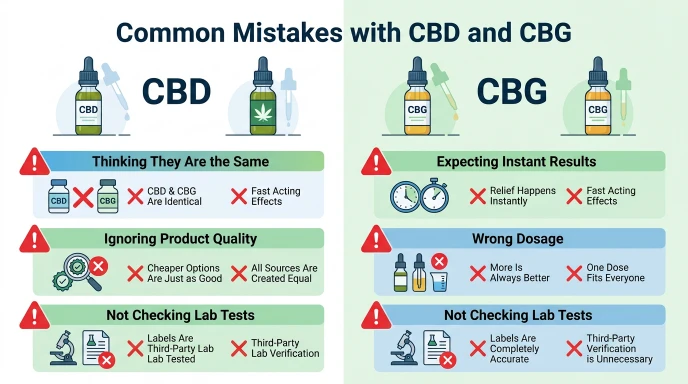
Many beginners misunderstand how cannabinoids work. Avoiding these common mistakes can help you make more informed decisions.
Mistake 1: Thinking CBD and CBG Are the Same
Although both are cannabinoids, they are different natural compounds with distinct chemical structures.
Correction:
Read product labels carefully to identify which cannabinoids are included.
Mistake 2: Assuming More Is Always Better
Some people believe higher cannabinoid concentrations automatically produce better results.
Correction:
These products are made for people who want different natural hemp compounds.
Mistake 3: Believing All Research Is Conclusive
Many online articles present preliminary findings as proven facts.
Correction:
Choose information backed by research, as cannabinoid science is still growing.
Mistake 4: Ignoring Third-Party Lab Testing
Not every hemp product has been independently tested.
Correction:
Choose products with transparent third-party laboratory reports that verify cannabinoid content and purity.
Mistake 5: Overlooking Drug Interactions
Some consumers assume hemp-derived products cannot interact with medications.
Correction:
Talk to a healthcare professional before using CBD or CBG, especially if you take prescription medicine.
Real-Life Examples with CBD and CBG
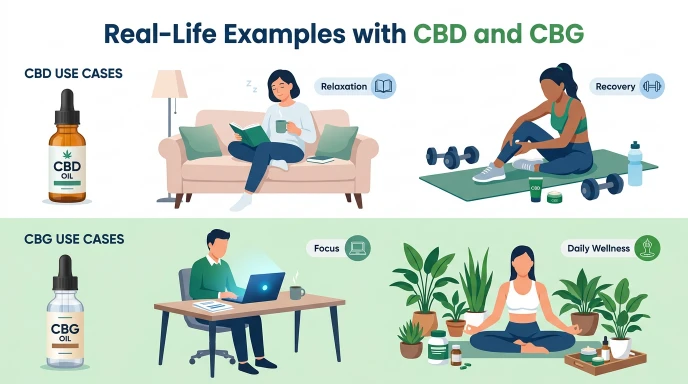
Example 1: First-Time Consumer
A person visiting a wellness store wants to try a hemp-derived product.
Likely choice: CBD
Reason: Greater availability and wider product selection.
Example 2: Experienced Hemp User
Someone already familiar with CBD decides to explore products containing additional cannabinoids.
Likely choice: CBG or a CBD + CBG combination.
Example 3: Wellness Brand
A company develops a premium hemp oil containing several cannabinoids.
The formula includes both CBD and CBG to create a multi-cannabinoid product.
Example 4: Scientific Research
A university research team studies how different cannabinoids interact with biological systems.
Both CBD and CBG become subjects of laboratory investigation.
Example 5: Online Shopping
A consumer compares two hemp oils with similar ingredients.
One contains only CBD, while the other combines CBD and CBG, resulting in a higher price.
When to Use Each
CBD May Be a Better Choice When:
- You’re looking for the widest product selection.
- You want a cannabinoid with more published research.
- Budget is an important consideration.
- You’re purchasing your first hemp-derived product.
CBG May Be Worth Considering When:
- You’re interested in exploring additional cannabinoids.
- You prefer products containing multiple hemp compounds.
- You’re comfortable paying a premium for less common formulations.
- You understand that research is still developing.
Why People Get Confused About the Difference Between CBD and CBG
Several reasons contribute to the confusion.
Similar Names
Both abbreviations begin with “CB,” making them easy to mix up.
Same Plant Source
CBD and CBG both come from hemp and cannabis plants.
This causes many people to assume they are identical compounds.
Marketing Claims
Some advertisements exaggerate differences or benefits without sufficient scientific evidence.
Consumers should always distinguish marketing language from established research.
Social Media Content
Videos on YouTube, wellness discussions on Instagram, and posts shared across Meta platforms often compare CBD and CBG. Check online claims with trusted scientific sources, as not all information is accurate.
How Search Engines Understand “Difference Between CBD and CBG” and User Intent
Search engines such as Google analyze more than the words in a query they try to understand why someone is searching.
For example:
- “Difference between CBD and CBG” usually reflects informational intent.
- “CBD vs CBG benefits” often indicates product comparison before purchasing.
- “Which is better CBD or CBG?” suggests decision-making intent.
- “What is CBG?” shows a beginner seeking foundational knowledge.
Google prefers content that clearly explains hemp, cannabinoids, product quality, and testing.
Expert Insight
CBD and CBG are different cannabinoids with different properties.
CBD has a larger body of published research and is widely available, making it the cannabinoid most consumers encounter first. CBG is found in smaller amounts and has been studied less, but researchers are interested in it because of its unique role and properties.
FAQs
1. What is the main difference between CBD and CBG?
CBD is the main non-intoxicating cannabinoid in hemp, while CBG is found in smaller amounts and helps form other cannabinoids.
2. Which is better, CBD or CBG?
Neither is universally better. CBD is more common and better studied, while CBG is still being researched. The best choice depends on your needs and a healthcare professional’s advice.
3. Do CBD and CBG make you feel high?
No. Both CBD and CBG are non-intoxicating cannabinoids. Unlike THC, they do not produce the psychoactive “high” commonly associated with cannabis.
4. Can CBD and CBG be taken together?
Yes. Many hemp-derived products combine CBD and CBG in a single formula. These multi-cannabinoid products are designed to include more than one naturally occurring cannabinoid.
5. Why is CBG more expensive than CBD?
CBG is naturally found in much smaller amounts in hemp plants, making it more difficult and costly to cultivate and extract. This usually results in higher retail prices.
6. Is CBG stronger than CBD?
Not necessarily. It is not accurate to say one is “stronger” because CBD and CBG are different cannabinoids with different chemical properties. Current research does not support a simple stronger-versus-weaker conclusion.
7. Are CBD and CBG legal?
Their legal status depends on your country’s laws and local regulations. In many regions, hemp-derived CBD and CBG products are legal if they meet THC limits, but laws vary worldwide.
8. What products contain CBD and CBG?
Both cannabinoids are available in:
- Oils and tinctures
- Capsules
- Gummies
- Softgels
- Topical creams
- Wellness formulations
Some products contain only CBD, while others combine CBD, CBG, and additional cannabinoids.
9. Why do people compare CBD and CBG?
People compare them because both are naturally occurring, non-intoxicating cannabinoids derived from hemp. Consumers often want to understand their differences before purchasing a product.
10. What should I look for before buying CBD or CBG?
Choose products that provide:
- Third-party laboratory testing
- Clear cannabinoid content
- Transparent ingredient lists
- Reputable manufacturer information
- Compliance with local regulations
These factors are often more important than marketing claims.
Conclusion
Knowing the difference between CBD and CBG helps you choose hemp products more wisely. Both are natural, non-intoxicating cannabinoids, but they differ in availability, research, and price.
CBD is more common and better studied, making it a popular choice. CBG is found in smaller amounts and is gaining attention in scientific research.
As interest in hemp continues to grow in 2026, you’ll likely see more products containing CBD, CBG, or combinations of both. Research is still growing, so don’t rely only on ads. Choose products with lab testing, clear ingredients, and healthcare professional guidance.
Ultimately,CBD and CBG are different cannabinoids. Learn how they differ and choose products based on your needs and trusted scientific information.
Read more about!
Difference Between Inverter and Generator: Which Is Better?
Difference Between Hawk and Eagle: Key Differences

I am Emily Johnson, a USA-based content writer who creates easy-to-read blogs on language and daily life topics. I explain complex ideas in simple English for students and beginners so they can understand easily.