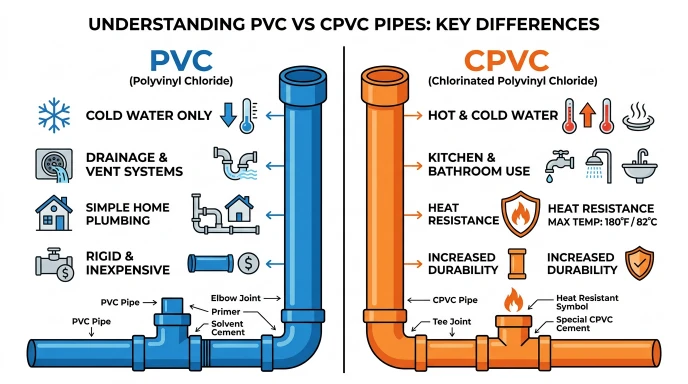
PVC is best for cold water, drainage, and irrigation, while CPVC is better for hot water and high-temperature plumbing.
Choosing the right pipe material can be confusing, especially when comparing PVC and CPVC. Many people search for the difference between PVC and CPVC because they look similar but have different uses.
Simply put, PVC is best for cold water and drainage systems, while CPVC can handle both hot and cold water because it resists higher temperatures.
This guide explains their key differences, uses, benefits, and how to choose the right one.
Difference Between PVC and CPVC
The main difference between PVC and CPVC is that PVC is used for cold water, while CPVC is used for both hot and cold water.
Example: A garden irrigation system usually uses PVC pipes, while the hot-water line inside a home is commonly made from CPVC pipes.
Definition of PVC and CPVC
PVC (Polyvinyl Chloride):
PVC is a strong, lightweight plastic pipe used for cold water, drainage, irrigation, and electrical wiring.
CPVC (Chlorinated Polyvinyl Chloride):
CPVC is a modified form of PVC that contains extra chlorine, making it more resistant to heat, pressure, and chemicals. It is widely used for residential and commercial hot- and cold-water plumbing.
Pronunciation
| Term | US Pronunciation | UK Pronunciation |
| PVC | Pee-Vee-See (/ˌpiː.viːˈsiː/) | Pee-Vee-See (/ˌpiː.viːˈsiː/) |
| CPVC | See-Pee-Vee-See (/ˌsiː.piː.viːˈsiː/) | See-Pee-Vee-See (/ˌsiː.piː.viːˈsiː/) |
Now, let’s look at the key differences between PVC and CPVC to help you choose the right pipe.
Difference Between PVC and CPVC: Comparison
| Feature | PVC | CPVC |
| Full Form | Polyvinyl Chloride | Chlorinated Polyvinyl Chloride |
| Heat Resistance | Suitable for cold water only | Suitable for hot and cold water |
| Maximum Temperature | Around 140°F (60°C) | Around 200°F (93°C) |
| Chemical Composition | Standard PVC resin | PVC resin with added chlorine |
| Common Applications | Drainage, irrigation, sewer systems | Residential and commercial plumbing |
| Cost | Less expensive | Slightly more expensive |
| Pressure Handling | Good for standard applications | Better for high-temperature pressure systems |
| Installation | Easy using PVC cement | Requires CPVC-specific primer and cement |
| Color | Usually white or gray | Usually cream or light beige |
| Best For | Outdoor and cold-water projects | Indoor hot- and cold-water supply |
Key Differences Explained Between PVC and CPVC
1. Heat Resistance
The biggest difference between PVC and CPVC is how much heat they can safely handle.
PVC performs well with cold water but begins to soften when exposed to higher temperatures.
CPVC is chemically modified with extra chlorine, allowing it to carry hot water without losing its strength.
Real-life example: A cold-water pipe may use PVC, while a hot-water pipe usually uses CPVC.
2. Chemical Composition
Although they look alike, their chemical structures are different.
PVC is manufactured using polyvinyl chloride resin.
CPVC goes through an additional chlorination process, increasing its chlorine content. This improves its resistance to heat, chemicals, and corrosion.
User insight: Many beginners assume CPVC is simply a thicker PVC pipe, but the real difference lies in the material itself.
3. Temperature Performance
Temperature is one of the most important factors when selecting piping materials.
PVC works efficiently in cool environments and standard water supply systems.
CPVC works well for hot water in showers, kitchens, and buildings.
Example: PVC can bend with hot water, but CPVC is designed for hot-water pipes.
4. Cost
PVC is generally more affordable than CPVC.
If your project only requires cold-water transportation or drainage, PVC often provides the best value.
CPVC is slightly more expensive because it resists high temperatures.
Example: PVC is commonly used in farm irrigation because it’s durable and affordable.
5. Installation Process
Both materials are relatively easy to install, but they require different adhesives.
PVC pipes use PVC primer and solvent cement.
CPVC requires cement specifically formulated for CPVC to ensure a secure, leak-free joint.
Using the wrong adhesive can weaken the connection and increase the risk of leaks.
6. Typical Applications
Another important difference between PVC and CPVC is where each material is commonly used.
PVC is widely installed in:
- Drainage systems
- Irrigation networks
- Sewer lines
- Vent pipes
- Electrical conduit
CPVC is commonly used for:
- Residential hot-water plumbing
- Cold-water supply
- Commercial buildings
- Hospitals
- Industrial fluid systems
Choosing the correct pipe for its intended purpose improves both safety and long-term performance.
Why Does the Difference Between PVC and CPVC Matter?
At first glance, PVC and CPVC pipes appear almost identical. However, choosing the wrong material can lead to plumbing problems and expensive repairs.
For example:
- A homeowner replacing a kitchen hot-water pipe should choose CPVC.
- A farmer installing an irrigation system usually benefits from the lower cost of PVC.
- A commercial building with high-temperature water systems often relies on CPVC.
- Underground drainage systems commonly use PVC because heat resistance isn’t necessary.
Knowing the difference between PVC and CPVC helps you choose the right pipe and avoid costly mistakes.
How Does PVC Work?
PVC pipes transport liquids without corroding or rusting.
Here’s how they work:
- Cold water or wastewater enters the pipe.
- The smooth inner surface minimizes friction.
- Water flows efficiently through the piping system.
- The rigid plastic resists corrosion, chemicals, and moisture.
- Properly installed joints create leak-resistant connections.
Why many people choose PVC
- Affordable
- Lightweight
- Easy to cut and install
- Corrosion-resistant
- Excellent for drainage and irrigation
- Long service life with minimal maintenance
Mini Summary
PVC is a low-cost, reliable pipe for cold water, drainage, and irrigation.
How Does CPVC Work?
CPVC functions similarly to PVC but is engineered to withstand much higher temperatures.
Extra chlorine makes CPVC strong enough for both hot and cold water.
Here’s how CPVC works:
- Hot or cold water enters the piping system.
- The chlorinated material resists heat and pressure.
- Water flows through smooth, corrosion-resistant pipes.
- Leak-resistant solvent-welded joints maintain system integrity.
- The pipe continues performing reliably even in high-temperature plumbing applications.
Advantages of CPVC
- Handles hot and cold water
- Higher heat resistance
- Excellent chemical resistance
- Corrosion-free performance
- Long lifespan
- Suitable for residential, commercial, and industrial plumbing
Mini Summary
CPVC is the best choice for hot-water plumbing.
Why Choose PVC Instead of CPVC?
Many users wonder if PVC is still a good choice when CPVC offers higher heat resistance. The answer is yes if your project doesn’t involve hot water, PVC is often the more practical and economical option.
1. Lower Cost
PVC is less expensive than CPVC, making it ideal for large projects where budget matters.
Example: Installing hundreds of feet of irrigation pipe on a farm is much more affordable with PVC.
2. Excellent for Cold-Water Systems
PVC performs exceptionally well in applications where water temperatures remain low.
Common uses include:
- Irrigation systems
- Swimming pool plumbing
- Drainage pipes
- Sewer systems
- Rainwater collection
For these projects, the extra heat resistance of CPVC isn’t necessary.
3. Easy Installation
PVC is lightweight and simple to cut, glue, and install.
Many DIY homeowners choose PVC because it reduces installation time and labor costs.
4. Corrosion Resistance
Unlike metal pipes, PVC does not rust or corrode.
This makes it a dependable option for underground water lines and outdoor environments.
Why Choose CPVC Instead of PVC?
Although CPVC costs more, it performs better in many plumbing systems.
1. Handles Hot Water Safely
The biggest advantage of CPVC is its ability to transport hot water without softening or deforming.
This makes it the standard choice for:
- Water heaters
- Bathroom plumbing
- Kitchen supply lines
- Commercial hot-water systems
2. Better Heat and Pressure Resistance
CPVC maintains its strength under higher temperatures and pressure.
This improves long-term reliability in demanding plumbing systems.
3. Longer Service Life in Hot-Water Applications
CPVC lasts longer because it is designed for high temperatures.
Difference and Similarity
| Feature | PVC | CPVC | Similarity |
| Purpose | Best for cold-water and drainage systems | Best for hot- and cold-water plumbing | Both transport water efficiently. |
| Material | Polyvinyl Chloride | Chlorinated Polyvinyl Chloride | Both are durable thermoplastic materials. |
| Corrosion Resistance | Highly corrosion-resistant | Highly corrosion-resistant | Neither pipe rusts like metal. |
| Installation | Uses PVC primer and cement | Uses CPVC-specific solvent cement | Both are lightweight and easy to install. |
| Durability | Long-lasting in cold-water use | Long-lasting in hot- and cold-water use | Both offer excellent service life when properly installed. |
| Chemical Resistance | Good | Excellent | Both resist many household chemicals. |
| Applications | Irrigation, drainage, sewer lines | Residential and commercial plumbing | Both are widely used in construction. |
| Maintenance | Very low | Very low | Both require little maintenance after installation. |
This table clearly shows the difference and similarity between PVC and CPVC for quick understanding.
Common Mistakes with PVC and CPVC
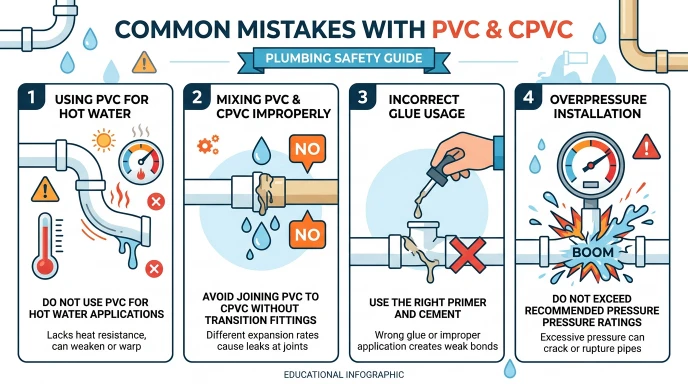
Many beginners assume PVC and CPVC are interchangeable because they look similar. In reality, using the wrong material can cause expensive plumbing problems.
Mistake 1: Using PVC for Hot Water
Some homeowners install PVC on hot-water lines.
Use CPVC for hot-water plumbing because it handles heat better.
Mistake 2: Assuming Both Pipes Use the Same Glue
PVC and CPVC require different solvent cements.
Correction: Always use the adhesive recommended by the pipe manufacturer.
Mistake 3: Choosing Based Only on Price
People often buy PVC because it’s cheaper without considering the application.
Correction: Select the pipe based on temperature, pressure, and intended use not just cost.
Mistake 4: Ignoring Local Plumbing Codes
Building regulations often specify which pipe materials are permitted.
Correction: Check local plumbing codes before beginning any installation.
Mistake 5: Mixing PVC and CPVC Incorrectly
Joining the two materials without proper transition fittings or approved methods may result in leaks.
Correction: Follow manufacturer recommendations and local code requirements when connecting different pipe types.
Real-Life Examples with PVC and CPVC
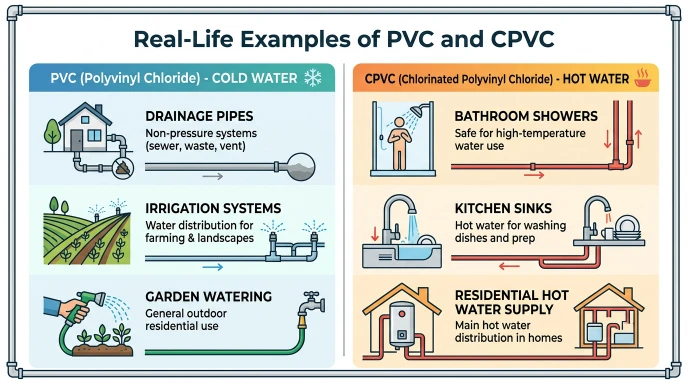
Example 1: Home Bathroom Renovation
A homeowner replaces the hot-water pipes connected to a shower.
Best choice: CPVC
Reason: It safely handles high-temperature water.
Example 2: Garden Irrigation System
A homeowner installs underground pipes to water plants.
Best choice: PVC
Reason: Cold water and lower installation costs.
Example 3: Commercial Office Building
The building requires reliable hot- and cold-water distribution.
Best choice: CPVC
Reason: Better heat resistance and long-term durability.
Example 4: Municipal Drainage Project
Engineers design a stormwater drainage network.
Best choice: PVC
Reason: Excellent corrosion resistance and affordability.
Example 5: Chemical Processing Facility
Certain industrial systems transport heated chemical solutions.
Best choice: CPVC
Reason: Improved chemical and temperature resistance.
When to Use Each
Choose PVC When:
- You need pipes for cold-water systems.
- You’re installing irrigation or sprinkler lines.
- The project involves drainage or sewer systems.
- Budget is a major consideration.
- Outdoor underground piping is required.
Choose CPVC When:
- The plumbing system carries hot water.
- Installing residential water supply lines.
- Building commercial plumbing systems.
- Heat resistance is essential.
- Long-term reliability under pressure is important.
Why People Get Confused About the Difference Between PVC and CPVC
Several factors make these two materials easy to confuse.
Similar Appearance
PVC and CPVC pipes have nearly the same shape and design, making them difficult to distinguish at first glance.
Similar Names
The names differ by only one letter, leading many people to believe they are identical products.
Overlapping Applications
Both materials can carry water, resist corrosion, and are commonly used in plumbing systems.
Online Information
YouTube, Instagram, and Meta posts often give simple plumbing advice, so beginners may think PVC and CPVC are the same, but they are not.
How Search Engines Understand “Difference Between PVC and CPVC” and User Intent
Search engines such as Google analyze more than just keywords they try to understand the reason behind the search.
For example:
- People searching “difference between PVC and CPVC” usually want to compare the two before buying pipes.
- A query like “PVC vs CPVC for hot water” indicates a practical installation decision.
- Searches such as “which pipe is better for plumbing” or “can PVC be used for hot water” show informational and buying intent.
Search engines also look at related topics like pipe fittings, heat resistance, and water systems. Covering these helps articles rank better.
Expert Insight
The best choice depends on the plumbing job, not which pipe is better.
Plumbers use PVC for drainage, irrigation, and cold water because it is affordable. They use CPVC for hot water because it handles heat better.
Many beginners think PVC and CPVC are the same, but choosing the right pipe makes the plumbing safer and longer-lasting.
FAQs
1. What is the main difference between PVC and CPVC?
PVC is used for cold water and drainage, while CPVC is used for hot and cold water because it can handle more heat.
2. Which is better for home plumbing: PVC or CPVC?
For indoor water supply, CPVC is usually the better choice because it can handle hot and cold water. PVC is better suited for drain lines, irrigation systems, and outdoor cold-water applications.
3. Can PVC be used for hot water?
No. PVC is not recommended for hot water because high heat can soften the pipe and cause leaks. CPVC is specifically designed for hot-water systems.
4. Why is CPVC more expensive than PVC?
CPVC costs more because it undergoes an additional chlorination process during manufacturing. This makes CPVC stronger, more heat-resistant, and better for tough plumbing jobs.
5. Can PVC and CPVC pipes be connected together?
Yes, but they must be connected with the right fittings and solvent cement for a strong, leak-free joint.
6. Which pipe lasts longer, PVC or CPVC?
Both materials have long service lives when installed correctly. CPVC usually lasts longer in hot-water systems because it can handle high temperatures.
7. Is CPVC safe for drinking water?
Yes. CPVC is approved for home and commercial drinking water systems if it meets local plumbing standards.
8. Which pipe is better for irrigation?
PVC is the best choice for irrigation because it is affordable, strong, lightweight, and good for cold water.
9. Does CPVC resist chemicals better than PVC?
Yes. Both resist chemicals well, but CPVC works better with high heat and stronger chemicals.
10. Should I choose PVC or CPVC in 2026?
Use PVC for drainage and cold water. Use CPVC for hot water and better heat resistance.
Conclusion
Knowing the difference between PVC and CPVC helps you choose the right pipe for your plumbing project. They may look alike, but they are made for different uses.
PVC is affordable, lightweight, and good for cold water, drainage, irrigation, and electrical pipes. It is durable and easy to install.
CPVC is made for both hot and cold water. It handles heat and pressure well, so it is used in homes, buildings, hospitals, and industries. It costs more than PVC but lasts longer in hot conditions.
Ultimately, the right choice depends on your needs, water temperature, budget, and local rules. Knowing the difference between PVC and CPVC helps you choose correctly and avoid mistakes.
Read more about!
Difference Between Principal and Principle: Easy Guide
Difference Between Divorce and Annulment: Key Facts

I am James Carter, a professional content writer from the United States. I specialize in writing simple and clear comparison blogs that help students and readers understand difficult topics easily. My writing focuses on everyday language, education, science, and lifestyle topics. I believe that learning should be easy for everyone, so I use simple words and real-life examples in my articles.