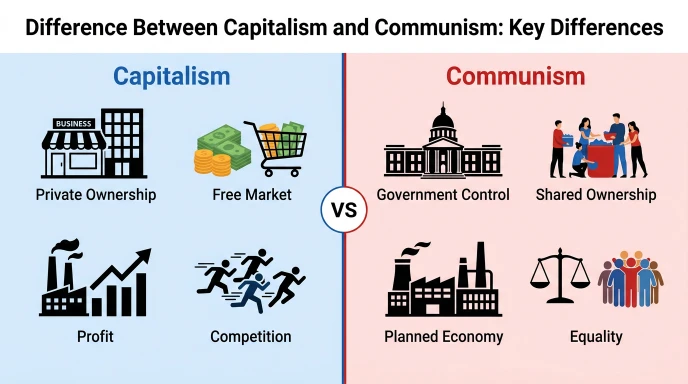
Capitalism is based on private ownership and profit, while communism is based on shared ownership and equal distribution of resources.
Capitalism and communism are two economic systems that decide how countries make and share money and resources. Knowing the difference helps explain different economies, businesses, and living standards.
In capitalism, people and businesses can own property and make money. In communism, the government or society owns and controls most resources. This affects jobs, businesses, taxes, and public services.
This guide explains capitalism and communism with simple differences, similarities, and examples.
Difference Between Capitalism and Communism
In capitalism, people can own businesses and earn money. In communism, the government or community owns and manages most resources.
Example: In a capitalist economy, an entrepreneur can start a technology company and keep the profits. In communism, the government usually owns and controls major industries instead of private people.
Definition of Capitalism and Communism
Capitalism: A system where people and private businesses own property, run businesses, and make profits.
Communism: A system where the government owns most land, businesses, and resources and shares them with everyone.
Pronunciation
| Term | US Pronunciation | UK Pronunciation |
| Capitalism | KAP-i-tl-iz-um | KAP-i-tl-iz-um |
| Communism | KOM-yuh-niz-um | KOM-yoo-niz-um |
Now that you know the basic meanings, let’s explore the difference between capitalism and communism in greater detail.
Difference Between Capitalism and Communism Comparison
| Feature | Capitalism | Communism |
| Ownership | Private individuals own businesses and property. | Government or society owns major resources. |
| Main Goal | Profit and economic growth. | Equality and shared wealth. |
| Market | Free market competition. | Government-planned economy. |
| Prices | Determined by supply and demand. | Often controlled by the government. |
| Business | Anyone can start a business. | Major businesses are state-owned or controlled. |
| Competition | Encouraged to improve products and services. | Limited because the state controls production. |
| Income | People earn based on skills, investment, and market demand. | Income is intended to be distributed more equally. |
| Consumer Choice | Wide variety of products and brands. | Consumer choices may be more limited. |
| Innovation | Driven by competition and profit. | Often directed by government planning. |
| Examples | United States, Canada, Australia | Historically Soviet Union, Mao-era China; modern examples include Cuba and North Korea, though many countries today use mixed systems. |
Key Differences Explained Between Capitalism and Communism
1. Ownership of Property
The biggest difference between capitalism and communism is ownership.
In capitalism, people can own homes, land, factories, and businesses. This encourages investment and entrepreneurship.
In communism, the government or community owns most industries and resources instead of private people.
Real-life example: A person opening a local coffee shop is an example of private ownership under capitalism.
2. Profit vs Equality
Capitalism rewards people who successfully create products or services that customers want. Profit motivates businesses to grow.
Communism focuses on reducing income inequality by distributing resources more evenly among citizens.
Example: In capitalism, a software company can earn large profits. In communism, profits from government-owned businesses are meant to help everyone.
3. Government’s Role
Governments exist in both systems, but their economic roles differ.
In capitalism, the government protects laws and property, while businesses can run freely.
In communism, the government decides what to produce, prices, and how resources are used.
4. Competition
Competition is a driving force in capitalism. Businesses compete by offering better products, lower prices, or improved services.
Communist economies often reduce or eliminate competition because the government controls major industries.
Example: Smartphone manufacturers constantly compete to introduce better devices in capitalist markets.
5. Consumer Choice
Capitalism gives people more choices because businesses compete with each other.
Communist economies may provide fewer choices since production decisions are centrally planned.
People can see this difference by comparing markets with many brands to those with only a few government-approved choices.
6. Innovation
Capitalism encourages innovation because businesses create new ideas to compete and grow.
Many technology companies invest in AI, cloud computing, and clean energy to grow their business and make more money.
Communist systems can also create new ideas with government support, but in a different way.
What Is Capitalism?
Capitalism is a system where people own businesses and decide what to make and sell, not the government.
In a capitalist economy:
- Individuals can own businesses.
- Companies compete for customers.
- Prices are largely determined by supply and demand.
- Investors can earn profits.
- Consumers choose from competing products.
Why Does Capitalism Exist?
Capitalism developed because people believed that economic freedom encourages innovation, investment, and productivity. When businesses compete, they often improve quality and reduce prices to attract customers.
Example:
Companies like Apple, Samsung, and Tesla improve their products to compete and attract more customers. Consumers benefit from new features, better technology, and more choices.
What Is Communism?
Communism is a system where major resources are owned by the government or the community instead of private people. The idea is to reduce economic inequality by ensuring that wealth and production benefit society as a whole.
In a traditional communist system:
- Major industries are state-owned.
- Central planners decide production goals.
- Essential resources are distributed according to government policies.
- Private ownership of large businesses is limited or eliminated.
Why Was Communism Created?
Communism started because many people believed capitalism made the rich richer and the poor poorer. It supports shared ownership to create more equality.
Historically, different countries have used communism in different ways. Today, most countries use a mix of capitalism and government rules instead of following one system completely.
How Does the Difference Between Capitalism and Communism Affect Everyday Life?
Many people think these systems only matter to economists or politicians, but they also affect everyday life.
For example, the economic system can affect:
- Career opportunities
- Business ownership
- Product availability
- Prices of goods
- Taxes and public services
- Investment opportunities
- Innovation in technology
- Consumer freedom
Today, most countries use a mixed economy with both capitalism and government support. This helps provide public services while allowing businesses to grow and compete.
Difference Between Capitalism and Communism: How They Work in Practice
Capitalism and communism are different systems, but most countries today use a mix of both ideas. This helps support businesses, public services, and a stable economy.
How Capitalism Works
In a capitalist economy:
- Individuals and businesses own most property.
- Companies decide what products to make.
- Consumers choose what to buy.
- Prices are set mainly by supply and demand.
- Investors risk money to earn profits.
Example:
A small entrepreneur opens a restaurant. If customers enjoy the food, the business grows. If not, the owner must improve or risk losing money. Competition encourages better quality and innovation.
How Communism Works
In a communist economy:
- The government usually owns major industries.
- Production goals are planned centrally.
- Resources are allocated according to government priorities.
- Basic services such as healthcare, housing, or education may be heavily subsidized or provided by the state.
Example:
The government runs one company that provides electricity across the country.
Why Does the Difference Between Capitalism and Communism Matter Today?
Many people think this debate is only about history, but it still affects economic policies today.
The difference between capitalism and communism affects:
- Employment opportunities
- Business investment
- Tax systems
- Healthcare funding
- Education policies
- Housing markets
- Technology development
- International trade
Countries change their economic system to meet new challenges.
Advantages of Capitalism
Capitalism has helped drive significant economic growth in many countries.
1. Encourages Innovation
Businesses compete by creating better products and services.
Example: Smartphone companies release new features every year to attract customers.
2. Greater Consumer Choice
Competition creates a wide variety of products across different price ranges.
Consumers can compare brands before making purchasing decisions.
3. Rewards Hard Work and Investment
People who develop successful businesses or invest wisely may earn higher incomes.
This creates incentives for entrepreneurship.
4. Efficient Resource Allocation
When demand changes, businesses often adjust production quickly to meet consumer needs.
5. Economic Growth
Private investment and competition frequently contribute to higher productivity and technological advancement.
Disadvantages of Capitalism
No economic system is perfect.
Income Inequality
Some individuals accumulate significant wealth while others earn much less.
Market Failures
Businesses may create monopolies or reduce competition if regulations are weak.
Economic Cycles
Capitalist economies can experience recessions, inflation, and unemployment during economic downturns.
Focus on Profit
Some companies may focus on profits more than the environment or workers unless laws prevent it.
Advantages of Communism
Communism aims to reduce major economic inequalities.
More Equal Distribution
Resources are intended to be shared more evenly across society.
Universal Basic Services
Healthcare, education, and housing are often provided or heavily supported by the government.
Reduced Extreme Poverty
Supporters argue that collective ownership can help ensure everyone’s basic needs are met.
Focus on Public Welfare
Major industries may prioritize national goals over maximizing profits.
Disadvantages of Communism
Limited Economic Freedom
Individuals often have fewer opportunities to start private businesses.
Reduced Competition
Without competition, companies may not improve or create new products.
Central Planning Challenges
Governments may struggle to accurately predict consumer demand.
This can lead to shortages or surpluses.
Slower Innovation
Innovation may depend more on government priorities than market competition.
Difference and Similarity
| Feature | Capitalism | Communism | Similarity |
| Main Purpose | Creates wealth through private enterprise | Seeks economic equality | Both organize economic activity |
| Ownership | Mostly private | Mostly public or collective | Both manage national resources |
| Decision Making | Businesses and consumers decide | Government plans production | Both require economic planning |
| Employment | Driven by market demand | Often influenced by state planning | Both provide jobs through economic activity |
| Innovation | Competition encourages new ideas | Government supports selected innovations | Both can produce technological progress |
| Resource Management | Market allocates resources | Government allocates resources | Both must distribute limited resources |
| Economic Goal | Growth and profit | Equality and shared welfare | Both aim to improve living standards |
| Government Role | Limited to moderate regulation | Extensive economic control | Governments play a role in both systems |
This table shows the main differences and similarities between capitalism and communism.
Common Mistakes with Capitalism and Communism
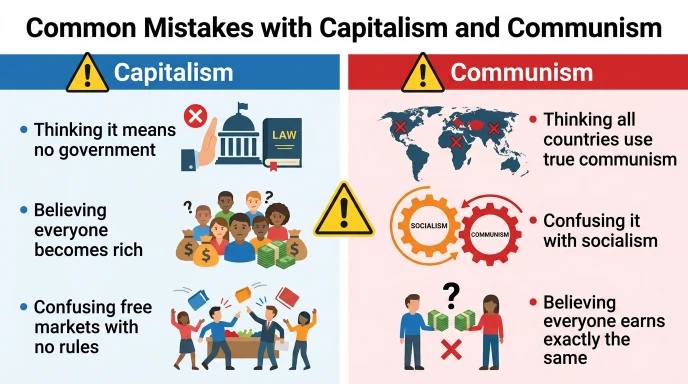
Many beginners misunderstand these systems. Here are some common mistakes and how to avoid them.
Mistake
Correct Understanding
Thinking capitalism means no government at all
Most capitalist countries regulate businesses and markets.
Believing communism always eliminates all private property
Traditional communism limits private ownership of major industries, but implementation varies by country.
Assuming every country is purely capitalist or communist
Most modern economies are mixed economies.
Confusing socialism with communism
Socialism and communism are related but not identical concepts.
Assuming capitalism always creates wealth for everyone equally
Capitalism can generate prosperity but may also increase income inequality.
Believing communism guarantees equal outcomes
Real-world results have varied widely across different countries and historical periods.
Real-Life Examples with Capitalism and Communism
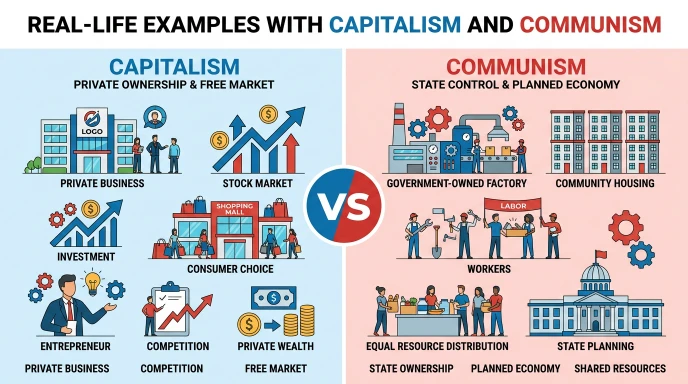
1. Personal Example
A freelance graphic designer starts an online business, sets prices, and keeps profits.
This reflects capitalist principles.
2. Business Example
A technology startup develops new software to compete with existing companies.
Competition encourages innovation and better products.
3. Government Example
A government-run railway shows shared ownership, which is linked to communism.
4. Mixed Economy Example
Many countries allow private businesses while also providing public education and healthcare.
This combines features of capitalism with government involvement.
5. Global Trade Example
International companies compete across borders while governments regulate trade, taxes, and labor standards.
This illustrates how modern economies blend multiple economic approaches.
When to Use Each System
There is no universal answer because every country has different economic priorities.
Capitalism Works Best When:
- Encouraging entrepreneurship
- Supporting innovation
- Expanding private investment
- Increasing consumer choice
- Promoting competitive markets
Communism May Appeal When:
- Reducing extreme income inequality
- Expanding universal public services
- Centralizing control over key industries
- Prioritizing equal access to essential resources
In practice, most governments adopt policies from both systems rather than relying entirely on one.
Why People Get Confused About Capitalism and Communism
Several factors contribute to the confusion.
Similar Economic Goals
Both systems aim to improve society, but they use different methods.
Mixed Economies
Most countries blend free markets with government regulation.
This makes strict labels less accurate.
Political Discussions
Media, politics, and social media often make economic ideas seem simpler and more extreme than they really are.
Historical Changes
Economic systems evolve over time. Countries may adopt reforms that make them different from their historical models.
This helps explain why real economies don’t fit into just one system.
How Search Engines Understand “Difference Between Capitalism and Communism” and User Intent
Search engines like Google aim to understand why someone searches for this topic, not just the exact words they type.
For example, a user searching “difference between capitalism and communism” might actually want:
- A simple definition
- A comparison table
- Historical context
- Real-world examples
- Exam preparation
- A quick answer for homework
Google analyzes search intent using semantic understanding, related concepts, and user engagement signals. It also explains related ideas like socialism, free markets, planned economies, ownership, and equality in an easy way.
Search engines also value content that is:
- Easy to scan with headings and tables.
- Written in natural language.
- Factually accurate and balanced.
- Helpful for beginners while still offering deeper insights.
Covering definitions, comparisons, examples, and misconceptions helps meet different user needs.
Expert Insight
Comparing capitalism and communism helps us see how they use resources, rewards, and public needs, not to decide which one is better.
In real life, economists check how an economy is performing, not just ideas in theory. Most successful countries use both free markets and government help, depending on their history and goals.
The main idea is that to understand capitalism and communism, we should not only read their definitions but also see how they work in real life.
FAQs
1. What is the main difference between capitalism and communism?
The main difference between capitalism and communism is ownership. Capitalism means people and businesses can own property and make profit. Communism means the government or community owns most resources to reduce inequality.
2. Which countries are capitalist today?
Many countries operate largely capitalist economies with varying levels of government regulation. Examples include the United States, Canada, the United Kingdom, Australia, Japan, and Germany. Most of these countries are actually mixed economies, combining free markets with public services.
3. Is communism the same as socialism?
No. Although they share some ideas about reducing inequality, they are not the same.
Socialism allows some private ownership but the government plays a big role in services and the economy. Communism aims for shared ownership of resources and a society without classes.
4. Why do most countries use mixed economies instead of pure capitalism or communism?
Pure economic systems are uncommon because governments try to balance free markets and public welfare.
Most countries combine:
- Private businesses and competition
- Government regulation
- Public education
- Healthcare programs
- Infrastructure investment
This approach helps address both economic growth and social needs.
Capital
5. Does capitalism always create inequality?
Capitalism creates income differences based on skills, investment, and demand.
However, many capitalist countries use taxes, social programs, and labor laws to reduce large income gaps.
6. Does communism eliminate poverty?
The goal of communism is to reduce economic inequality and ensure basic needs are met. In real life, the results are different depending on how policies are used, how effective the government is, and the economic situation.
7. Which system encourages more innovation?
Capitalism generally encourages innovation through market competition and profit incentives. Companies invest in new products and technologies to attract customers and increase earnings.
Communist systems can also innovate in science and infrastructure, but incentives are different.
8. Which system gives people more economic freedom?
Capitalism usually provides greater economic freedom by allowing individuals to:
- Start businesses
- Invest money
- Choose careers
- Own property
- Compete in open markets
Communist systems typically involve greater government control over economic activities.
9. Can a country be both capitalist and communist?
Not in the strict theoretical sense. Many countries mix capitalism with government services. These are generally referred to as mixed economies, not purely capitalist or communist systems.
10. Why is the difference between capitalism and communism important?
It explains why countries are different economically and socially. It also helps us understand global politics, history, and economic debates.
Conclusion
Capitalism and communism differ in how they manage ownership, production, and wealth. Capitalism is based on private ownership and profit, while communism is based on shared ownership and equality.
In practical terms, neither system exists in its pure form across most of the world today. Many countries use a mixed economy with free markets and government support.
Learning about capitalism and communism helps you understand how countries manage their economies. Instead of asking which is better, learn what each system does, its good and bad sides, and how it works in real life. This helps you understand different economic systems better.
Read more about!
Difference Between PVC and CPVC: Which Pipe to Choose?
Difference Between Wholesale and Retail: Key Differences

I am Emily Johnson, a USA-based content writer who creates easy-to-read blogs on language and daily life topics. I explain complex ideas in simple English for students and beginners so they can understand easily.