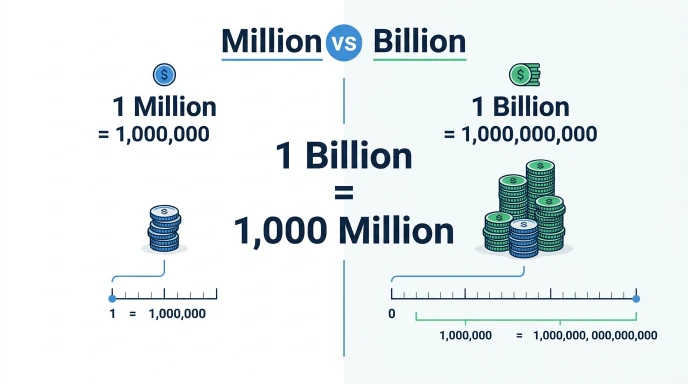
The difference between a million and a billion is that a billion equals 1,000 million, making it 1,000 times larger than a million.
Have you ever heard someone say a company is worth a million dollars while another is worth a billion dollars and wondered how much bigger a billion really is? Many people confuse these large numbers because they sound similar, but the difference is enormous.
Understanding the difference between million and billion is important in everyday life, if you’re reading financial news, discussing government budgets, or learning basic math.
In simple words, a million equals 1,000,000, while a billion equals 1,000,000,000. A billion is 1,000 times larger than a million not just a little bigger.
In this guide, you’ll learn simple definitions, pronunciation, key differences, comparison tables, real-life examples, common mistakes, FAQs, and expert insights to understand these numbers with confidence.
Difference Between Million and Billion
The difference between million and billion is simple: a million is 1,000,000, while a billion is 1,000,000,000. A billion is 1,000 times greater than a million.
Example: If you have $1 million, you own one million dollars. If you have $1 billion, you own one thousand million dollars.
Definition of Million and Billion
Million:
A million is the number 1,000,000, which has six zeros. It is often used to describe large amounts of money, population, or data.
Example: A city may have a population of 2 million people.
Billion:
A billion is the number 1,000,000,000, which has nine zeros. It equals one thousand million.
Example: A country’s budget may be 5 billion dollars.
Pronunciation
| Term | US Pronunciation | UK Pronunciation |
| Million | /ˈmɪljən/ | /ˈmɪljən/ |
| Billion | /ˈbɪljən/ | /ˈbɪljən/ |
Now that you know what each number means and how to pronounce them, let’s compare them side by side to understand their differences more clearly.
Difference Between Million and Billion Comparison
| Feature | Million | Billion |
| Number | 1,000,000 | 1,000,000,000 |
| Number of Zeros | 6 | 9 |
| Value | One million | One thousand million |
| Size | Smaller | Much larger |
| Common Uses | Salaries, city populations, small businesses | National budgets, company valuations, country populations |
| Place Value | 10⁶ | 10⁹ |
| Time Equivalent | About 11.6 days in seconds | About 31.7 years in seconds |
| Relationship | Base value | 1 billion = 1,000 million |
Key Differences Explained Between Million and Billion
1. Number of Zeros
The biggest difference is the number of zeros.
- Million = 6 zeros
- Billion = 9 zeros
Example:
1 Million = 1,000,000
1 Billion = 1,000,000,000
2. Size
A billion is much larger than a million.
One billion equals 1,000 million, making it one thousand times greater.
Example:
Winning $1 million is life-changing, but $1 billion is an entirely different level of wealth.
3. Mathematical Value
In mathematics:
- Million = 10⁶
- Billion = 10⁹
This difference of three powers of ten means a billion is significantly larger.
Example: Scientists and economists often use these values when working with very large numbers.
4. Common Uses
Millions are commonly used for:
- House prices
- Company revenue
- City populations
- Lottery prizes
Billions are commonly used for:
- National economies
- Government spending
- Global companies
- Space missions
Example: A startup may earn $5 million, while a multinational company may generate $50 billion in annual revenue.
5. Time Comparison
Thinking in terms of time makes the difference easier to understand.
- One million seconds is about 11.6 days.
- One billion seconds is about 31.7 years.
This example clearly shows how much larger a billion really is.
6. Financial Importance
Million-dollar amounts are common for successful businesses, celebrities, and property investments.
Billion-dollar amounts usually involve major corporations, national budgets, and the world’s wealthiest individuals.
Example: A successful local business may be worth $10 million, while a global technology company may be worth hundreds of billions of dollars.
7. Everyday Usage
Most people are more likely to encounter millions than billions in daily life.
Billions are generally discussed in international business, economics, government spending, and global finance.
Example: You might read about a million-dollar home, but government infrastructure projects are often measured in billions of dollars.
What Is the Difference Between Million and Billion?
The difference between million and billion is the size of the number. A million equals 1,000,000 (six zeros), while a billion equals 1,000,000,000 (nine zeros). In other words, 1 billion is equal to 1,000 million.
Although both numbers represent large quantities, a billion is much larger. This difference becomes important when discussing money, populations, business values, government budgets, and scientific data.
Why Does the Difference Between Million and Billion Matter?
Understanding these numbers helps you interpret real-world information correctly.
For example:
- Investors compare million-dollar startups with billion-dollar corporations.
- Governments announce budgets worth billions of dollars.
- News reports often mention millions or billions when discussing populations, economic growth, or company earnings.
Knowing the difference prevents misunderstandings and improves financial and mathematical literacy.
How Are Million and Billion Used in Real Life?
Money
A millionaire owns at least $1 million, while a billionaire owns at least $1 billion.
Population
A city may have 3 million residents, while a country like India has more than one billion people.
Business
Small companies may earn millions in yearly revenue, while global companies often generate billions.
Technology
Large technology companies invest billions of dollars in research, artificial intelligence, and infrastructure.
Million vs Billion in Mathematics
In mathematics, these numbers are based on powers of ten.
- Million = 10⁶
- Billion = 10⁹
Every step adds three more zeros.
For example:
- Thousand = 10³
- Million = 10⁶
- Billion = 10⁹
- Trillion = 10¹²
Understanding this pattern makes it easier to recognize larger numbers.
Difference Between Million and Billion in Money
Money is where many people notice this difference most clearly.
Imagine earning:
- $1 million
- $1 billion
A billionaire doesn’t simply have “a little more” money they have 1,000 times more than a millionaire with $1 million.
This is why billion-dollar companies, investment funds, and government projects operate on a completely different financial scale.
Difference + Similarity Between Million and Billion
| Feature | Million | Billion | Similarity |
| Meaning | One million (1,000,000) | One thousand million (1,000,000,000) | Both are large counting numbers. |
| Number of Zeros | 6 | 9 | Both use groups of zeros. |
| Mathematical Value | 10⁶ | 10⁹ | Both are powers of ten. |
| Size | Smaller | 1,000 times larger | Both represent large quantities. |
| Common Use | Salaries, property, city populations | Government budgets, company values, national populations | Both are used in finance, economics, and statistics. |
| Place Value | Millions place | Billions place | Both belong to the place-value system. |
| Everyday Usage | More common | Less common in daily life | Both appear in news and business reports. |
This table clearly shows the difference and similarity between million and billion for quick understanding.
Common Mistakes with Million and Billion
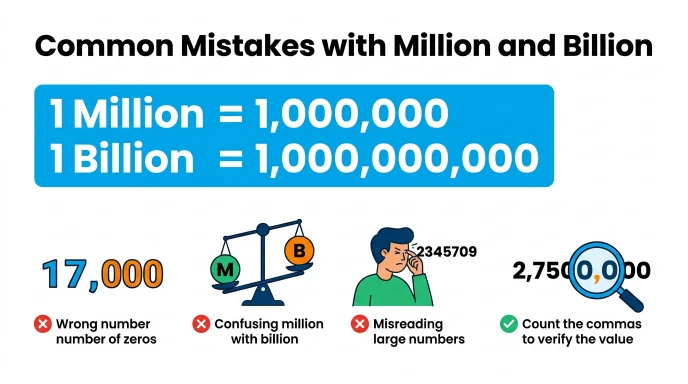
1. Thinking a Billion Is 100 Million
Correction: A billion equals 1,000 million, not 100 million.
2. Counting the Wrong Number of Zeros
Correction:
- Million = 6 zeros
- Billion = 9 zeros
3. Assuming the Difference Is Small
Correction: A billion is 1,000 times larger than a million.
4. Confusing Place Values
Correction: Learn the order:
Thousands → Millions → Billions → Trillions.
5. Misreading Financial News
Correction: Always check if reports mention millions or billions because the difference is enormous.
Real-Life Examples with Million and Billion

Example 1: Salary
A professional athlete may earn $5 million per year.
Example 2: Company Value
A large technology company may be worth over $500 billion.
Example 3: Government Budget
A country’s education budget may total billions of dollars.
Example 4: Population
A large city may have 8 million residents, while a country may have more than one billion people.
Example 5: Lottery
Winning $2 million is life-changing, but winning $2 billion is far beyond that.
When to Use Each
Use “Million” When Talking About:
- House prices
- Annual salaries
- Small and medium businesses
- City populations
- Lottery prizes
Use “Billion” When Talking About:
- National budgets
- Global company values
- Country populations
- International investments
- Space and scientific projects
Why People Get Confused Between Million and Billion
Many beginners confuse these numbers because:
- Both describe very large amounts.
- Their names sound similar.
- People rarely count numbers this large.
- News headlines often mention both without explaining the scale.
- It’s difficult to imagine the true size of a billion.
An easy way to remember is:
- Million = 6 zeros
- Billion = 9 zeros
- 1 Billion = 1,000 Million
How Search Engines Understand “Difference Between Million and Billion” and User Intent
When users search “difference between million and billion,” search engines recognize that they want a simple comparison and clear explanation.
Most users are looking for:
- The number of zeros.
- Which number is larger.
- Simple definitions.
- Money examples.
- Comparison tables.
- Real-world examples.
- Easy ways to remember the difference.
Content that answers these questions clearly is more likely to satisfy user intent and appear in featured snippets.
Expert Insight
In practical situations, the difference between a million and a billion is often underestimated. Financial experts, economists, and business analysts pay close attention to these numbers because even a small wording mistake can represent a difference of 1,000 times.
A helpful way to visualize the scale is through time: one million seconds is about 11.6 days, while one billion seconds is about 31.7 years. This simple comparison makes the size difference much easier to understand and remember.
FAQs
1. What is the main difference between million and billion?
A million has 6 zeros, while a billion has 9 zeros. One billion equals 1,000 million.
2. Which is bigger, a million or a billion?
A billion is much bigger than a million.
3. How many millions make one billion?
1,000 million equals 1 billion.
4. How many zeros are in a million?
A million has 6 zeros.
5. How many zeros are in a billion?
A billion has 9 zeros.
6. Is one billion twice as much as one million?
No. A billion is 1,000 times larger than a million.
7. Why is a billion so much larger?
Because it adds three extra zeros, increasing the value by a factor of 1,000.
8. Where are millions and billions commonly used?
They are commonly used in finance, business, economics, government budgets, population statistics, and scientific research.
Conclusion
Understanding the difference between million and billion is essential for interpreting numbers correctly in everyday life. While both represent large values, they are not close in size. A million equals 1,000,000, whereas a billion equals 1,000,000,000, making a billion 1,000 times larger than a million.
If you’re reading financial news, studying mathematics, comparing company values, or learning about world populations, knowing the difference helps you avoid common mistakes and understand large numbers with confidence. Remember the simple rule: a million has six zeros, a billion has nine zeros, and one billion equals one thousand million.
Read more about!
- Difference Between Median and Mean: Key Differences Explained
- Difference Between DisplayPort and HDMI: Easy Guide

I am Emily Johnson, a USA-based content writer who creates easy-to-read blogs on language and daily life topics. I explain complex ideas in simple English for students and beginners so they can understand easily.