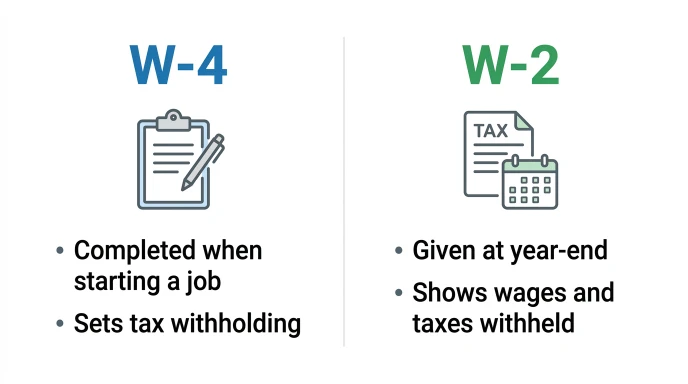
A W-4 tells your employer how much federal tax to withhold from your paycheck, while a W-2 reports your annual wages and taxes withheld for tax filing.
Starting a new job or preparing your taxes often brings up two important forms: the W-4 and the W-2. Many people confuse them because both are related to employment and taxes, but they serve completely different purposes.
Understanding the difference between W-4 and W-2 can help you complete your paperwork correctly and avoid tax-related mistakes.
In simple words, a W-4 tells your employer how much federal income tax to withhold from your paycheck, while a W-2 reports your annual wages and the taxes already withheld.
In this guide, you’ll learn the difference between W-4 and W-2 through simple definitions, comparison tables, practical examples, and easy-to-understand explanations.
Difference Between W-4 and W-2
A W-4 is a tax withholding form that employees complete when they start a job or need to update their tax information. A W-2 is a year-end tax form your employer provides that shows your earnings and the taxes withheld during the year.
Example: You fill out a W-4 on your first day at a new job, but you receive a W-2 after the end of the tax year to help file your tax return.
What Is a W-4 and a W-2?
W-4
A W-4 is a form that tells your employer how much federal income tax to withhold from each paycheck.
Example: If your family or financial situation changes, you can submit a new W-4 to adjust your tax withholding.
W-2
A W-2 is a tax document your employer sends after the end of the year. It shows your total wages and the taxes withheld from your pay.
Example: You use your W-2 when preparing your annual income tax return.
Pronunciation
| Term | US Pronunciation | UK Pronunciation |
| W-4 | /ˌdʌbəl.juː ˈfɔːr/ | /ˌdʌbəl.juː ˈfɔː/ |
| W-2 | /ˌdʌbəl.juː ˈtuː/ | /ˌdʌbəl.juː ˈtuː/ |
Now that you know the basics, let’s explore the difference between W-4 and W-2 in more detail.
Difference Between W-4 and W-2 Comparison
| Feature | W-4 | W-2 |
| Purpose | Sets tax withholding | Reports yearly wages and taxes |
| Completed By | Employee | Employer |
| When Used | At hiring or when tax information changes | After the end of each tax year |
| Main Function | Helps calculate paycheck tax withholding | Helps prepare tax returns |
| Sent To | Employer | Employee and tax authorities |
| Updated | As needed | Issued annually |
Key Differences Explained Between W-4 and W-2
1. Purpose
The biggest difference is their purpose.
A W-4 tells your employer how much federal income tax to withhold from your paycheck.
A W-2 reports how much you earned and how much tax was withheld during the year.
Example:
- W-4 → Tax withholding instructions
- W-2 → Annual tax summary
2. Who Completes the Form?
The employee completes the W-4.
The employer prepares the W-2 after the tax year ends.
Example:
When you start a new job, you complete a W-4. At the beginning of the next year, your employer sends you a W-2.
3. When Is Each Form Used?
A W-4 is usually completed:
- When starting a new job
- After getting married
- After having a child
- When your tax situation changes
A W-2 is issued once each year after the end of the tax year.
4. Information Included
A W-4 includes information that helps determine tax withholding, such as filing status and any additional withholding you request.
A W-2 includes:
- Total wages
- Federal income tax withheld
- Social Security wages
- Medicare wages
- State tax information (if applicable)
5. Role in Taxes
The W-4 affects your future paychecks by determining how much tax is withheld.
The W-2 helps you file your annual income tax return because it reports what has already been earned and withheld.
6. Can They Be Changed?
A W-4 can be updated whenever your financial or personal circumstances change.
A W-2 cannot be changed by the employee. If there is an error, your employer must issue a corrected form.
7. Timing
The W-4 comes first.
The W-2 comes later.
Simple timeline:
- Start a job.
- Complete the W-4.
- Receive paychecks throughout the year.
- Receive the W-2 after the tax year ends.
- Use the W-2 to file your tax return.
Why Does the Difference Between W-4 and W-2 Matter?
Understanding these forms helps you avoid tax surprises.
For example:
- Completing your W-4 correctly can help reduce the chance of owing a large tax bill or receiving an unexpectedly large refund.
- Keeping your W-2 safe makes filing your annual tax return easier and more accurate.
Knowing which form to use at the right time can save time and reduce mistakes during tax season.
How Does a W-4 Work?
A W-4 tells your employer how much federal income tax to withhold from each paycheck.
Factors that can affect withholding include:
- Filing status
- Multiple jobs
- Dependents
- Additional income
- Extra withholding requests
Updating your W-4 after major life events helps ensure your tax withholding better matches your current situation.
How Does a W-2 Work?
A W-2 summarizes your earnings and tax withholding for the year.
It commonly includes:
- Annual wages
- Federal income tax withheld
- Social Security tax
- Medicare tax
- State and local tax information (where applicable)
Most employees receive their W-2 early in the year following the tax year, and they use it to prepare their tax return.
When Should You Use Each?
Use a W-4 When You Need To:
- Start a new job
- Update your tax withholding
- Reflect changes in your family or financial situation
- Request additional tax withholding
Use a W-2 When You Need To:
- File your annual income tax return
- Verify your yearly earnings
- Confirm taxes withheld from your pay
- Provide proof of income when required
Understanding when each form is used makes tax paperwork much easier and helps ensure your information is accurate.
Difference + Similarity: Difference Between W-4 and W-2
| Feature | W-4 | W-2 | Similarity |
| Purpose | Tells your employer how much federal income tax to withhold from your paycheck. | Reports your annual wages and taxes withheld for tax filing. | Both are important federal tax forms for employees. |
| When You Use It | Completed when starting a new job or updating tax information. | Received after the end of each tax year. | Both relate to your employment and taxes. |
| Who Completes It | The employee fills out the form. | The employer prepares and provides the form. | Both involve both the employee and employer. |
| Main Function | Helps calculate paycheck tax withholding. | Summarizes yearly earnings and tax withholdings. | Both help ensure accurate tax reporting. |
| Timing | Submitted before or during employment. | Issued after the tax year ends, usually by January 31. | Both are used during different stages of employment. |
| Information Included | Filing status, multiple jobs, dependents, and withholding adjustments. | Wages, tips, tax withheld, and other compensation details. | Both contain personal and tax-related information. |
| Tax Filing Role | Does not get filed with your annual tax return. | Used when preparing and filing your tax return. | Both affect your overall tax situation. |
| Can It Be Updated? | Yes, you can submit a new W-4 anytime your tax situation changes. | No, it reflects completed tax-year information. | Both should contain accurate information. |
This table clearly shows the difference and similarity between W-4 and W-2 for quick understanding.
Key Differences Explained Between W-4 and W-2
1. Purpose
A W-4 helps your employer determine how much federal income tax to withhold from your paycheck. A W-2 reports your yearly earnings and taxes withheld.
Example: When you start a new job, you complete a W-4. At the end of the year, your employer sends you a W-2.
2. Who Completes the Form
Employees fill out the W-4, while employers prepare and issue the W-2.
Example: You provide your filing status on the W-4, but your payroll department creates your W-2.
3. When It Is Used
The W-4 is used before and during employment, while the W-2 is used after the tax year ends.
Example: You submit a W-4 on your first day of work. You receive a W-2 the following January.
4. Information Included
The W-4 includes withholding preferences, while the W-2 includes your total wages and taxes paid.
Example: The W-4 asks about dependents. The W-2 shows your annual salary and tax deductions.
5. Tax Filing Role
A W-4 affects how much tax is withheld during the year. A W-2 helps you prepare your income tax return.
Example: Changing your W-4 may increase or decrease your paycheck, while your W-2 is required when filing taxes.
6. Updates
You can update your W-4 whenever your financial or family situation changes. A W-2 cannot be changed unless there is an error.
Example: After getting married, you may submit a new W-4. Your W-2 remains fixed for that tax year.
What Is the Difference Between W-4 and W-2?
Although both forms are related to employee taxes, they serve different purposes.
A W-4 is a withholding form completed by employees so employers know how much federal income tax to deduct from each paycheck.
A W-2 is a wage statement issued by employers after the end of the year. It summarizes your income and the taxes already withheld.
Think of it this way:
- W-4 = Future paycheck tax instructions
- W-2 = Past year’s tax summary
Why Do Employees Need Both Forms?
Many people wonder why both forms exist.
The answer is simple:
- The W-4 helps calculate the correct tax withholding throughout the year.
- The W-2 confirms what actually happened during the year.
Without a W-4, employers wouldn’t know how much tax to withhold. Without a W-2, employees couldn’t accurately file their tax returns.
How Does the W-4 Work?
The W-4 allows employees to provide information that affects tax withholding.
This includes:
- Filing status
- Multiple jobs
- Dependents
- Additional withholding
- Other tax adjustments
Payroll systems use this information to estimate how much federal income tax should be deducted from each paycheck.
If your personal situation changes, updating your W-4 can help prevent paying too much or too little tax.
How Does the W-2 Work?
The W-2 is created after the tax year ends.
It summarizes:
- Total wages earned
- Federal income tax withheld
- Social Security wages
- Medicare wages
- State and local taxes (if applicable)
Employees use this information when preparing their annual tax returns.
A W-2 also serves as proof of income for loans, mortgages, and financial applications.
Common Mistakes with W-4 and W-2
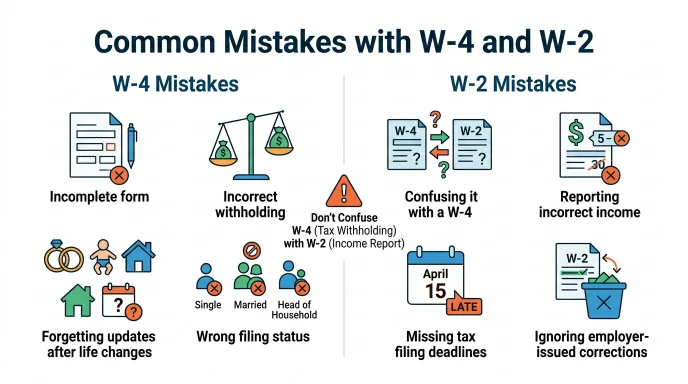
Many beginners confuse these forms because both relate to taxes. Here are the most common mistakes and how to avoid them.
1. Thinking a W-4 Is Used to File Taxes
Mistake: Filing a W-4 with your annual tax return.
Correction: A W-4 only tells your employer how much tax to withhold. It is not used when filing your tax return.
2. Assuming the W-2 Changes Your Tax Withholding
Mistake: Believing you can edit your W-2 to reduce taxes.
Correction: A W-2 only reports what already happened during the tax year. To change future withholding, update your W-4.
3. Forgetting to Update a W-4
Mistake: Keeping the same W-4 after major life changes.
Correction: Update your W-4 after events like marriage, divorce, having children, or starting a second job.
4. Losing Your W-2
Mistake: Misplacing your W-2 before filing taxes.
Correction: Keep a digital and printed copy. If needed, request another copy from your employer.
5. Confusing Wages with Tax Withholding
Mistake: Thinking the tax withheld on a W-2 equals the tax you owe.
Correction: Your final tax bill depends on your total income, deductions, and tax credits.
Real-Life Examples with W-4 and W-2
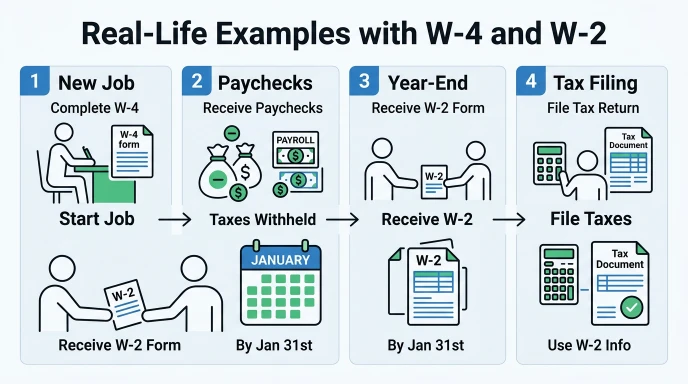
Example 1: Starting a New Job
Sarah begins a new job and completes a W-4 so her employer knows how much federal income tax to withhold from each paycheck.
Example 2: Filing Annual Taxes
In January, Sarah receives her W-2, showing her total earnings and taxes withheld. She uses it to prepare her tax return.
Example 3: Getting Married
After getting married, James updates his W-4 because his filing status has changed. His future paycheck withholding is adjusted.
Example 4: Applying for a Mortgage
A bank asks Emma to provide her recent W-2 as proof of annual income when applying for a home loan.
Example 5: Working Multiple Jobs
David works two part-time jobs. He updates his W-4 forms so enough tax is withheld from both employers, helping him avoid a tax bill later.
When to Use Each
Use a W-4 When:
- You start a new job.
- Your family situation changes.
- You have multiple jobs.
- You want to increase or reduce tax withholding.
- You want more accurate paycheck deductions.
Use a W-2 When:
- Filing your annual income tax return.
- Verifying your yearly income.
- Applying for a mortgage or loan.
- Applying for financial aid.
- Keeping tax records.
Why People Get Confused Between W-4 and W-2
The confusion is understandable because both forms deal with employment and taxes.
Common reasons include:
- Their names are very similar.
- Both are provided through your employer.
- Both contain personal tax information.
- Many first-time employees receive both within their first year.
- People assume every tax form is filed with the IRS in the same way.
An easy way to remember the difference is:
- W-4 = Before and During Employment (withholding instructions)
- W-2 = After the Year Ends (income report)
How Search Engines Understand “Difference Between W-4 and W-2” and User Intent
When someone searches “difference between W-4 and W-2,” search engines recognize it as a comparison-based informational query.
Users usually want answers to questions such as:
- What is a W-4?
- What is a W-2?
- Which form do I fill out?
- Which form do I receive?
- Can I change a W-2?
- Which form is needed for tax filing?
Helpful content performs well because it:
- Uses simple definitions.
- Includes comparison tables.
- Provides real-life examples.
- Answers beginner questions directly.
- Explains when each form is used instead of only defining them.
Expert Insight
In practical payroll and tax situations, the W-4 and W-2 work together but serve different purposes.
The W-4 helps estimate the correct amount of tax to withhold from each paycheck throughout the year. A properly completed W-4 can reduce the chances of owing a large tax bill or receiving an unexpectedly large refund.
The W-2, on the other hand, becomes your official record of earnings and taxes withheld after the year ends. Reviewing your W-2 carefully before filing your tax return helps catch errors early and avoids delays.
For most employees, understanding the role of these two forms makes payroll and tax filing much easier.
FAQs
1. What is the main difference between W-4 and W-2?
A W-4 tells your employer how much tax to withhold, while a W-2 reports your annual wages and taxes withheld.
2. Do I fill out both forms?
You complete the W-4. Your employer prepares and gives you the W-2.
3. Can I change my W-4 anytime?
Yes. You can submit a new W-4 whenever your tax situation changes.
4. Is a W-2 required for filing taxes?
Yes. Most employees use their W-2 to prepare and file their federal income tax return.
5. Does a W-2 show my salary?
Yes. It reports your annual wages, tips, and other taxable compensation.
6. What happens if my W-4 is incorrect?
Too much or too little tax may be withheld from your paycheck, which can affect your tax refund or amount owed.
7. Can I get another copy of my W-2?
Yes. If you lose it, ask your employer for a replacement copy.
8. Which form affects my paycheck?
The W-4 directly affects how much federal income tax is withheld from each paycheck.
Conclusion
Understanding the difference between W-4 and W-2 is essential for every employee. Although both forms relate to taxes, they have completely different purposes. A W-4 is completed when you start a job or update your tax withholding, helping your employer calculate the correct amount of federal income tax to deduct from each paycheck. A W-2, on the other hand, is issued after the tax year ends and summarizes your earnings and taxes withheld for filing your tax return.
In simple terms, the W-4 looks ahead by guiding future tax withholding, while the W-2 looks back by reporting what actually happened during the year. Knowing when to use each form can help you avoid common tax mistakes, receive more accurate paychecks, and file your taxes with confidence. If you’re starting your first job or reviewing your yearly tax documents, understanding these two forms makes managing your finances much easier.
Read more about!
- Difference Between DisplayPort and HDMI: Easy Guide
- Difference Between Velocity and Acceleration: Complete Guide

I am Emily Johnson, a USA-based content writer who creates easy-to-read blogs on language and daily life topics. I explain complex ideas in simple English for students and beginners so they can understand easily.