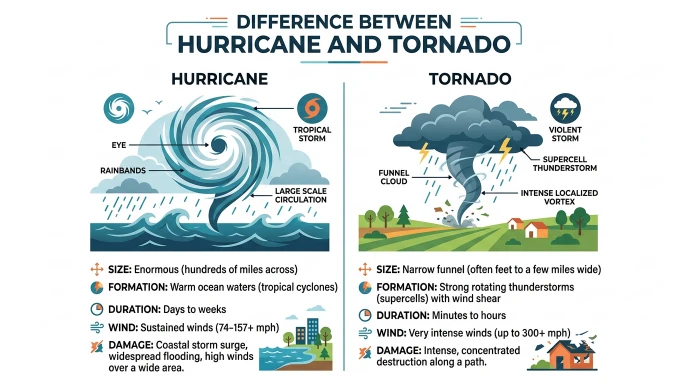
The difference between hurricane and tornado is mainly their size, formation, duration, and wind pattern.
A hurricane is a huge tropical storm that forms over warm ocean water, while a tornado is a narrow, fast-spinning column of air that usually develops from severe thunderstorms over land.
The difference between hurricane and tornado can be confusing because both bring powerful winds, heavy rain, and serious damage. However, they are very different weather systems.
In this guide, you will learn what each one is, how they form, how long they last, where they occur, and which one is larger or stronger. Understanding these differences can also help you better understand weather warnings from the National Weather Service and NOAA.
Quick Answer:
A hurricane is a large tropical cyclone that forms over warm ocean water and can last for days or even weeks. A tornado is a much smaller rotating column of air that extends from a thunderstorm to the ground and usually lasts minutes.
For example, a hurricane can affect an entire region, while a tornado may damage only a narrow path through a town.
Definition of Hurricane and Tornado
- Hurricane: A large tropical cyclone with organized thunderstorms and sustained winds of at least 74 mph (119 km/h). It forms over warm ocean water.
- Tornado: A violently rotating column of air that extends from a thunderstorm cloud to the ground. It can produce extremely strong winds over a much smaller area.
In simple words, a hurricane is a giant ocean-based storm, while a tornado is a smaller but intensely rotating wind column.
Pronunciation
Hurricane
- US English: HUR-uh-kayn
- UK English: HUR-uh-kayn
Tornado
- US English: tor-NAY-doh
- UK English: tor-NAY-doh
Now that the basic definitions are clear, let’s look at how these two powerful weather events really differ.
What Is the Main Difference Between a Hurricane and a Tornado?
The biggest difference is scale.
A hurricane can be hundreds of miles wide and affect large coastal and inland areas. A tornado is usually only a fraction of a mile wide, although some can become much wider.
Their energy sources are also different. Hurricanes get much of their energy from warm ocean water, while tornadoes develop from powerful thunderstorms and their rotating wind structures.
A hurricane may continue for several days as it moves across a large region. Most tornadoes last much less time.
This means a hurricane is a large, long-lasting weather system, while a tornado is a small, short-lived but highly concentrated weather event.
Difference Between Hurricane and Tornado: Size
Size is one of the easiest ways to tell these storms apart.
A hurricane can have a circulation hundreds of miles across. Its effects can cover several states or even much larger areas.
A tornado is much smaller. Most tornado damage occurs along a relatively narrow path.
For example, a hurricane may bring dangerous weather to an entire coastline. A tornado might cross a few neighborhoods while leaving nearby areas mostly untouched.
This does not mean a tornado is harmless. Its smaller size simply means its destructive winds are concentrated in a much narrower area.
Quick fact: A hurricane is vastly larger than a tornado in overall physical size.
How Do Hurricanes Form?
Hurricanes need specific conditions to develop.
They usually form over warm tropical or subtropical ocean water. Warm water provides heat and moisture that help fuel the storm.
A simplified formation process looks like this:
- Warm ocean water adds heat and moisture to the air.
- Warm, moist air rises.
- Lower pressure develops near the surface.
- More air moves toward the low-pressure area.
- Earth’s rotation helps the system begin rotating.
- Thunderstorms become organized around the center.
- Under favorable conditions, the system can strengthen into a hurricane.
Hurricanes have a central circulation and can develop an eye, which is the relatively calm center of a mature hurricane.
The eyewall surrounding the eye contains some of the storm’s strongest winds and heaviest rainfall.
How Do Tornadoes Form?
Tornado formation is more closely linked to severe thunderstorms.
Many strong tornadoes develop from storms called supercells. These storms can contain rotating air called a mesocyclone.
A simplified process is:
- Warm, moist air is present near the ground.
- Cooler, drier air exists higher in the atmosphere.
- Winds change speed or direction with height.
- These conditions create wind shear.
- A powerful thunderstorm develops.
- Rotation can become organized inside the storm.
- A narrow rotating column may extend toward the ground.
- If it reaches the ground, it is called a tornado.
Tornado formation is complex, and not every rotating thunderstorm produces one.
Hurricane vs. Tornado: How Long Do They Last?
Duration is another major difference.
A hurricane can last for days or longer. It may travel over a large area while gradually changing strength.
A tornado usually lasts minutes, although some powerful tornadoes can remain on the ground much longer.
This difference matters for emergency planning.
With a hurricane, people may have hours or even days to prepare as the storm approaches.
With a tornado, warnings can be much more urgent because conditions can change quickly.
Which Has Stronger Winds?
This question is not as simple as it first sounds.
Hurricanes are measured by their maximum sustained winds, while tornado wind speeds are commonly discussed using estimates because directly measuring the strongest winds inside a tornado is difficult.
The strongest tornadoes can produce winds far higher than the sustained winds of most hurricanes.
However, hurricanes can cause enormous damage without having tornado-level wind speeds. Their huge size, long duration, storm surge, rainfall, and widespread winds make them extremely dangerous.
So, asking which is “stronger” depends on what you are measuring.
For peak localized wind: a powerful tornado can be more intense.
For total area and long-lasting impact: a hurricane can affect a much larger region.
Difference in Damage
Hurricanes and tornadoes can both cause severe destruction, but the damage often looks different.
A hurricane can cause:
- Widespread wind damage
- Coastal flooding
- Storm surge
- Heavy rainfall
- River flooding
- Power outages
- Structural damage
- Dangerous waves
A tornado can cause:
- Destroyed roofs
- Broken windows
- Uprooted trees
- Damaged vehicles
- Destroyed buildings
- Downed power lines
- Debris scattered across a narrow path
A key difference is storm surge. Tornadoes do not produce storm surge. Storm surge is a major hurricane hazard caused by abnormal rises in seawater pushed toward the coast by the storm.
Difference in Location
Hurricanes usually begin over warm ocean water.
They are especially associated with tropical and subtropical regions. In the Atlantic and northeastern Pacific, these storms are called hurricanes. In other parts of the world, similar systems may be called typhoons or tropical cyclones.
Tornadoes can occur in many parts of the world.
The United States experiences more tornadoes than any other country, with many occurring in the central and southern parts of the country. Tornadoes can also happen in Canada, Bangladesh, India, Australia, parts of Europe, and other regions.
So, hurricanes are strongly connected to warm oceans, while tornadoes are mainly connected to severe thunderstorms over land.
Difference in Warning Time
Hurricanes are usually easier to track several days before they arrive.
Weather agencies can monitor a developing tropical system using satellites, aircraft, radar, computer models, and other tools.
Tornadoes are harder to predict at the exact location and time.
Forecasters can identify conditions that make tornadoes more likely, but knowing precisely which neighborhood will be hit is much more difficult.
Once a tornado forms or becomes likely, weather radar and trained storm spotters can help provide warnings.
This is why a tornado warning should always be taken seriously and acted on quickly.
Difference Between Hurricane and Tornado: Comparison
| Feature | Hurricane | Tornado | Similarity |
|---|---|---|---|
| Basic meaning | A large tropical cyclone | A rotating column of air | Both are severe weather events |
| Main formation area | Warm ocean | Usually land near thunderstorms | Both need specific atmospheric conditions |
| Size | Hundreds of miles wide | Usually much smaller | Both can cause serious damage |
| Duration | Days or longer | Usually minutes | Both can change quickly |
| Wind pattern | Large rotating circulation | Narrow, intense rotation | Both contain rotating winds |
| Main hazards | Wind, rain, flooding, storm surge | Extreme wind and flying debris | Both can threaten lives and property |
| Forecasting | Often tracked days ahead | Exact location is harder to predict | Weather technology helps monitor both |
| Typical warning | Hurricane watch or warning | Tornado watch or warning | Both use official weather alerts |
This table clearly shows the difference and similarity between hurricane and tornado for quick understanding.
Why Do Hurricanes Rotate?
Hurricanes rotate because of the Coriolis effect, which comes from Earth’s rotation.
Air moving toward the storm’s low-pressure center is deflected as Earth rotates. This helps create the organized spinning pattern of a tropical cyclone.
In the Northern Hemisphere, hurricanes generally rotate counterclockwise.
In the Southern Hemisphere, they generally rotate clockwise.
The Coriolis effect is also important for why tropical cyclones do not normally form directly at the equator.
Why Do Tornadoes Rotate?
Tornado rotation is connected to the wind structure inside severe thunderstorms.
A major factor is wind shear, which means that wind speed or direction changes with height.
This can create horizontal rotation in the atmosphere. A strong thunderstorm can tilt and organize this rotation so that it becomes more vertical.
If the storm’s internal circulation becomes strong and concentrated enough, a tornado can develop.
Unlike a hurricane, a tornado does not need an enormous ocean-based circulation to form.
Can a Hurricane Create a Tornado?
Yes.
This is an important fact that many people miss.
Tornadoes can sometimes develop within or near the rainbands of a hurricane, especially after the storm moves inland.
These tornadoes can occur because hurricanes contain strong wind shear and thunderstorms.
So, a hurricane and tornado are different weather systems, but they are not completely unrelated.
One hurricane can sometimes produce multiple tornadoes during its passage.
Can a Tornado Become a Hurricane?
No.
A tornado does not grow into a hurricane.
They form through different atmospheric processes and require different conditions.
A tornado is connected mainly to a thunderstorm, while a hurricane is a large tropical cyclone that develops over warm ocean water.
A tornado moving over water can become a waterspout in certain situations, but that still does not turn it into a hurricane.
Hurricane vs. Tornado: Which Is More Dangerous?
There is no single answer.
The danger depends on location, strength, population, warning time, and the hazards involved.
A hurricane can be extremely dangerous because it may affect millions of people and bring several hazards at once.
For coastal communities, storm surge can be one of the greatest threats. Inland areas may face flooding, damaging winds, and sometimes tornadoes.
A tornado can be extremely dangerous because its strongest winds are concentrated into a small area and can develop quickly.
The safest approach is not to compare them simply as “more dangerous” or “less dangerous.” Each requires a different type of preparation.
Real-Life Examples of the Difference
Example 1: Coastal Hurricane
Imagine a hurricane approaching the southeastern United States.
Weather agencies track it for several days. Residents prepare for strong winds, heavy rain, flooding, and possible storm surge.
The storm may affect hundreds of miles of coastline and continue inland after leaving the ocean.
That is typical hurricane behavior.
Example 2: Tornado During a Thunderstorm
Now imagine a powerful thunderstorm moving across the central United States.
Radar shows strong rotation, and a tornado warning is issued.
A tornado forms and moves across several miles of land, damaging homes and trees along a narrow path.
That is typical tornado behavior.
Example 3: Hurricane Producing Tornadoes
A hurricane moves inland and produces bands of thunderstorms.
One of those storms produces a tornado.
The tornado is still a tornado. It does not become part of the hurricane’s main circulation in the same way that rain and wind bands are.
This shows that the two systems can occur together while remaining different phenomena.
Common Mistakes About Hurricanes and Tornadoes
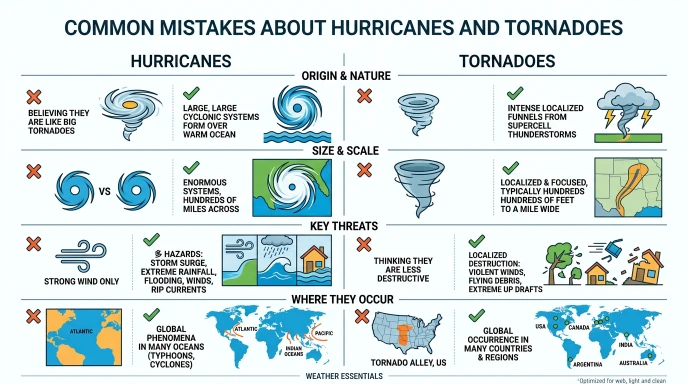
Mistake 1: Thinking Hurricanes and Tornadoes Are the Same
They are not.
A hurricane is a large tropical cyclone, while a tornado is a rotating column associated with a thunderstorm.
Mistake 2: Thinking a Hurricane Is Just a Giant Tornado
A hurricane is much larger and has a completely different structure and formation process.
Mistake 3: Assuming Tornadoes Only Happen in One Country
Tornadoes occur in many parts of the world.
The United States is especially well known for them, but it is not the only country where tornadoes occur.
Mistake 4: Thinking Hurricanes Only Cause Wind
Hurricanes can produce storm surge, heavy rainfall, flooding, dangerous waves, and sometimes tornadoes.
Mistake 5: Assuming a Weak Hurricane Cannot Be Dangerous
Even a storm with lower wind speeds can produce dangerous flooding or storm surge.
The storm’s category does not describe every possible hazard.
Mistake 6: Believing Every Rotating Cloud Is a Tornado
A visible funnel does not automatically mean a tornado is occurring. A tornado is a rotating column of air that extends from a thunderstorm to the ground.
When Should You Use “Hurricane” and “Tornado”?
Use hurricane when talking about a large tropical cyclone that meets hurricane-strength criteria.
For example:
“The hurricane is moving toward the coast.”
Use tornado when referring to a rotating column of air connected to a thunderstorm and extending to the ground.
For example:
“A tornado damaged several homes.”
Using the correct term matters because the hazards and safety actions can be very different.
How Weather Experts Track Hurricanes and Tornadoes
Weather science uses different tools to monitor these storms.
For hurricanes, meteorologists use:
- Weather satellites
- Radar
- Hurricane reconnaissance aircraft
- Ocean observations
- Weather stations
- Computer forecast models
These tools help experts track a hurricane’s location, strength, movement, and possible impacts.
For tornadoes, weather experts rely heavily on:
- Doppler radar
- Storm spotters
- Severe weather reports
- Satellite information
- Atmospheric measurements
- Computer models
Radar can detect signs of strong rotation inside thunderstorms, helping meteorologists identify storms that may produce tornadoes.
Why the Difference Matters for Safety
Knowing the difference between hurricane and tornado is more than a vocabulary lesson.
The correct information helps people understand the type of threat they may face.
During a hurricane, preparation may include securing property, preparing for power outages, moving away from flood-prone areas, and following evacuation orders.
During a tornado warning, people generally need to seek shelter quickly in a sturdy building, preferably in a basement or a small interior room away from windows.
The best response depends on the specific weather warning.
Always follow instructions from trusted local weather authorities rather than relying only on social media posts or rumors.
How Google and Social Media Can Affect Weather Information
People often search Google, YouTube, Instagram, TikTok, Reddit, and other platforms when severe weather develops.
These platforms can help people find explanations, radar images, videos, and official updates. However, not every post is accurate.
For important weather information, look for official sources such as the National Weather Service, NOAA, or your local weather authority.
Social media content can spread quickly, but speed does not always mean accuracy.
This is especially important during emergencies, when outdated videos or old storm footage can be shared as if it were current.
Expert Insight
A simple mental picture can make the entire topic easier.
Think of a hurricane as a huge weather engine over warm ocean water.
Think of a tornado as a narrow spinning extension of a powerful thunderstorm.
The hurricane’s biggest advantage is its enormous size and long duration. The tornado’s danger comes from its concentrated and sometimes extreme winds.
There is also an important connection: hurricanes can sometimes create tornadoes, especially after moving inland.
So, the two should not be treated as completely unrelated, but they should never be treated as the same storm type.
FAQs
What is the main difference between a hurricane and a tornado?
A hurricane is a large tropical cyclone that forms over warm ocean water. A tornado is a narrow rotating column of air that usually develops from a severe thunderstorm.
Which is bigger, a hurricane or a tornado?
A hurricane is much bigger. It can be hundreds of miles wide, while tornadoes usually affect a much smaller area.
Which has stronger winds, a hurricane or a tornado?
A powerful tornado can have higher peak winds than a hurricane. However, hurricanes affect much larger areas and can cause many different types of damage.
Can a hurricane cause a tornado?
Yes. Hurricanes can produce tornadoes, particularly in their outer rainbands and after they move inland.
Can a tornado turn into a hurricane?
No. Tornadoes and hurricanes form through different processes. A tornado cannot develop into a hurricane.
Do hurricanes last longer than tornadoes?
Yes. Hurricanes can last for days or longer, while most tornadoes last only minutes.
Where do hurricanes form?
Hurricanes form over warm tropical or subtropical ocean water.
Where do tornadoes form?
Tornadoes can occur in many parts of the world and usually develop from severe thunderstorms. They are especially common in the United States.
Conclusion
The difference between hurricane and tornado becomes clear when you compare their size, formation, duration, and hazards. A hurricane is a huge tropical cyclone that develops over warm ocean water and can remain active for days. A tornado is a much smaller rotating column of air that develops from a severe thunderstorm and usually lasts for a much shorter time.
Hurricanes can affect enormous areas and bring several hazards, including damaging winds, heavy rain, flooding, and storm surge. Tornadoes usually affect a much narrower path but can produce extremely intense winds and flying debris.
One important connection is that hurricanes can sometimes produce tornadoes, especially when they move inland. Still, the two are separate types of weather events.
In simple terms, a hurricane is large, long-lasting, and ocean-based, while a tornado is smaller, shorter-lived, and linked to severe thunderstorms. Understanding this difference helps you interpret weather reports, warnings, and safety advice more accurately.
Read more about!
- Difference Between Afternoon and Evening: Simple Guide
- Difference Between Adjective and Adverb: Key Differences Explain

I am James Carter, a professional content writer from the United States. I specialize in writing simple and clear comparison blogs that help students and readers understand difficult topics easily. My writing focuses on everyday language, education, science, and lifestyle topics. I believe that learning should be easy for everyone, so I use simple words and real-life examples in my articles.