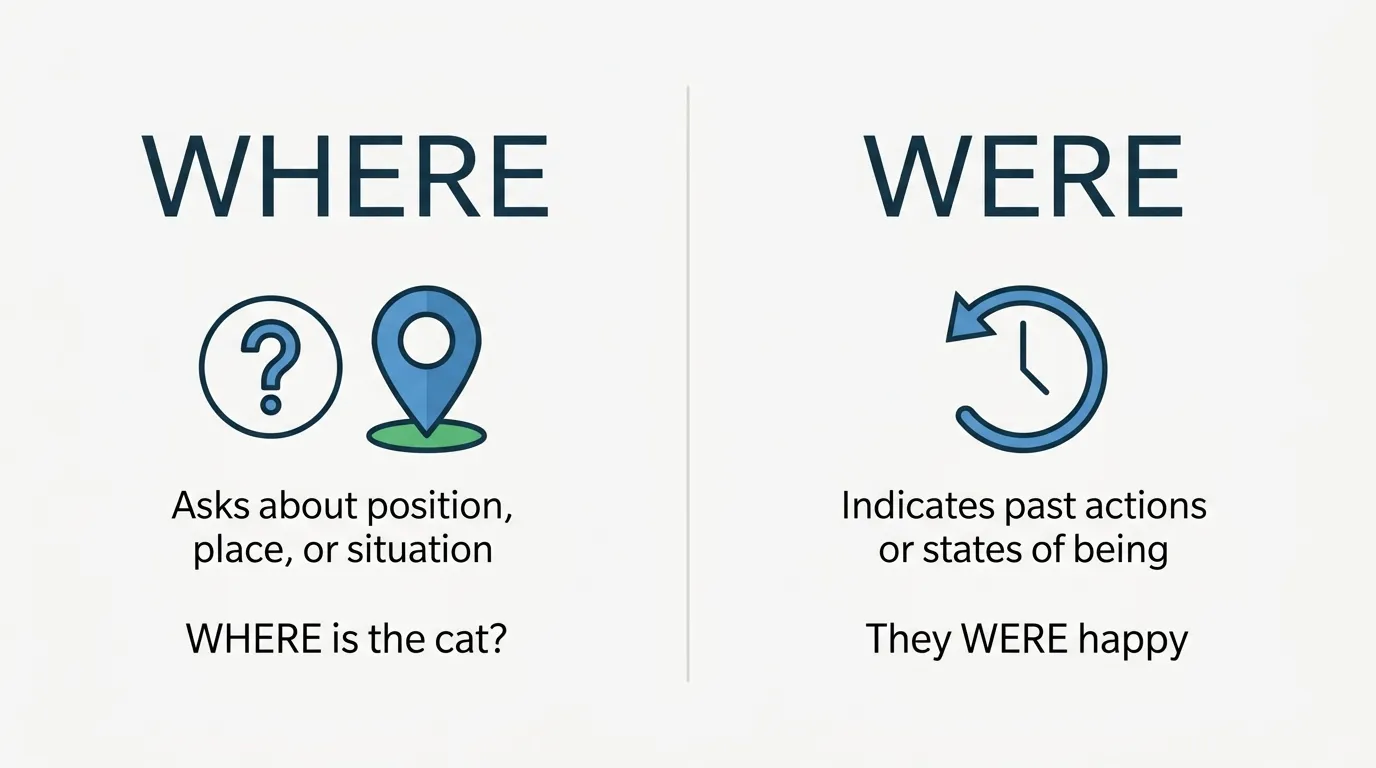
“Where” is used to talk about a place or location, while “were” is the past tense of “are” used with plural subjects.
The difference between where and were is one of the most common grammar confusions in English, especially for beginners, students, and even native speakers in quick writing situations.
Many users search for “what is difference between where and were” or “how to use where and were correctly” because both words sound similar but have completely different meanings and grammatical roles.
In simple words, where is related to place or location, while were is a verb form of “to be” used in the past tense. This confusion often appears in writing on platforms like Google search, Instagram captions, emails, essays, and even professional content, where small mistakes can change meaning completely.
In this complete guide, you will learn:
✔ Clear definitions of where and were
✔ Key differences with examples
✔ Grammar rules and usage
✔ Real-life sentences
✔ Common mistakes learners make
✔ Easy memory tricks
Let’s understand the difference between where and were in the most simple, practical, and expert way.
Difference Between Where and Were
Where is used to talk about place or location, while were is the past tense form of “are/is”.
👉 Example:
- Where are you going? (location)
- They were happy yesterday. (past tense action)
Definition of Where and Were
Where:
“Where” is a question word (adverb) used to ask about or describe location, place, or position.
Were:
“Were” is the past tense form of the verb “to be” used with plural subjects or “you” in past time.
Pronunciation
Understanding pronunciation also helps reduce confusion:
- Where
- US: /wer/ or /wɛr/
- UK: /weə/
- Were
- US: /wɜːr/
- UK: /wɜː/
👉 Even though they sound similar, their meanings are totally different.
Difference Between Where and Were: Comparison
| Feature | Where | Were | Similarity |
| Meaning | Shows place or location | Past tense verb form | Both are common English words |
| Grammar Type | Adverb / question word | Verb (past tense) | Used in sentences |
| Usage | Asking location | Describing past actions | Used in questions/statements |
| Example | Where is my book? | They were at school | Both used in daily speech |
| Function | Shows “place” | Shows “time (past)” | Help form sentences |
| Confusion reason | Sounds like “were” | Sounds like “where” | Similar pronunciation |
| Sentence role | Question word | Action verb | Essential grammar elements |
👉 This table clearly shows the difference between where and were for quick understanding.
Key Differences Explained Between Where and Were
1. Meaning Difference
- “Where” = location
- “Were” = past action
👉 Example: Where do you live? / They were tired.
2. Grammar Role
- “Where” = question word (adverb)
- “Were” = verb (past tense of “are/is”)
👉 Example: Where is the station? / We were late.
3. Time Reference
- “Where” → no time concept
- “Were” → always past time
4. Sentence Type
- “Where” → mostly questions
- “Were” → statements or past questions
5. Real Usage
- Where are you going? (present location)
- You were there yesterday. (past action)
6. User Intent Confusion
Many learners confuse them because:
✔ Similar pronunciation
✔ Fast speaking English
✔ Typing mistakes
Deep Explanation: Where in English Grammar
The word “where” is used in:
✔ WH questions
✔ Relative clauses
✔ Indirect questions
Examples:
- Where is your phone?
- I know where she lives.
- This is the place where we met.
👉 In modern grammar usage on platforms like Google Search and YouTube learning content, “where” is one of the most frequently searched WH-words.
Deep Explanation: Were in English Grammar
The word “were” is used as:
✔ Past tense of “are”
✔ Subjunctive mood in English
Examples:
- They were happy.
- You were late.
- If I were rich, I would travel the world.
👉 In advanced English (used in exams and professional writing), “were” is very important for correct tense formation.
Common Mistakes with Where and Were
❌ 1. Mixing spelling
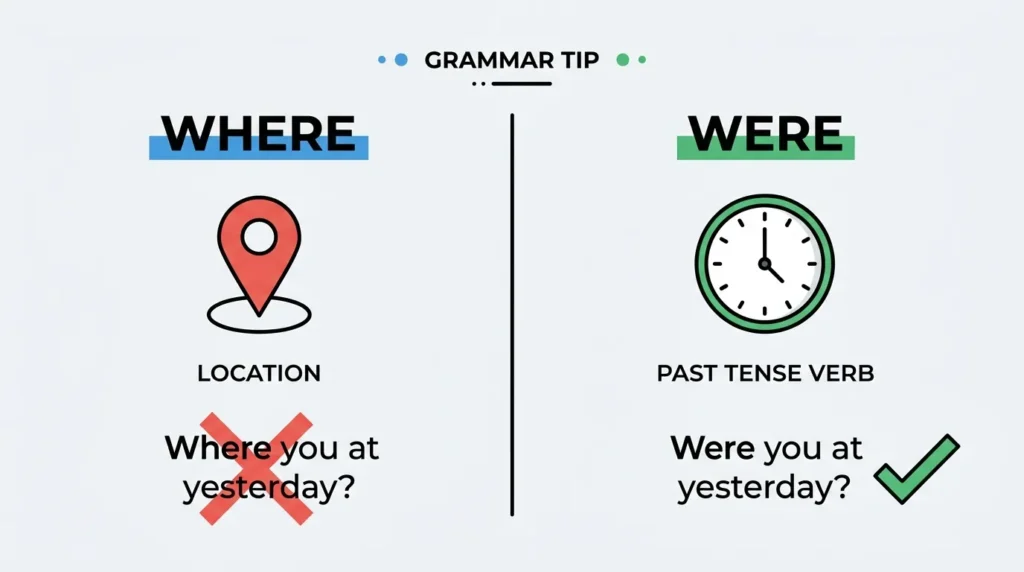
- Wrong: Were is my bag?
- Correct: Where is my bag?
❌ 2. Wrong tense usage
- Wrong: They where happy
- Correct: They were happy
❌ 3. Pronunciation confusion
- Writing based on sound leads to mistakes
❌ 4. Ignoring grammar role
- “Where” is not a verb
- “Were” is not a location word
❌ 5. Overgeneralization
- Thinking both can replace each other
Real-Life Examples with Where and Were
✔Daily Life
- Where are you going?
- We were at the market yesterday.
✔Education
- Where is the capital of France?
- Students were studying hard.
✔Business
- Where is the meeting?
- Employees were late to the office.
✔Social Media
- Where are you now? (Instagram story)
- We were having fun! (post caption)
When to Use Where vs Were
Use WHERE when:
✔ Asking about location
✔ Talking about place
✔ Making WH questions
Use WERE when:
✔ Talking about past events
✔ Describing actions
✔ Using past tense grammar
Why People Get Confused Between Where and Were
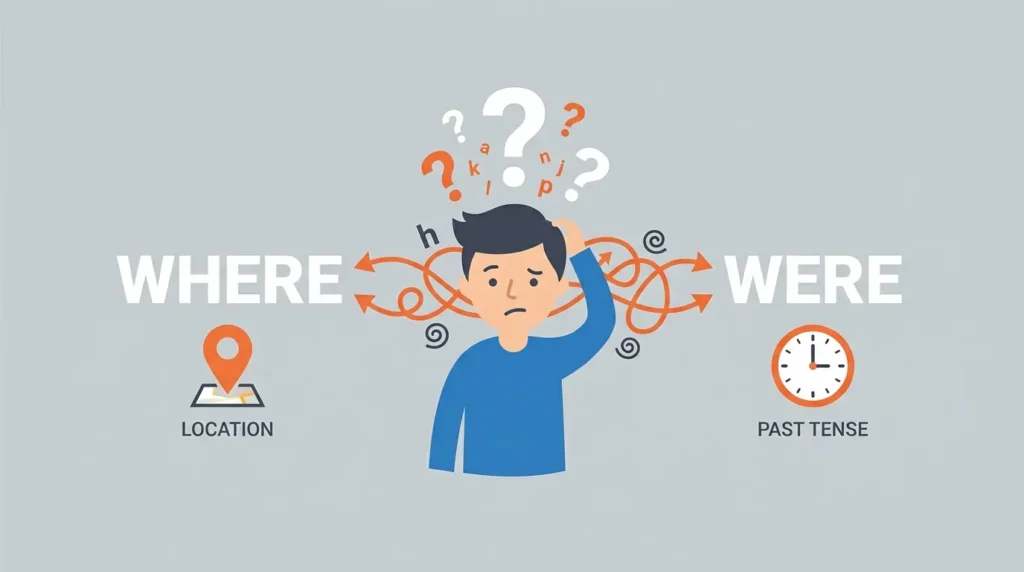
Many learners struggle because:
✔ They sound almost identical
✔ Fast speech removes clarity
✔ Auto-correct mistakes in typing
✔ Lack of grammar understanding
✔ Learning English informally via social media
Even platforms like YouTube Shorts and Instagram Reels often show casual English, which increases confusion.
How Search Engines Understand Where vs Were
Search engines like Google use NLP (Natural Language Processing) to understand:
✔ Context of sentence
✔ Intent (location vs time)
✔ Grammar patterns
For example:
- “where is hotel” → location intent
- “they were happy” → past tense intent
Google does not just read words; it understands meaning + intent + structure.
Expert Insight
From an English grammar teaching perspective, the confusion between where and were is a beginner-level but high-frequency error.
In real teaching environments:
✔ 70% of beginners mix these words initially
✔ Visual learning improves retention
✔ Sentence practice is more effective than memorization
Experts recommend learning through:
✔ Real examples
✔ Daily writing practice
✔ Listening to native speakers
FAQs
1. What is the main difference between where and were?
Where shows location, while were shows past tense.
2. Is where a verb?
No, where is a question word (adverb).
3. Is were present or past tense?
Were is past tense.
4. Why do people confuse where and were?
Because they sound similar in spoken English.
5. Can where and were be used interchangeably?
No, they have completely different meanings.
6. What is an easy trick to remember?
Where = place (think “here/there”), Were = past (think “yesterday”).
7. Is “you were” correct grammar?
Yes, it is correct past tense.
Conclusion:
The difference between where and were is simple once you understand their roles in English grammar. “Where” is always connected to place or location, while “were” is connected to past tense actions or states. Many learners confuse them due to similar pronunciation, but their meaning and usage are completely different.
If you remember one rule, it should be this:
👉 Where = place
👉 Were = past
By practicing real examples, reading sentences, and using them in daily communication, you can easily master the difference between where and were. This small grammar rule improves writing clarity, speaking accuracy, and overall English fluency.
Read more about!
Difference Between Whey and Isolate: Complete Guide
Difference Between Bourbon and Scotch: Complete Guide

I am James Carter, a professional content writer from the United States. I specialize in writing simple and clear comparison blogs that help students and readers understand difficult topics easily. My writing focuses on everyday language, education, science, and lifestyle topics. I believe that learning should be easy for everyone, so I use simple words and real-life examples in my articles.